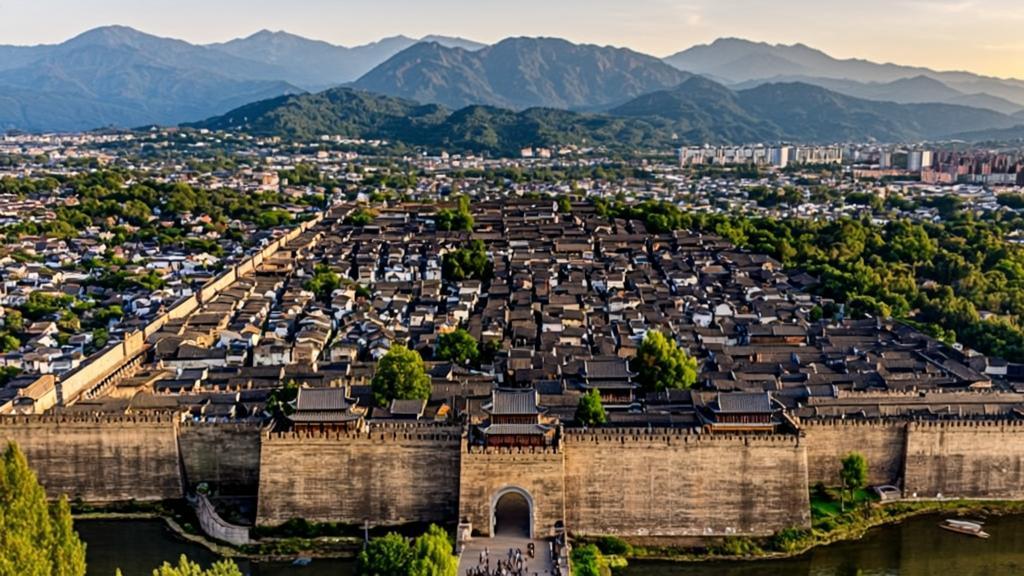
The Ancient City of Pingyao in Shanxi Province, China, is one of the best-preserved walled cities on Earth. But here is the part most travel guides skip: the city was deliberately shaped like a turtle. Not accidentally. Not poetically. Literally — by design, with every gate, road, and lane serving as part of the animal’s body. Once you know this, walking through Pingyao is never the same.
This is not folklore decorating a medieval town. It is philosophy made into urban planning. And it explains something deeper about how ancient Chinese civilization understood the relationship between humans, nature, and time.
Why a Turtle? The Ancient Logic Behind Pingyao’s Design
In the Western imagination, the turtle is slow and a little comic. In ancient China, it was one of four sacred creatures — alongside the dragon, phoenix, and qilin — symbolizing longevity, cosmic order, and divine protection. Turtles were used for oracle divination in the Shang Dynasty. Their shells were the original maps of the universe.
So when Ming Dynasty engineers rebuilt Pingyao in 1370, they did not just build walls. They encoded meaning into the city’s very bones.
According to Baidu Baike’s entry on Pingyao Ancient City, the layout follows the ancient saying: “Mountains face the sun, the turtle plays in the water — this is why the city was built here, and why it prospers.” The designers chose the turtle shape deliberately for its symbolism of immortality and endurance.
The result: a city that looks, from above, like a great tortoise crawling south.
The Six Gates: A Body Built in Stone
Pingyao’s city wall has six gates. Each one corresponds to a part of the turtle’s anatomy:
- South Gate (迎薰门 / Yingxun Gate) — the turtle’s head, facing the Liugen River. Two wells outside the gate represent its eyes. The head leans slightly east, as if the turtle is looking up and to the right.
- North Gate (拱极门 / Gongjie Gate) — the turtle’s tail, at the city’s lowest point. All water drains outward from here — practical and symbolic at once.
- Four East and West Gates — the turtle’s four legs, each outer gate angled at 90 degrees to mimic a limb bent in motion.
But there is one exception. And it is the most memorable detail of all.
The lower east gate (下东门 / Qinghan Gate) does not angle at 90 degrees like the others. Its outer gate opens in a straight line, pointing directly east. According to China News Service’s reporting on Pingyao’s turtle design, legend says the builders feared the turtle would escape — taking the city’s fortune with it. So they “tied” its left rear leg straight, then fastened a rope to Lütai Pagoda, 12 kilometers to the east. The nine-arch bridge over the nearby Huiji River represents the chain links.
Is this mythology? Of course. But it is mythology built in stone, and it has lasted 650 years.
Inside the Shell: Streets, Lanes, and the Eight Trigrams
The design does not stop at the gates. Step inside the Ancient City of Pingyao and the internal grid continues the symbolism:
- 4 main streets, 8 smaller streets, 72 narrow lanes — the street pattern traces the outline of the Eight Trigrams (Bagua, 八卦), the ancient Chinese cosmological diagram
- 72 lanes also echo the 72 disciples of Confucius
- 3,000 battlements on the city wall represent the 3,000 students Confucius taught
- The lanes together form a pattern said to resemble the markings on a turtle’s back — a “longevity pattern”
The city’s central axis runs along South Street. Temples, government offices, and markets are arranged with precise symmetry: the City God Temple to the east, the County Yamen to the west, the Confucian Temple on the left, the Military Temple on the right. Daoist shrines face east; Buddhist temples face west.
As Shanxi’s official tourism platform describes it, this creates a feudal ritual order frozen in space — hierarchy made into architecture.
How Does This Compare to Western City Planning?
Here is where the contrast gets genuinely interesting.
Western urban planning has its own obsessions with order and cosmos. Roman military camps (castra) used a rigid grid — two main roads crossing at right angles, creating four equal quadrants. The layout was efficient, replicable, and universal. It was rational geometry in service of military control.
Medieval European cities grew differently — organically, following rivers, markets, and church bells. Carcassonne in France and Bruges in Belgium have their own beauty, but it is the beauty of accumulation. No single mind designed them. They emerged.
Pingyao is neither of these. It combines a geometric order as strict as any Roman grid with a philosophical framework as layered as any medieval cathedral. The difference is the underlying intent. Roman planners thought in terms of efficiency and control. Pingyao’s builders thought in terms of cosmic alignment — the city as a living organism embedded in natural and metaphysical forces.
The closest Western analogy might be Pierre Charles L’Enfant’s 1791 plan for Washington D.C., which also imposed symbolic geometry on a city grid (the diagonal avenues, the Mall’s axis). But L’Enfant was working with Enlightenment ideals of republican virtue. Pingyao’s designers were working with Daoist cosmology and Confucian social order — a fundamentally different understanding of what a city is for.
Why did Chinese city planning embed philosophy into geometry? Partly because Chinese governance was inseparable from moral cosmology. The emperor ruled because Heaven authorized him. Cities were built to reflect that cosmic mandate — to be aligned with the forces that governed the universe, not just the needs of trade or defense.
What Visitors Actually See Today
The turtle legend is not just an academic footnote. It shapes the physical experience of visiting Pingyao.
Walking south to north through the Ancient City of Pingyao, you are literally tracing the turtle’s spine. The slight misalignment of the city’s axis — not true north-south, but tilted — is itself intentional. As local historians note, only the imperial palace in Beijing could claim a perfectly true axis. Pingyao’s tilt is a deliberate act of deference to the emperor, encoded in the city’s orientation for six centuries.
Some practical points if visiting:
- The best view of the turtle shape is from the city wall itself, early morning before crowds arrive
- The lower east gate (直线门洞) is the one gate where you can see the “straight leg” alignment — worth a specific detour
- The street grid’s Bagua pattern is most visible on a map, but walking the narrow 72 lanes gives the ground-level sensation of a world designed by geometry and symbolism working together
- Asia Odyssey Travel’s 2026 guide notes opening hours as 08:00–18:00 (April–October) and 08:00–17:30 (November–March), with a through-ticket around CNY 150
The city received over 11 million visitors in 2025 alone, according to Baidu Baike’s updated statistics. And yet it still functions as a living town, with real residents behind those Ming Dynasty doors.
Why Pingyao Survived When So Many Others Did Not
One last thought worth sitting with.
Most ancient Chinese cities were demolished and rebuilt as China modernized. Pingyao nearly suffered the same fate. In 1980, urban planner Ruan Yisan reportedly intervened to stop bulldozers from clearing parts of the old city. His argument: preservation was more valuable than modernization.
That argument won. In 1997, UNESCO recognized the Ancient City of Pingyao as a World Heritage Site. The UNESCO World Heritage Committee stated that it represents “an outstanding example of Han cities” that “provides a complete picture of the cultural, social, economic and religious development” of Chinese civilization (UNESCO World Heritage List).
A turtle, as it turns out, is an apt symbol for a place that simply refused to disappear.
References
Asia Odyssey Travel. (2026). Ancient City of Pingyao, Shanxi: 2026 guide. https://www.asiaodysseytravel.com/shanxi/pingyao-ancient-city.html
Baidu Baike. (2026). 平遥古城 [Pingyao Ancient City]. https://baike.baidu.com/item/平遥古城/791
China News Service. (2012, March 19). 平遥古城竟是神奇”龟城” 摇头摆尾富有活力 [Pingyao Ancient City turns out to be a magical “Turtle City”]. https://www.chinanews.com.cn/cul/2012/03-19/3755729.shtml
Shanxi Cultural Tourism Platform. (n.d.). 晋善晋美 平遥古城 [The beauty of Shanxi: Pingyao Ancient City]. https://www.sxwlw.com/home/index/beauty/jinid/2.html
UNESCO World Heritage Committee. (1997). Ancient City of Ping Yao (China) — World Heritage List No. 812. https://whc.unesco.org/en/list/812