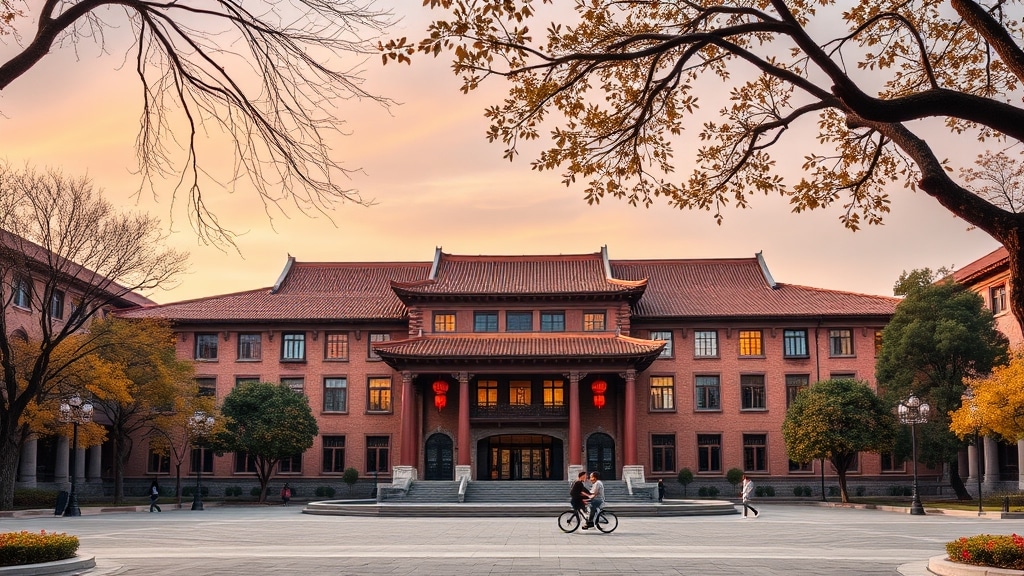
Anhui University holds a credential most international students have never heard of — and it might just change how you think about learning Chinese in China.
In 2000, China’s Overseas Chinese Affairs Office under the State Council officially designated Anhui University (AHU) as a Teaching Base for Chinese Language and Culture (Stony Brook University Study Abroad, n.d.). It’s an official title. Not a marketing tagline. Yet in the English-speaking world, almost no one talks about it.
So — what does it actually mean for you, as someone starting from zero?
Why Anhui University Is Built Differently for Language Learners
Most international students pick China’s big-name cities first: Beijing, Shanghai, Guangzhou. Makes sense. But here’s the thing — language acquisition research suggests those cities might not be the fastest route to real fluency.
Studies on Chinese immersion programs consistently point to one factor above others: how much English you can avoid each day. In Shanghai or Beijing, expat communities are everywhere. English menus, English-speaking taxi drivers, international cafes. It’s easy to slide into an English bubble without noticing.
Hefei — where Anhui University is located — is different. It’s a mid-sized city, the capital of Anhui Province, and home to one of China’s four major science and education hubs. There’s a university district, local street food stalls, bike lanes by Chao Lake. But not a Starbucks on every corner with a barista who already speaks your language.
As LTL Mandarin School’s immersion research notes, students who study in less internationally saturated cities get ahead faster than those in more foreign-friendly cities like Shanghai, Shenzhen, Beijing, and Guangzhou. Hefei fits that profile well.
Furthermore, Anhui sits geographically in central-eastern China, where standard Mandarin (Putonghua) is spoken without the heavy southern accents or the famous Beijing “er-hua” retroflex. That matters when you’re training your ear from scratch.
What “Teaching Base” Actually Means in Practice
The designation isn’t just honorary. It signals that AHU has structured infrastructure for teaching Chinese to non-native speakers — dedicated faculty, curriculum materials, and cultural integration programs.
Anhui University has accepted foreign students since 1980 and is authorized by the Ministry of Education to enroll international students who receive Chinese Government Scholarships. Currently, the university has around 500 international students, and has agreements with 74 overseas universities.
The international student program at AHU typically includes:
- Chinese language courses at multiple levels (beginner to advanced)
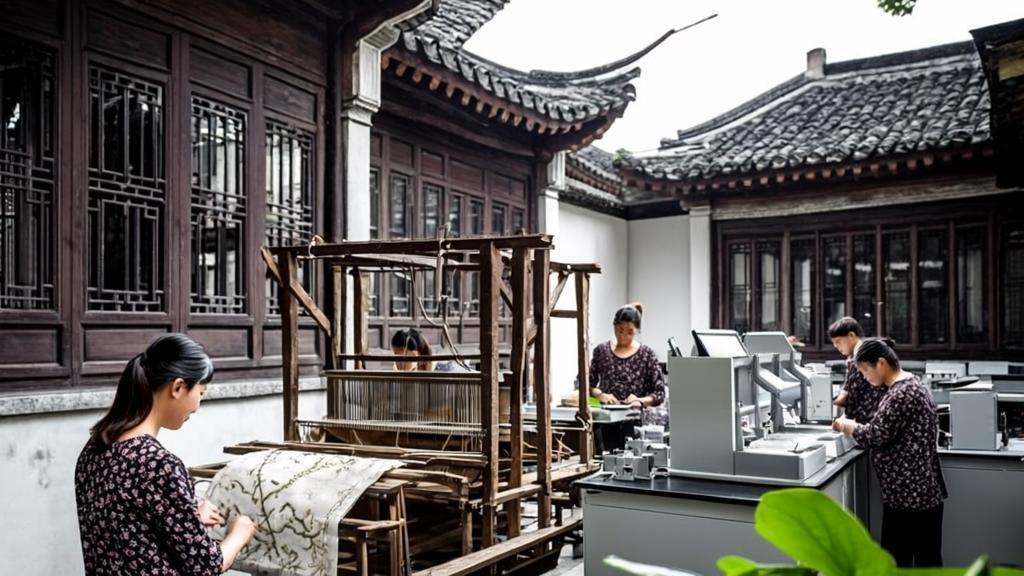
- Cultural immersion activities — calligraphy, traditional arts, local excursions
- Language exchange partnerships with local Chinese students
- A curriculum explicitly designed around non-native learner needs
This is not the same as just enrolling in a regular degree program and hoping for the best. The Teaching Base designation means the institution has invested specifically in this kind of learning environment.
How Long Does It Actually Take? A Realistic Timeline
Let’s be direct. Chinese is hard. The U.S. Foreign Service Institute classifies Mandarin as a Category V language — it takes around 2,200 hours to reach professional working proficiency for English speakers. But that number describes a very specific, high-level target.
Here’s a more useful breakdown for typical students:
From zero to basic conversation (HSK 1–2): Reaching basic proficiency takes 3 to 6 months for most learners studying 1–2 hours daily. At AHU, you’re studying in class AND using Chinese outside class every day. Timeline compresses noticeably.
From basic to functional daily use (HSK 3–4): Most learners targeting conversational fluency (HSK 3–4) can get there in 12–18 months with consistent daily practice. That’s a full academic year or slightly more.
From functional to genuinely fluent (HSK 5–6): This takes 3–5 years of serious effort. But frankly, after 18 months at AHU, you’ll be having real conversations. You’ll be reading menus without a translation app. That alone is transformative.
The immersion factor matters more than people realize. Concentrated study of 110 hours over 5 weeks proved 63% more effective than spreading the same hours across 7 months — and students who maintain a Chinese-only environment progress significantly faster overall.
Comparing Chinese to European Languages: It’s Not What You Think
If you’ve studied Spanish or French before, you already know the rhythm of language learning — gradual grammar rules, familiar alphabet, cognates you recognize. Chinese works differently, and that surprises many students.
There’s no alphabet. Instead, there are characters (汉字, hànzì). There are four tones, where the same syllable means completely different things depending on pitch. There’s no verb conjugation in the Western sense — but word order carries enormous meaning.
Interestingly, though, Chinese grammar structure is simpler in some ways than European languages. No gendered nouns. No verb tense tables. Sentences like “I tomorrow go Beijing” are grammatically fine. The challenge is phonological and character-based, not grammatical.
For Japanese or Korean speakers, the transition is actually easier — many characters share meaning across those writing systems. For everyone else, it helps to think of Chinese not as “harder” but as “different in a very specific way.”
The good news: tones are learnable. They feel impossible for the first few weeks. Then, suddenly, they click. Most students who persist through the initial phonological discomfort report that the grammar relief makes up for the early difficulty.
Daily Life as a Language Learner at Anhui University
So what does a typical day look like?
Morning: Chinese language class, usually 2–3 hours. Beginner classes focus on tones, pinyin, and basic vocabulary. Intermediate classes move into reading, longer conversation patterns, and cultural context.
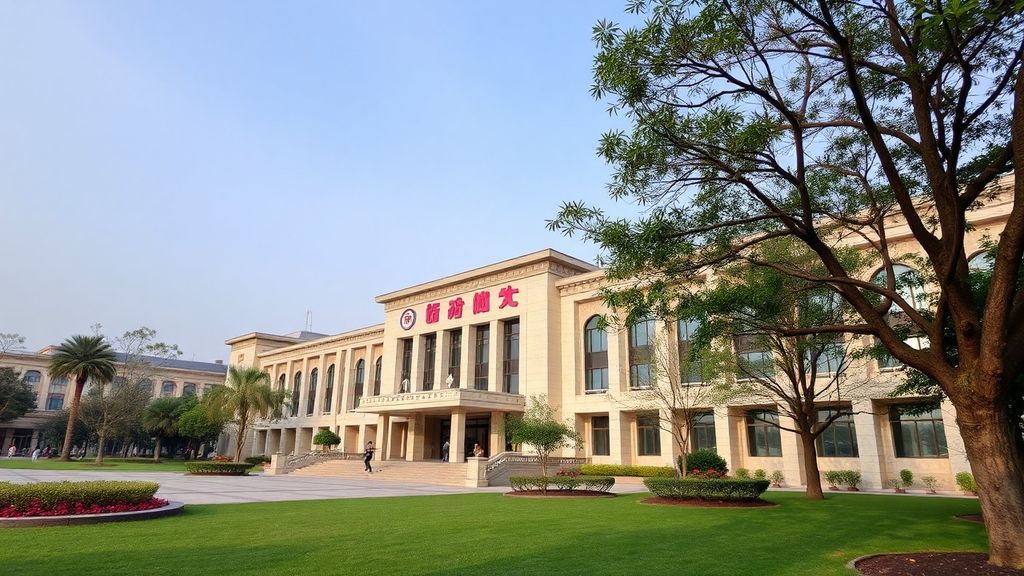
Afternoon: You’re on campus. The library has 1.75 million books. The sports facilities include gymnasiums and a swimming pool. The campus is large — about 207 hectares across multiple sites.
Evening: This is where real immersion happens. Head off campus. Find a local noodle shop and order in Chinese. Get it wrong — it’s fine. The person behind the counter will understand the effort, often smile, and help you. That kind of low-stakes daily practice is genuinely irreplaceable.
Weekends? On-campus dormitories cost between 5,000 and 8,000 CNY per year depending on room type — which keeps your living budget low and leaves money for weekend trips. Huangshan (Yellow Mountain), one of China’s most iconic UNESCO World Heritage sites, is about 2.5 hours by high-speed train. Nanjing is under an hour. The geography rewards exploration.
Costs and Scholarships: What’s Realistic
Tuition: AHU’s language programs for international students are priced significantly below equivalent programs in Beijing or Shanghai. Specific fees vary by program type (language-only vs. degree program), so checking directly with the international office is recommended.
Living costs: Hefei is one of China’s more affordable cities. A typical student budget runs roughly 2,000–3,000 RMB per month, covering food, transport, and incidentals.
Scholarships:
- Chinese Government Scholarship (CSC): Fully funded, covering tuition and accommodation. CSC stipends are standard across all universities: Bachelor’s students receive ¥2,500/month, Master’s students ¥3,000/month, and PhD students ¥3,500/month. The CSC agency number for AHU is 10357 (Chinese Government Scholarship Guide, n.d.).
- Anhui Government Scholarship: Provincial-level scholarship specifically for students enrolled in Anhui institutions. It provides financial assistance to international students studying in Anhui Province and can cover tuition, accommodation, and living expenses.
The CSC application deadline is typically April 30 each year. Start early — the paperwork takes time.
Practical Tips Before You Go
1. Start before you arrive. Learn pinyin before your flight. It’s the phonetic romanization system for Chinese. About 2–3 weeks of online practice means your first class won’t be spent just figuring out pronunciation basics.
2. Get the apps. Pleco (dictionary), HelloChinese or ChinesePod (structured learning), and Anki (flashcard spaced repetition) are the three tools most serious learners use consistently.
3. Embrace being wrong. Chinese pronunciation involves sounds that don’t exist in most European languages. You will get the tones wrong. Repeatedly. That’s not a problem — that’s the process. The more you speak early, the faster your ear adjusts.
4. Find a language partner on campus. Many Chinese students at AHU want to practice their English. A one-hour weekly swap — 30 minutes of English, 30 minutes of Chinese — is often more valuable than an extra hour of class.
5. Keep a character journal. Writing characters by hand builds memory in a way that typing doesn’t. Even 5–10 characters a day adds up quickly. By month three, you’ll have a visible record of real progress.
6. Don’t underestimate Hefei. The city has real cultural depth. It’s the hometown of Bao Zheng, the legendary Song Dynasty judge who became a symbol of justice in Chinese culture — a figure roughly comparable to the Western idea of a principled judge archetype, but celebrated in poetry, opera, and popular storytelling for over a thousand years. You’ll hear his name mentioned in ways that make no sense at first, then gradually begin to understand — and that’s exactly what language immersion looks like.
Is Anhui University the Right Choice for You?
It depends on what you’re after. If you want the international brand name recognition of a Tier 1 city program, Anhui University might feel under the radar. And honestly — that’s somewhat the point.
AHU is part of the Double First-Class Construction and Project 211, with 11 disciplines ranking among the global top 1% according to Essential Science Indicators. Academically, it’s legitimate and respected within China.
But for language learning specifically, the combination matters: an officially designated Chinese language teaching base, a mid-sized city with lower English exposure, affordable costs, and a campus culture that genuinely welcomes international students who are there to learn.
That’s a specific, somewhat rare combination. And for a motivated learner starting from zero, it might be exactly what works.
References
China Scholarship Council Guide. (n.d.). Anhui University CSC Scholarship 2026. Chinese Scholarship Council. https://www.chinesescholarshipcouncil.com/anhui-university.html
Chinese Government Scholarship Guide. (n.d.). Anhui University CSC Scholarship 2026 — Full Guide. https://chinesegovernmentscholarship.com/universities/anhui-university/
FluentU. (2025). How long does it take to learn Chinese? The honest (and surprising) truth. FluentU Chinese Blog. https://www.fluentu.com/blog/chinese/how-long-does-it-take-to-learn-chinese/
LTL Mandarin School. (2024). The fastest way to learn Chinese: Ultimate immersive experience. LTL School. https://ltl-school.com/why-immersion-china/
Mandarin Zone. (2025). Intensive Chinese learning in China: Complete Beijing immersion guide. https://www.mandarinzone.com/intensive-learn-chinese-china/
Minister, R. (2026, February). How long does it take to learn Chinese? Honest timeline by level. HSKLord. https://hsklord.com/blog/how-long-does-it-take-to-learn-chinese
Apply for China. (2025, April 22). Anhui University: Program, ranking and campus life. https://applyforchina.com/universities/anhui-university/
Stony Brook University. (n.d.). Anhui University study abroad program. Office of International Academic Programs. https://www.stonybrook.edu/commcms/studyabroad/outgoing/programs/current-year/academic-year/china/anhui
Wikipedia contributors. (2025, December 19). Anhui University. Wikipedia. https://en.wikipedia.org/wiki/Anhui_University
WuKong Education. (2026, February). How long does it take to learn Chinese? 2026 timeline. WuKong School. https://www.wukongsch.com/blog/how-long-it-takes-to-learn-chinese-post-23297/