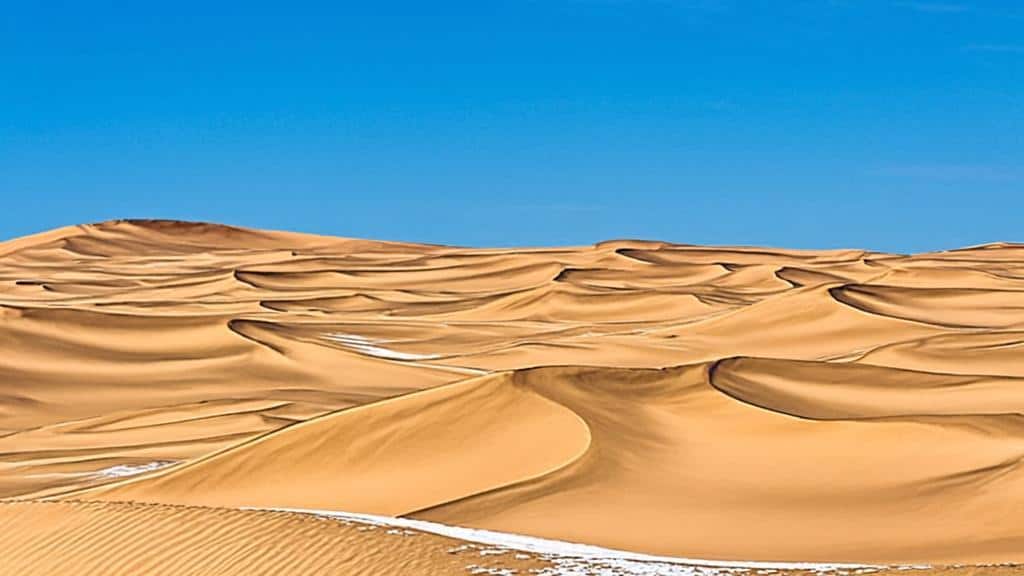
Badain Jaran Desert doesn’t play by the rules of a typical desert. It makes music. And sometimes — in April — it snows.
Located in China’s Inner Mongolia, this is the country’s third-largest desert. It stretches across 49,000 square kilometers. But size alone doesn’t explain why travelers keep coming back. The real draw is stranger than that: megadunes that produce a low, thundering roar — and a spring season that occasionally wraps those golden peaks in white.
Most people imagine deserts as silent and scorched. Badain Jaran breaks both assumptions at once.
How the Badain Jaran Desert Learned to Sing
The singing sand phenomenon here is no gentle whisper. According to the European Space Agency’s Earth Observation report (ESA, 2025), the booming sound at Badain Jaran can last up to several minutes. Wind pulls the top layer of dry sand off the layer below. The friction creates an electrostatic charge. That charge generates a resonating hum.
Atlas Obscura (2025) documents that the sound reaches up to 105 decibels — roughly as loud as a low-flying propeller aircraft. Visitors often hear it before they see any movement on the dune face.
But the singing only happens under precise conditions. The sand must be dry. The slope must exceed 30 degrees on the leeward face. The sand particles must carry a specific structural density — built up over millennia in the lower dune layers, compacted since the last glacial maximum around 20,000 years ago.
In other words: the dunes don’t sing by accident. They sing because of time, pressure, and physics working together.
The largest singing sand zone is Baoritaolegai, nicknamed the “Kingdom of Booming Sands.” Sliding down its slopes by hand alone triggers the sound. The rumble resonates for up to a minute — even after all visible motion has stopped. That detail is genuinely unsettling, in the best way.
April in Badain Jaran Desert: When Snow Meets Sand
Here’s where things get genuinely strange. April in Badain Jaran Desert sits in a sharp transitional window. The desert sits at an average elevation of 1,200 to 1,700 meters above sea level. At that altitude, the continental climate swings hard.
Temperatures rise through April, but northwest winds remain powerful and cold. Sandstorms are common. And then, occasionally, it snows.
Not a blizzard. Not a lasting cover. But a thin dusting of white across the golden ridges of the megadunes — a sight so contradictory it feels like a glitch in the natural world. Imagine standing at the base of Bilutu Peak, the world’s tallest stationary sand dune with a relative height of 460 meters (UNESCO, 2024), and watching snowflakes settle on dry desert sand.
The scientific backdrop explains why. A peer-reviewed study in Scientific Reports (Zhang et al., 2017) describes the desert’s climate as “extreme continental type controlled by Mongolian High, with cold winter.” Cold air masses from the northwest push into the region well into spring. The desert sits on a high plateau with essentially zero heat buffer from vegetation.
This is what makes early April visits so unpredictable — and so dramatic. It’s a moment the summer tourists never see.
The Five Wonders of Badain Jaran Desert — and What Spring Shows Differently
Badain Jaran Desert is officially celebrated for five attractions: towering sand peaks, singing dunes, colorful lakes, sacred springs, and an ancient Tibetan Buddhist temple.
In summer, the lakes turn vivid — turquoise, emerald, and even pink, driven by varying salinity and microbial communities. In April, however, the light is sharper. The crowds are smaller. The reflection of golden dunes in still lake water looks almost painted.
The desert holds 144 inter-dunal lakes. UNESCO (2024) notes their origin remains scientifically debated, though most researchers believe they are fed by deep groundwater — possibly recharged by distant mountain snowmelt through underground circulation spanning hundreds of kilometers. The peer-reviewed Zhang et al. (2017) study found that local circulation between lakes and megadunes helps maintain their fragile coexistence over thousands of years.
In other words, the very lakes that make this landscape beautiful are still not fully understood.
The Badain Jaran Temple, built in 1755 during the Qing Dynasty, sits quietly at the edge of one of these lakes. Monks still reside there. Its white walls against April’s pale sky look suspended between two worlds — and that contrast, honestly, is one of the more quietly beautiful things you can see in northwestern China.
Three Lakes Worth Knowing Before You Go
- Badain Lake (巴丹湖): The name-giving lake of the desert. Surrounded by reeds and accessible via a boardwalk. You can watch fish from above.
- Yinderitu (音德日图): Called the “Sacred Spring,” this salty lake holds a small island containing 108 freshwater springs that bubble continuously.
- Red Lake (Honghaizi): Its vivid red color comes from iron-rich minerals and specific algae. Visually surreal.
Each lake tells a different chemical story. That’s the kind of detail that makes Badain Jaran genuinely educational, not just photogenic.
Why Westerners Find Badain Jaran Desert Hard to Categorize
Think about how Western travelers typically picture deserts: the Sahara, the Mojave, the Atacama. Flat horizons. Silence. A certain emptiness.
Badain Jaran Desert doesn’t fit that frame. It has mountains of sand that sing, lakes that support fish, crustaceans, and aquatic worms. It has a 270-year-old Buddhist monastery. And it borders the ancient Silk Road.
The closest comparison for Western readers might be the Great Sand Dunes National Park in Colorado — which also features acoustic sand phenomena and surprising water at its base. But Badain Jaran operates at a different scale entirely. Its megadunes dwarf anything in North America. And the lake density — 144 lakes compressed into one vast sand sea — has no real parallel anywhere on Earth.
The UNESCO World Heritage Committee (2024) specifically described this landscape as potentially “unparalleled” in its geological complexity. That’s not marketing language. That’s the phrase scientists used in their nomination evaluation.
A Cultural Note for Western Visitors
The name “Badain Jaran” is Mongolian. “Badain” likely derives from the name of an ancient inhabitant of the region; “Jaran” is said to trace back to a Tibetan word meaning “hell” — a historically common way to describe lands of extreme heat and difficulty. So the full name translates, roughly, as something like “Badai’s Hell.” That context makes the existence of 144 shimmering lakes inside it feel almost like a cosmic joke.
Or perhaps a promise.
Practical Guide: How to Reach Badain Jaran Desert
This place is remote. Plan accordingly.
Step 1 — Get to a gateway city. Most travelers fly into Zhangye in Gansu Province, then drive approximately 4–5 hours to Badain Jaran Town. Alternatively, fly into Jinchang, which cuts the road journey to roughly 3–4 hours (AnywhereChina, 2025). Both cities have regular domestic flights from Beijing, Shanghai, and Xi’an.
Step 2 — Hire a 4×4 at the park entrance. Self-driving is not permitted inside the scenic area. At the entrance, you hire an official jeep with a licensed local driver. Book in advance — capacity is limited and the terrain requires genuine expertise.
Step 3 — Plan 2 days minimum. A standard tour covers Badain Lake, Yinderitu Spring, Bilutu Peak, and the Badain Jaran Temple. Overnight accommodation is in Mongolian yurts or guesthouses near the temple area. The night sky here — zero light pollution, 1,400 meters of elevation — is often described by visitors as the unexpected highlight of the trip.
Best timing:
- September–October: Clear skies, comfortable temperatures, peak photography conditions.
- May–June: Fewer crowds, wildflowers near the lake oases, pleasant daytime heat.
- April: Cold, wind-exposed, occasional snow on sand — dramatic, low-tourism, genuinely unlike any other desert experience. Not the easiest, but arguably the most memorable.
Avoid January and February. The desert becomes genuinely hostile in deep winter.
One Last Thought
Part of what makes Badain Jaran Desert so hard to forget is its refusal to be one thing. It’s ancient and geologically active, hyper-arid and full of lakes. It’s silent in winter, booming in summer, and occasionally dusted in April snow.
Most deserts make you feel small in one direction. This one makes you feel small in several directions simultaneously.
If you’ve traveled to the Sahara, the Gobi, or the Arabian sands, Badain Jaran will still surprise you. Plan accordingly — and maybe pack a light jacket for April. You might need it.
References
European Space Agency. (2025). Earth from Space: Singing dunes and mysterious lakes. ESA Multimedia. https://www.esa.int/ESA_Multimedia/Images/2025/12/Earth_from_Space_Singing_dunes_and_mysterious_lakes
Atlas Obscura. (2025). Booming dunes of Badain Jaran Desert in Alxa. https://www.atlasobscura.com/places/booming-dunes-badain-desert
United Nations Educational, Scientific and Cultural Organization. (2024). Badain Jaran Desert – Towers of Sand and Lakes (World Heritage List No. 1638). UNESCO World Heritage Centre. https://whc.unesco.org/en/list/1638/
Zhang, K., et al. (2017). Local circulation maintains the coexistence of lake-dune pattern in the Badain Jaran Desert. Scientific Reports, 7, 40238. https://doi.org/10.1038/srep40238
AnywhereChina. (2025). The ultimate guide to the Badain Jaran Desert: A landscape of towering dunes and mysterious lakes. https://www.anywherechina.com/post/the-ultimate-guide-to-the-badain-jaran-desert-a-landscape-of-towering-dunes-and-mysterious-lakes
Asia Odyssey Travel. (2025). Best time to visit Inner Mongolia: Weather & monthly tips. https://www.asiaodysseytravel.com/inner-mongolia/best-time-to-visit.html
Wikipedia. (2026). Badain Jaran Desert. Wikimedia Foundation. https://en.wikipedia.org/wiki/Badain_Jaran_Desert