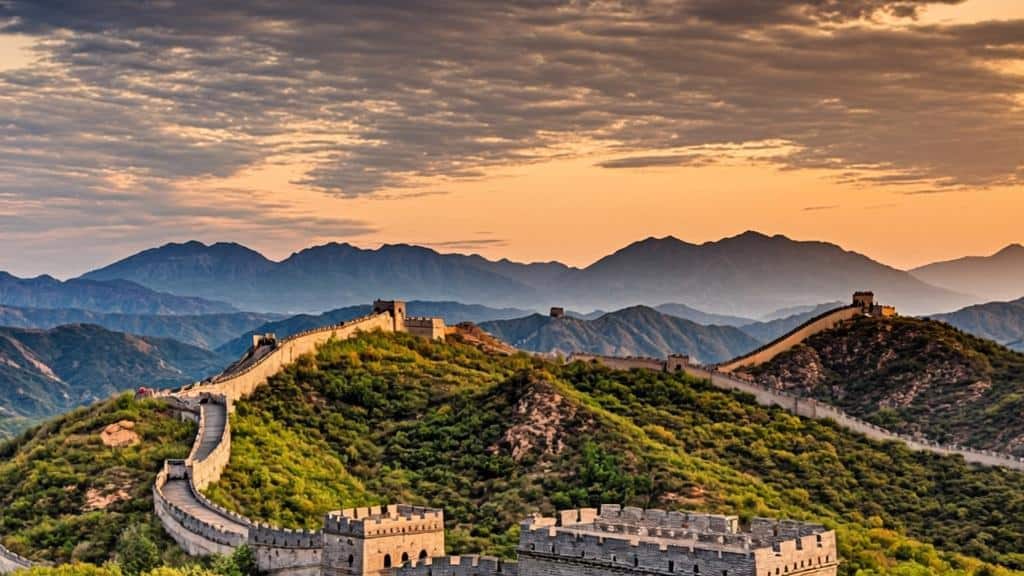
The moment you step onto the Badaling Great Wall, a wind tears through the Guankou valley and hits you full in the face. Beneath your feet are Ming dynasty bricks, five hundred years old. Ahead, the wall snakes along the ridgeline until it disappears into the distance.
Most people standing there ask the same question: why did the ancient Chinese build this thing?
The answer might surprise you completely.
Two Thousand Years of Misreading: Was the Badaling Great Wall Really a “War Machine”?
Almost everyone assumes the same thing: the wall was built for war.
Western media has gone further — labeling it a symbol of isolation and closure. In many ways, this is a misconception that has persisted for two millennia.
Dong Yaohui, Executive Vice President of the China Great Wall Society, has spent decades studying the wall. He has accompanied dozens of world leaders on tours of the Badaling Great Wall. Whenever someone asks why the wall was built so formidably, his answer is always the same:
“This reflects the wish of generation after generation of Great Wall builders in ancient China — they did not want to fight. Peace was the shared pursuit of all peoples on both sides of the wall.” (Dong Yaohui, China News Service, 2021)
That is not diplomatic language. It is a conclusion rooted in historical logic.
Along most of the wall’s length, large-scale warfare almost never happened. Even in areas that did see conflict, the vast majority of years passed in peace (Dong Yaohui, China News Service, 2021). In other words, the wall’s very existence reduced the frequency of war.
The Badaling Great Wall’s Core Logic: Preparing for War to Prevent It
The Cost of War Was the Real Deterrent
The ancient reasoning was practical — even startlingly modern.
Nomadic cavalry were fast and mobile. Without the wall, raiding southward was cheap and low-risk. With the wall in place, supply lines could not pass steadily through the passes. Even if invaders broke through at one point, they could not sustain a hold on the interior (Zhihu Great Wall Feature, 2023).
Once the cost of invasion rose sharply, war declined naturally.
This logic has a modern Western parallel — Cold War “Deterrence Theory.” The US and Soviet Union maintained nuclear equilibrium as a strategy of “preparing for war to preserve peace.” In that sense, the Badaling Great Wall was China’s version of strategic deterrence — just about two thousand years earlier.
The Gates Were Customs Checkpoints, Not a Blockade
There is a detail most visitors miss entirely.
The Badaling Great Wall was never a sealed iron curtain. Its passes contained designated trading points — official corridors for commerce. During the Ming dynasty, the wall’s gateways hosted the “Tea-Horse Trade” system: Central Plains farmers exchanged silk, tea, and salt for the nomads’ furs, cattle, and horses (The Paper, 2021).
Two civilizations. Mutual need. Mutual benefit.
The key point is this: the wall’s passes functioned more like today’s customs checkpoints — managing the flow of people and goods — rather than cutting the two sides off entirely. That fact alone dismantles the “closed and isolated” stereotype.
East Meets West: Hadrian’s Wall vs. the Badaling Great Wall — Two Choices From the Same Era
Here is a fascinating historical coincidence worth sitting with.
Around the same period that China was building its great walls during the Qin and Han dynasties, the Roman Empire built Hadrian’s Wall across northern Britain. Both were inscribed on the UNESCO World Heritage List in the same year: 1987.
The similarities are real:
- Both were built during the peak of imperial power
- Both served as defensive lines between settled agricultural civilizations and mobile nomadic peoples
- Both combined military defense with trade management functions
But the differences are more revealing.
Hadrian’s Wall stretches roughly 120 kilometers — more of an administrative boundary marker than a living cultural structure. When the Roman Empire collapsed, it became an archaeological ruin. Today, only dedicated history enthusiasts make a point of visiting it.
The Ming Great Wall, of which the Badaling Great Wall is the finest section, runs over 8,800 kilometers (State Administration of Cultural Heritage, 2009). It did not fade with dynastic change. Instead, it became a spiritual symbol of the Chinese nation, drawing tens of millions of visitors every year.
Why such a stark difference in legacy?
Part of the answer may be this: Hadrian’s Wall was a boundary imposed on the land by imperial decree. The Badaling Great Wall, by contrast, was built and maintained across generations by many different peoples. It carries not just military memory but a shared sense of belonging — captured in the Chinese saying: “Both sides of the wall are home” (Qiushi, 2025).
Over 500 Heads of State Have Visited the Badaling Great Wall: Peace Confirmed in Modern Times
The Badaling Great Wall’s peaceful identity has found its most powerful validation in the modern era.
Since 1954, it has welcomed more than 500 heads of state, government leaders, and global figures (China News Service, 2021). Nixon, Reagan, Thatcher, Queen Elizabeth II, Obama — leaders of vastly different politics, all leaving the same kind of reflection on the same ancient stones.
In November 2024, a major exhibition titled “The Great Wall: A Gathering — Commemorating 70 Years of Great Wall Diplomacy” opened at the Badaling Great Wall Wangjing Cultural Square. It featured 663 carefully selected historical photographs, recreating seven decades of diplomatic memory in vivid detail (Qiushi, 2025).
An ancient wall became a stage for modern diplomacy. That, in itself, is the best evidence that its builders’ peaceful intentions were real.
Visiting the Badaling Great Wall in 2025: What’s New and What You Need to Know
Understanding why it was built changes how you experience the Badaling Great Wall entirely.
What’s new in 2025: According to Beijing municipal government plans, the final one-kilometer section of Badaling’s brick Great Wall is expected to be fully connected in 2025, expanding the accessible route for visitors (Beijing Municipal Government, 2025). The renovated China Great Wall Museum is also scheduled to open in 2026 — with the real Badaling Great Wall visible through a full glass wall as the museum’s largest “exhibit” (Beijing Municipal Government, 2025).
Essential visitor information:
- Tickets: Peak season (April–October) ¥45/person; off-season (November–March) ¥40/person
- Booking: Real-name advance reservation required via the official “Badaling Great Wall” WeChat public account; morning slots recommended during peak season
- Routes: The North Route has gentler slopes and more sights — good for families with children or older visitors; the South Route is steeper and less crowded, with an exceptional panoramic view from Tower Four
- Night Great Wall: The 2025 night experience has been upgraded under the theme “The Eternal Glory of the Great Wall,” with an immersive walk-through performance at ¥198 on weekdays
- Getting there: Bus routes 877 or 919 from Deshengmen in Beijing; alternatively, take the S2 commuter rail from Huangtudian in Changping — both go directly to the site
A Final Thought
People often say: “He who has not climbed the Great Wall is not a true hero.”
But perhaps the truer version is this: if you don’t understand why it was built, you haven’t really read it at all.
The Badaling Great Wall is not a wall built to shut the world out. It is the opposite — a declaration written in brick and stone by generation after generation of people who simply did not want to go to war.
They built the wall so they wouldn’t have to fight.
That logic, it turns out, is timeless.
References
Dong, Y. (2021). Why has the Great Wall become China’s symbol in the world’s vocabulary? China News Service. https://www.chinanews.com/gn/2021/09-17/9568357.shtml
Zhao, X. (2025). Great Wall culture passed down through the millennia. Qiushi. https://www.qstheory.cn/20250413/fe8346af1d0e4f9fbcb40eb8e1518f8e/c.html
Beijing Municipal People’s Government. (2025). Museum, mega scenic area, scenic road: Three major projects in Yanqing advance simultaneously. Capital Window. https://www.beijing.gov.cn/ywdt/yaowen/202512/t20251230_4377293.html
China Academy of Cultural Heritage. (2024). Third annual meeting of the Great Wall Protection Alliance successfully held in Beijing. CACH Official Website. http://www.cach.org.cn/tabid/76/InfoID/3118/frtid/41/Default.aspx
The Paper. (2021). Excavating the cultural value of the Great Wall, carrying forward the national spirit. The Paper. https://www.thepaper.cn/newsDetail_forward_14495171