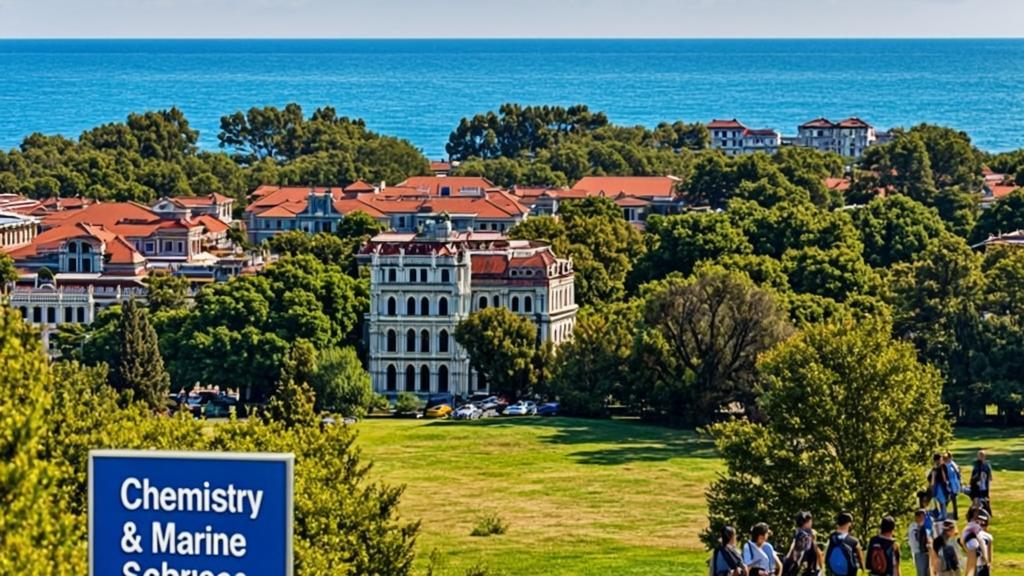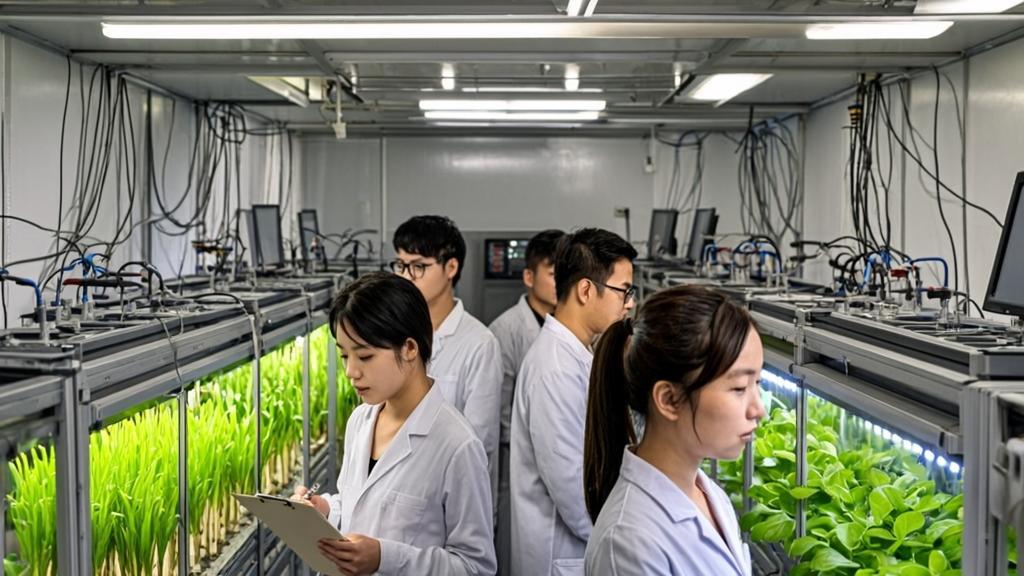
Beihang University sits on Xueyuan Road in Beijing’s Haidian district. Most people know it as China’s leading aerospace engineering school. However, somewhere on that campus — quiet, sealed, and completely self-contained — there is a laboratory that once housed eight student volunteers for 370 days straight. Fresh air from outside? None. Grocery deliveries? Also none. An exit? Absolutely not. Just plants, mealworms, and a closed-loop system designed to keep humans alive on the Moon.
This is Lunar Palace 1 (月宫一号, Yuegong-1). And it may be the most remarkable experiment most people have never heard of.
What Is Lunar Palace 1 at Beihang University?
Lunar Palace 1 is a bioregenerative life support system (BLSS) — a closed artificial ecosystem where air, water, and food all cycle without outside input. In other words, think of it as a tiny, functional version of what a real Moon base would need.
Specifically, the facility covers 160 square meters and 500 cubic meters of space (Wikipedia, 2024). It divides into three modules:
- Two plant cabins for growing crops
- One comprehensive cabin with bedrooms, a dining room, a bathroom, and a waste treatment chamber
Professor Liu Hong and her team at the School of Biological Science and Medical Engineering designed and built the system. Their core question was both practical and urgent: can humans survive indefinitely on the Moon using only what they grow and recycle?
How Students at Beihang University Lived Like Astronauts for Over a Year
The flagship experiment — called “Lunar Palace 365” — launched on May 10, 2017. Eight postgraduate students, four men and four women, rotated inside the sealed cabin across three phases for a total of 370 days (Space.com, 2018):
- Phase 1: Group A entered first and stayed 60 days
- Phase 2: Group B took over and remained for a world-record 200 consecutive days
- Phase 3: Group A returned for the final 110 days
Finally, on May 15, 2018, the last volunteer stepped out. As a result, the experiment officially set the world record for the longest human stay in a bioregenerative life support system (China Daily, 2018).
The Diet That Would Surprise Any College Student
What did the volunteers eat? Mostly what they grew. Specifically, the full crop list included:
- Five cereals: wheat, corn, soybeans, peanuts, and lentils
- Fifteen vegetables: including carrots, cucumbers, and water spinach
- One fruit: strawberries
Wheat served as the main calorie source. Furthermore, it generated most of the cabin’s oxygen through photosynthesis. But the standout protein source came from somewhere unexpected — yellow mealworms (Tenebrio molitor). Volunteers raised these insects on plant waste, then ate them directly or baked them into a type of bread (Yuegong-1, Wikipedia, 2024).
Mealworm bread, raised on mushroom waste, inside a mock Moon base — on a university campus in Beijing. Remarkably, that sentence is not science fiction.
Beihang University vs. Biosphere 2: Why China Succeeded Where the West Struggled
Many Western readers know Biosphere 2. Built in Oracle, Arizona, and sealed in September 1991, it was a $200 million American attempt to create a self-sustaining ecosystem (Britannica, 2024).
However, the outcome became famous for the wrong reasons. Within 17 months, oxygen levels inside dropped from 20.9% to just 14.2%, roughly equivalent to standing at 13,000 feet altitude. Consequently, external oxygen had to be pumped in, and the mission’s credibility collapsed (Britannica, 2024).
So what did Beihang University’s team do differently?
The core difference lies in design philosophy. Biosphere 2 tried to replicate all of Earth — rainforests, deserts, oceans. That ambition, however, backfired badly. Concrete walls chemically absorbed carbon dioxide. Meanwhile, soil microbes consumed oxygen faster than plants could replenish it. As a result, the ecosystem fell apart under its own complexity.
In contrast, Lunar Palace 1 took a leaner, more engineered approach:
- Four-component loop only: plants → mealworms → microorganisms → humans, cycling back to plants
- No unnecessary biomes. Function first, spectacle never
- Engineered redundancy. Each biological layer supported the others in measurable, testable ways
The numbers speak clearly: Lunar Palace 1 achieved a 98.2% system closure rate, meaning external input accounted for just 1.8% of total resources (Liu et al., 2024). Even more strikingly, researchers confirmed that no volunteer showed behavioral disturbance or psychological distress across the entire 370-day period. That consistency suggests the system wasn’t just keeping bodies alive — it was, in fact, keeping minds stable too.
Ultimately, the contrast with Biosphere 2 is sharp. Both experiments began with the same essential ambition. One chose scale; the other chose precision. Precision won.
What Beihang University’s Research Means for the Future
This experiment is not simply academic history. Indeed, China’s National Space Administration has committed publicly to landing taikonauts on the Moon by 2030 and establishing a permanent base afterward (Phys.org, 2021).
Lunar Palace 1’s data feeds directly into that timeline. Specifically, the 370-day trial confirmed several things that no simulation alone can verify:
- Humans can maintain both physical and mental health in a closed biological system for over a year
- Gut microflora and plant cultivation — not just engineering — actively support crew wellbeing
- A four-species biological loop can achieve near-total resource recycling at functional scale
In 2025, moreover, the research entered China’s national middle school biology curriculum through the People’s Education Press (Beihang University, 2025). That inclusion signals something important: the Chinese government treats this work as foundational science, not fringe experimentation. Additionally, in 2017, Nature magazine selected Lunar Palace 1 as one of that year’s best science images — an endorsement that crosses all national borders.
As Professor Liu Hong’s team has outlined, the next step involves developing compact BLSS instruments for actual lunar and Martian probes. In short, the classroom experiment is becoming real hardware.
Can You Study at Beihang University and Connect with This Research?
For international students, this section is both practical and worth reading carefully.
Beihang University enrolls over 1,700 international students from more than 90 countries each year (QS World University Rankings, 2026). It offers over 250 English-taught courses — a number unusually high for a Chinese engineering university. Furthermore, graduate programs include aerospace engineering, biomedical engineering, and life science, all closely linked to the research culture behind Lunar Palace 1.
The university also provides:
- A buddy program — international students are matched with a local student before arrival
- Chinese language courses — elementary level is free of charge
- On-campus dormitories for exchange students, no separate application required
For anyone genuinely interested in space life science and bioregenerative systems, Professor Liu Hong’s group at the School of Biological Science and Medical Engineering continues active work. They publish regularly in peer-reviewed journals and collaborate with institutions across China and internationally (PMC, 2022).
Lunar Palace 1 itself sits on the Xueyuan Road campus. There is no standard public tour. However, students enrolled at Beihang University exist within the same research environment that produced it. For current application details, the International School’s official page at is.buaa.edu.cn holds the most updated information.
The Quiet Revolution Happening at Beihang University
Most articles about China’s space program highlight rockets and satellites. Those stories are dramatic, and they certainly deserve coverage. Yet the quieter story — the one unfolding in a 160-square-meter sealed room on a Beijing university campus — may matter just as much in the long run.
Living on another planet will require humans to grow food, recycle waste, maintain ecosystems, and preserve psychological health in an enclosed space, indefinitely. Beihang University’s student volunteers did not merely study those problems. They lived them — for 370 days, with no external safety net whatsoever.
That is not only impressive aerospace engineering. Ultimately, it is a functional, human-tested blueprint for one of the most ambitious journeys in human history.
References
China Daily. (2018, May 16). Ecosystem volunteers return to real world. China Daily. https://enapp.chinadaily.com.cn/a/201805/16/AP5afb6b0fa310aa3aad107c6c.html
Encyclopædia Britannica. (2024). Biosphere 2. Britannica. https://www.britannica.com/topic/Biosphere-2
Liu, H., Yao, Z., Fu, Y., & Feng, J. (2024). Human lunar base: Beihang University Lunar Palace 1 team outlines China’s lunar plan. The Innovation, 5(2). https://www.cell.com/the-innovation/fulltext/S2666-6758(24)00030-4
Phys.org. (2021, March 4). Chinese volunteers live in Lunar Palace 1 closed environment for 370 days. Phys.org. https://phys.org/news/2021-03-chinese-volunteers-lunar-palace-environment.html
QS World University Rankings. (2026). Beihang University (former BUAA). QS China. https://www.qschina.cn/en/universities/beihang-university-former-buaa
Shu, W., et al. (2022). Microbiomes of air dust collected during the ground-based closed bioregenerative life support experiment “Lunar Palace 365.” Environmental Microbiome, 17, 4. https://pmc.ncbi.nlm.nih.gov/articles/PMC8793263/
Space.com. (2018, May 17). Lunar Palace 1: China’s one-year mock Moon mission in pictures. Space.com. https://www.space.com/40610-china-mock-moon-mission-lunar-palace-1-photos.html
Beihang University. (2025). Beihang news. Official university news portal. https://ev.buaa.edu.cn/News/Beihang_News.htm
Wikipedia. (2024). Yuegong-1. Wikimedia Foundation. https://en.wikipedia.org/wiki/Yuegong-1