Beijing Institute of Technology is the kind of school where students build things that move fast and think for themselves. Its robotics team — known as DreamChaser — competes in RoboMaster, China’s most demanding university robotics competition, where robots navigate arenas autonomously, track targets with computer vision, and operate in coordinated teams. The machines are serious engineering. The training is serious. The stakes are real.
And then someone decided to turn one of the retired chassis into a jianbing cart.
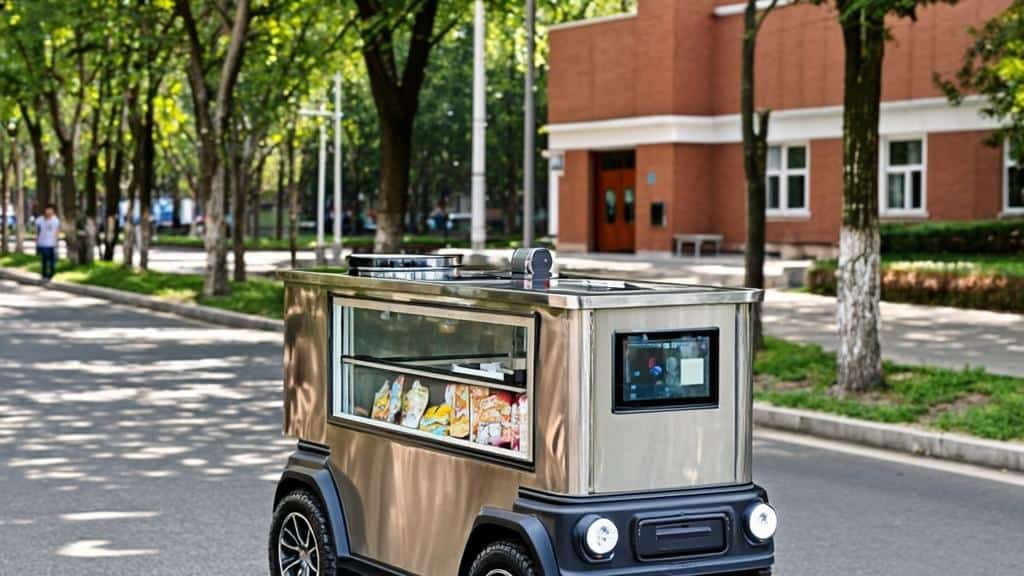
That’s the story. A small autonomous driving club at Beijing Institute of Technology stripped the upper module from a decommissioned RoboMaster robot, kept the mecanum wheel drivetrain, added a hot griddle, a payment terminal, and a navigation stack — and launched what is perhaps the world’s most over-engineered mobile snack vehicle.
The result is genuinely funny. It also says something interesting about how elite engineering education works in China.
What Is RoboMaster — And Why Does the Chassis Matter?
For Western readers who haven’t encountered RoboMaster before, a quick introduction helps.
RoboMaster is an annual robotics competition organized by DJI. University teams design and build a fleet of ground robots and aerial drones. The robots compete in real-time, executing autonomous maneuvers and tracking targets with computer vision across a structured arena. In 2017, more than 200 universities and 10,000 students participated (RoboMaster, 2021).
The standard infantry robot chassis uses four Mecanum wheels. These wheels enable omnidirectional movement, powered by RoboMaster M3508 P19 Brushless DC Gear Motors. The result is a platform that can slide sideways, spin on the spot, and strafe diagonally without rotating its body — like a crab that can also do math.
After a competition season, many chassis are damaged or replaced entirely. The mechanical structure, however, remains functional. That’s hardware that cost tens of thousands of RMB to build, sitting in a storage room.
The DreamChaser team at Beijing Institute of Technology started in 2018. According to Baidu Baike, the team’s name comes from the phrase “we are all running hard, we are all dream chasers” (Baidu Baike, 2025). The team competes under BIT’s School of Automation. It has run internal campus competitions, cross-university technical exchanges, and — now, apparently — sold snacks.
How the Conversion Actually Worked
The concept behind the mobile snack cart is straightforward. The engineering behind it is not.
A typical RoboMaster robot chassis is roughly 60cm × 60cm. Its STM32F427-based development board handles motion control. For the snack cart project, the autonomous driving club removed the upper module and sensor array, replacing them with a stainless steel food tray and a folding heat shield. The original motor controllers stayed in place. The power system was rebuilt to run both the drive system and a cooking griddle from the same battery bank.
The navigation side is where the autonomous driving expertise came in. The club added a LiDAR sensor for obstacle detection, a depth camera for pedestrian avoidance, and integrated a ROS (Robot Operating System) navigation stack. The robot learns a map of a campus zone. It then follows a predefined route, stops at designated spots, and signals via a small display screen that it is ready to take orders.
Payment is handled via a QR code. A student scans, selects their item, and the vendor — who follows at a short distance — prepares the food. The robot holds position, accepts payment confirmation, and signals when the next stop is approaching.
The chassis navigates. The human cooks. It’s a hybrid model that’s more honest than calling it “fully autonomous” — but arguably more practical for an outdoor food environment with unpredictable traffic.
The Engineering Humor Here Is Intentional
There’s a tradition in hacker and maker culture of applying disproportionate technology to trivial problems. Western readers might recognize this as “over-engineering for the joke” — the kind of project that shows up at MIT’s MakeMIT hackathon or in a Carnegie Mellon robotics lab at 2 a.m.
The BIT snack cart fits that mold exactly. But there’s a cultural dimension worth understanding.
In China, the phrase 学以致用 (xué yǐ zhì yòng) — loosely, “put learning into use” — is a foundational educational value. It doesn’t just mean applying textbook knowledge to job tasks. It means finding real, grounded applications for technical skills in everyday life. A mobile snack robot that navigates the campus is 学以致用 in its most literal and slightly absurd form.
For Western university culture, the nearest comparison might be Stanford’s d.school design philosophy: prototype something real, however imperfect, and let the constraints teach you. The BIT autonomous driving club did exactly that — except their prototype also serves breakfast.
Beijing Institute of Technology: More Than a Competition School
It’s worth stepping back to understand what kind of institution produces students who think like this.
Beijing Institute of Technology holds a rank of 302 in the 2025 QS World University Rankings, a position within the 101–150 range in the 2024 Academic Ranking of World Universities (ARWU), 179th in the 2024 U.S. News Best Global Universities Rankings, and 201–250 in the 2025 Times Higher Education World University Rankings.
BIT’s strengths sit in engineering, materials science, computer science, and autonomous systems. The Zhongguancun campus — located at No.5 South Zhongguancun Street, Haidian District — sits in Beijing’s technology corridor, surrounded by national research institutes and tech companies (Beijing Institute of Technology, 2023).
BIT is currently home to more than 2,800 international students from 149 different countries. Students from Malaysia, South Korea, Japan, Russia, Germany, and dozens of other countries live and study alongside BIT’s Chinese students. That international density shapes the campus culture in ways that are hard to anticipate before arrival.
One of those ways: in a student body this technically capable, the unofficial projects are sometimes more ambitious than the official ones.
What the Snack Cart Teaches International Students About Chinese Campus Life
The Gap Between Canteen and Curiosity
BIT’s campus canteens are legitimately good. The Flavor Canteen on the third floor of the South Canteen at Liangxiang Campus attracts students and teachers alike with dishes such as Beijing roast duck, curry shrimps, and boiled fish with pickled cabbage and chili. That’s not standard cafeteria food.
But canteens close. Late-night study sessions run past midnight. And sometimes, a student wants a jianbing at 10:30 p.m. — which is roughly the time the autonomous snack robot makes its final round.
This is the practical gap the project fills. Not glamorously. Just usefully.
The Mecanum Wheel Has a Second Career
There’s something worth noticing in the specific choice of chassis. Mecanum wheels are almost absurdly capable for a snack cart application. A standard wheeled cart needs only forward and backward motion. Mecanum wheels can strafe, spin, and navigate tight corners with zero turning radius.
That capability is overkill for delivering jianbing. But it means the robot can navigate crowds without bumping into anyone, back away from an obstacle without turning, and hold a stable position on a slight incline. The “over-engineering” turns out to solve real problems.
This is a pattern that shows up repeatedly in Chinese autonomous vehicle research: systems built for demanding competition environments, then redeployed in commercial contexts where even 20% of their original capability represents a significant improvement over the baseline.
A Lesson About What “Learning” Means Here
BIT’s DreamChaser team runs what it calls 薪火培训 (xīn huǒ péi xùn) — “passing the torch” training — aimed primarily at first-year students who have no robotics background (Baidu Baike, 2025). The goal is to create a pipeline of technical talent, year over year, with knowledge transferred between cohorts rather than starting from scratch each season.
The snack cart project sits outside the formal competition track. That’s the point. It exists in the same space as side projects, hackathon entries, and late-night “what if we just tried this” conversations that define the unofficial curriculum at any serious engineering school.
In that sense, it isn’t so different from what happens in engineering labs at MIT, ETH Zürich, or the National University of Singapore. The hardware changes. The impulse doesn’t.
How to Find the Snack Robot — And What Else to Know Before Visiting BIT
If you’re planning to visit Beijing Institute of Technology as a prospective student, exchange participant, or general visitor:
- Zhongguancun Campus (the main campus for graduate students and international students) is accessible directly from Weigongcun Station on Subway Line 4. The area is dense with universities — Peking University and Renmin University are nearby.
- Liangxiang Campus (the undergraduate campus since 2007) is reached via the Fangshan Line to Liangxiang University Town Station.
- Campus food: The canteen system is multi-tiered. Basic dishes start from ¥10–¥15 per meal. The Flavor Canteen (third floor) runs slightly higher but offers full sit-down dining. The Muslim Canteen operates under separate dietary standards for Muslim students.
- The snack robot: As of the time of writing, the autonomous snack cart operates within the Zhongguancun campus perimeter, typically in the evenings. It’s not a permanent commercial fixture — it’s a student project, which means its schedule depends on who’s running it that semester.
That last detail matters. The best things about this kind of campus aren’t on any official map.
References
Baidu Baike. (2025). 北京理工大学机器人队 [BIT Robotics Team]. https://baike.baidu.com/item/%E5%8C%97%E4%BA%AC%E7%90%86%E5%B7%A5%E5%A4%A7%E5%AD%A6%E6%9C%BA%E5%99%A8%E4%BA%BA%E9%98%9F/23333783
Beijing Institute of Technology. (2023). Campus location. BIT Official English Site. https://english.bit.edu.cn/2023-10/25/c_933594.htm
Beijing Institute of Technology. (2023). Canteens on Liangxiang Campus. BIT Official English Site. https://english.bit.edu.cn/2023-10/25/c_933597.htm
Beijing Institute of Technology International Students Office. (2025). 2025 BIT Admission Book for International Students. https://www.timeshighereducation.com/cms-academic/sites/default/files/institution_downloads/2024-11/2025%20BIT%20Admission%20Book%E5%8C%97%E4%BA%AC%E7%90%86%E5%B7%A5%E5%A4%A7%E5%AD%A6%E5%9B%BD%E9%99%85%E5%AD%A6%E7%94%9F%E6%8B%9B%E7%94%9F%E7%AE%80%E7%AB%A0.pdf
RoboMaster. (2021). RoboRTS hardware specifications. RoboMaster GitHub Repository. https://github.com/RoboMaster/RoboRTS-Tutorial/blob/master/en/hardware_specifications.md
Wikipedia. (2026). Beijing Institute of Technology. Wikimedia Foundation. https://en.wikipedia.org/wiki/Beijing_Institute_of_Technology