Beijing Normal University (BNU) confuses a lot of foreign visitors. The name sounds almost apologetic — normal? As in, just okay? Average? Nothing special? The confusion is completely understandable. In English, “normal” rarely signals ambition. Yet this university ranks among China’s top institutions, sits inside Project 985, and holds the #1 spot globally for Education and Training in the 2025 QS subject rankings. So what exactly is “normal” about it?
The answer goes back roughly 2,500 years. And it starts with a bell.
The Word “Normal” Has Nothing to Do With Being Average
First, a quick etymology detour — because this word has misled people for a long time.
The term “normal school” traces back to the French école normale, established in Paris in 1794. According to Britannica’s entry on normal schools, the concept referred to a school that set the norm — a standard model for teaching methods, to be replicated across the country. Napoleon later formalized it by decree in 1808, charging the institution with “training in the art of teaching the sciences and the humanities” (Wikipedia, École normale supérieure). The idea was standardization. The state needed teachers who all taught the same way.
As New World Encyclopedia explains, “several comprehensive universities — such as UCLA in the United States and Beijing Normal University in China — began as normal schools and later expanded.” So “normal” simply means: this is where teachers are trained to the norm. Boring etymology, yes. But in China, the university took that concept somewhere far less boring.
Then China Added a 2,500-Year-Old Bell to the Picture
Here is where Beijing Normal University diverges sharply from its French counterpart.
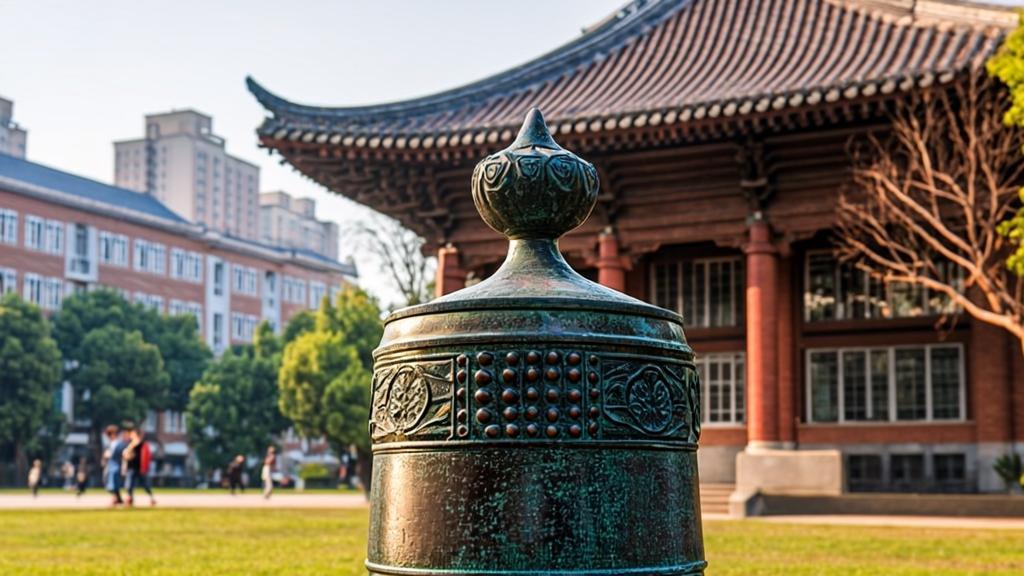
The university’s emblem does not show a textbook, a torch, or a graduation cap. At the center sits a muduo (木铎) — a wooden-tongued bronze bell used in ancient China since the Xia and Shang dynasties, over 3,000 years ago.
Why a bell? Because of a single line from the Analects of Confucius, Book III: “The world has not followed the Way for a long time, and Heaven will take the master as a muduo.”
In ancient Chinese governance, officials rang the muduo while walking through towns to announce government decrees. The sound carried authority and reached everyone. Confucius used this image to describe the teacher’s role: someone sent by Heaven to spread civilization, knowledge, and moral order across the land — not just to a classroom, but to the whole world. As the BNU Zhuhai campus notes, the muduo “symbolizes the sound of teaching” — the resonance of education beyond any single generation.
Additionally, the tradition held that the wooden-tongued muduo was used for civil affairs, while a metal-tongued version served military purposes. “Mù duó sī wén, jīn duó sī wǔ” — wooden bell for culture, metal bell for war. By placing the muduo at the heart of its emblem, Beijing Normal University declared its mission: the civilizing power of learning, not force.
Why the French and Chinese Ideas of “Normal” Are Fundamentally Different
Both France and China built institutions to train teachers. But the underlying logic could not be more different.
Napoleon’s école normale was a rational, state-engineering project. The goal was standardization. Train teachers identically, deploy them uniformly, achieve a homogeneous national education. It is the same logic that gave France its centralized curriculum, its competitive agrégation examination, and the famous observation that on any given day, the Minister of Education could look at the clock and know exactly which page of Racine was being read in every high school in France. Efficiency. Control. Replication.
BNU’s founding philosophy runs on a different axis entirely. The muduo image does not ask teachers to replicate a standard. It asks them to embody one. The distinction matters. In the Confucian framework, a teacher is not a civil servant executing a curriculum — a teacher is a moral model whose character shapes everyone around them. The university’s motto, written in calligraphy by the scholar Qi Gong (启功), makes this explicit:
学为人师,行为世范
“In learning, be a teacher to others. In conduct, be a model for the world.”
According to BNU’s official explanation of the motto’s origins, Qi Gong clarified: “Learning” (学) refers to the knowledge, skills, and scholarship a teacher must possess — not just enough to pass a test, but enough to serve as a true guide for others. “Conduct” (行) refers to behavior in every direction — how one treats people, how one acts in public, whether one’s character is genuinely admirable. There is no exam for this. No ranking. It demands lifelong self-examination.
That is a very different standard than “teach to the norm.”
The Scholar Who Wrote That Motto — and His Remarkable Story
Qi Gong (1912–2005) was the calligrapher who hand-inscribed the motto on stone for the university’s campus. His handwriting became so iconic at BNU that the font is now called “Qi Gong style” (启功体), and it appears on PPT slides, signage, and publications across campus to this day.
Here is what makes his story striking: Qi Gong only completed middle school. No university degree. No formal higher education. Yet he spent decades as an associate professor and then full professor at Beijing Normal University, eventually becoming one of China’s most revered calligraphers, painters, and scholars of Chinese classical literature.
He even wrote his own epitaph at age 66, in a famously self-deprecating style: “Middle school student. Associate professor. Knowledge not deep, expertise not thorough. Famous, but not deservingly so…” — and so it continued, wry and warm to the last line.
That a man without a diploma wrote the motto demanding others become “a teacher and model to the world” is either deeply ironic or perfectly fitting. In the Confucian view, it is the latter: genuine cultivation cannot be certified by transcripts. It shows in everything you do.
How Beijing Normal University Looks Today — for Anyone Considering a Visit or Study
Beyond the philosophy, BNU is a fully operational world-class research university in Beijing’s Haidian District. As of 2025:
- Ranked #271 globally in QS World University Rankings (TopUniversities, 2025)
- Ranked #1 in China and #2 in Asia-Pacific for Education and Training by QS Subject Rankings (Wikipedia, BNU)
- Home to over 24,000 full-time students, including approximately 6,000 international learners
The BNU Summer School 2026, announced in February 2026, features 11 international programs across humanities, social sciences, sustainability, and emerging technologies — all taught in English and designed for international students. Applications are open through the BNU International Office.
For visitors, the Beijing campus sits near the Third Ring Road in Haidian. The muduo sculpture near the main academic buildings is worth finding. It is not a grand monument. It is a small bronze bell, ancient in form, standing quietly beside one of China’s busiest universities. Somehow, that understatement feels appropriate.
What Makes “Normal” Special, in the End
Most Western universities named their highest aspiration after a place (Oxford), a founder (Harvard), or a virtue (Veritas — truth). Beijing Normal University named itself after a job. And then spent over 120 years arguing, through every wall, emblem, and stone-carved motto, that the job of teaching is not a profession — it is a calling that requires the whole person.
The French said: set the norm, replicate it everywhere.
Confucius said: be the bell. Let the sound carry on its own.
Both traditions shaped what “normal” means at BNU. But only one of them echoes back three thousand years. If that distinction interests you, the university has a summer school, a Chinese language program for beginners, and a campus where a small bronze bell waits at the center of everything — still ringing.
References
Beijing Normal University at Zhuhai. (n.d.). Campus tour: Muduo Building. https://english.bnuzh.edu.cn/CampusLife/Articles/3ef07da3f2ce47b38e399fac7ec4aac2.htm
Beijing Normal University. (2026, February 28). BNU Summer School 2026: 11 international programs. https://english.bnu.edu.cn/newsevents/events/e78230252aa443e4961636e48c0a08ca.htm
Beijing Normal University. (n.d.). The evolution of BNU’s motto. https://www.bnu.edu.cn/bsgs/ehw/87244.htm
Britannica. (n.d.). Normal school. https://www.britannica.com/topic/normal-school
New World Encyclopedia. (n.d.). Normal school. https://www.newworldencyclopedia.org/entry/Normal_school
TopUniversities. (2025). Beijing Normal University: QS World University Rankings 2026. https://www.topuniversities.com/universities/beijing-normal-university
Wikipedia contributors. (2025). Beijing Normal University. https://en.wikipedia.org/wiki/Beijing_Normal_University
Wikipedia contributors. (2026). École normale supérieure (Paris). https://en.wikipedia.org/wiki/%C3%89cole_normale_sup%C3%A9rieure_(Paris)