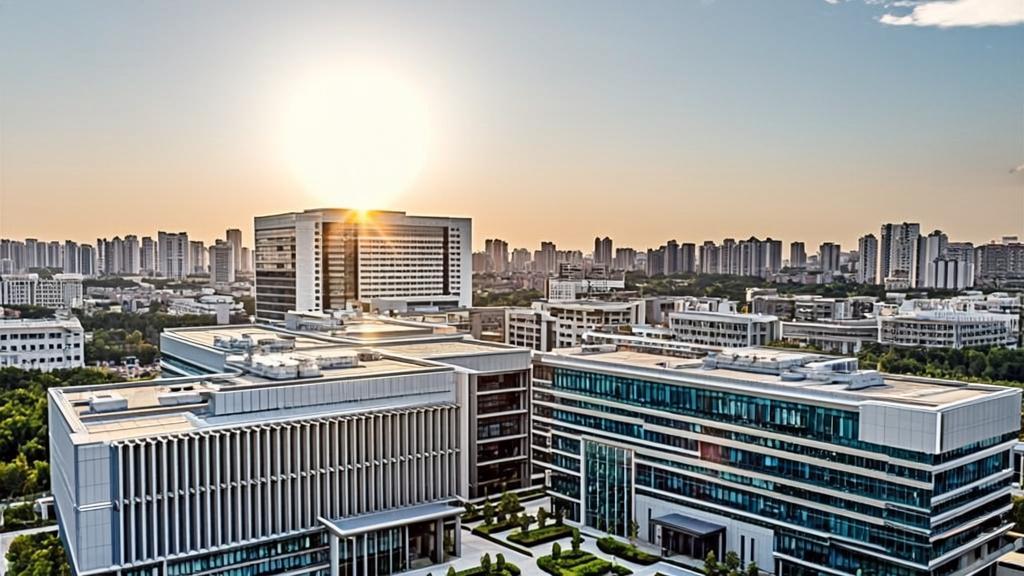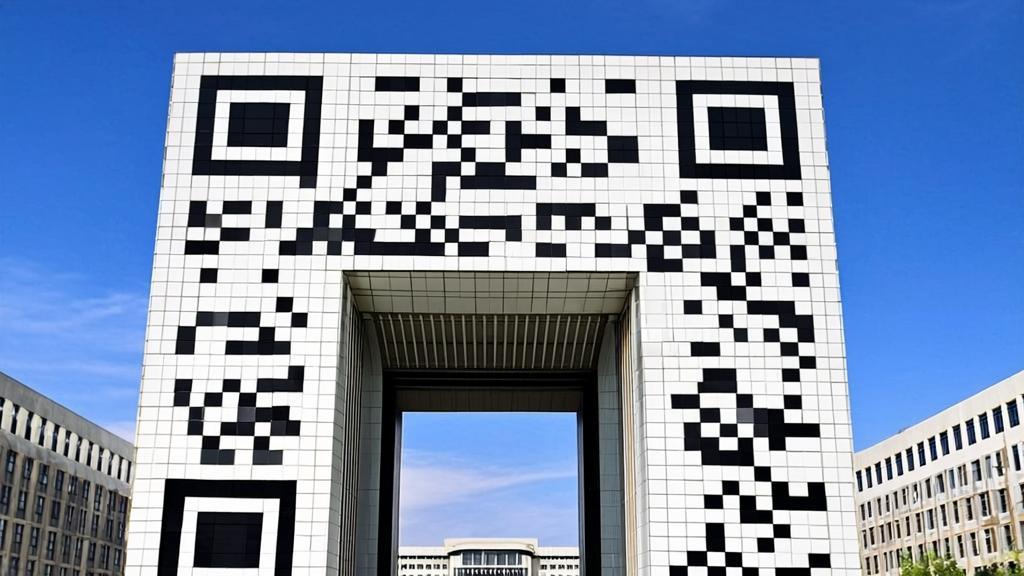
Beijing University of Posts and Telecommunications (BUPT) has one of the strangest university entrances on the planet. Scan the west gate of its Shahe Campus, and your phone jumps straight to the university’s official website. No sign. No stone arch. Just a full-scale, latticed QR code built into the architecture itself.
Most people outside China have never heard of this. Honestly, that’s part of why it’s worth talking about.
A Gate That Actually Does Something
Western universities love grand entrances. Think Harvard’s Johnston Gate, Oxford’s medieval archways, or the ornate iron fences of European campuses. They signal history, prestige, tradition.
BUPT’s Shahe west gate signals something different: this place is about information.
The gate’s structure uses hollow, three-dimensional QR code patterns across its entire face. From the right angle, the QR code is readable. Scan it, and you land on BUPT’s official site. It’s functional architecture — a gate that communicates in the literal language of the internet age.
Furthermore, the center square between the student activity center and the dining halls is called — fittingly — QR Code Plaza. So the QR code isn’t just a gate. It’s the organizing symbol of the whole campus.
Is this a gimmick? Maybe slightly. But it’s also a deliberate statement about identity. And once you start looking, the entire campus turns out to be built this way.
The Campus Is a Living Tech Museum
Seven Pillars for Seven Layers
Stand in front of BUPT’s main library at the Xitucheng (Haidian) Campus. You’ll see seven tall steel columns rising from the plaza.
They represent the OSI seven-layer model — the foundational framework that defines how data travels across networks. Every computer science student in the world learns this model. At BUPT, it’s a sculpture you walk past on the way to class.
That’s not decoration. That’s a university literally embedding its curriculum into the ground.
China’s First Stamp, Underfoot
Walk further and look down. Set into the pathway of the main square is a large marble tile carved in the shape of the Large Dragon stamp — China’s first nationally issued postage stamp, released during the Qing Dynasty in 1878.
BUPT was founded in 1955 as China’s first institution of higher education in posts and telecommunications. The stamp underfoot is a direct thread to that origin. Additionally, it’s a reminder that “posts and telecommunications” isn’t just a bureaucratic name — it’s the lineage of a technology that connected a nation.
Morse Code on the Footpath
Between the west gate and the school motto stone, the walkway at the Xitucheng Campus features a unique design: the university’s motto rendered in Morse code, embedded in the paving itself.
Most visitors walk over it without realizing. Students who study communications recognize it immediately. For international students arriving for the first time, it tends to stop them mid-step.
The Characters “Post” and “Telegraph” in the Landscape
In the campus gardens, two water features were designed around Chinese characters. One follows the brushstroke pattern of 邮 (yóu, meaning “post”). The other mirrors 电 (diàn, meaning “electricity/telecommunications”). Together, they spell out the university’s identity — not on a sign, but in flowing water and stone.
Why Does a University Do This?
This is worth pausing on. Why would a university spend resources encoding its values into physical architecture rather than, say, more lab equipment?
The short answer: Chinese universities, particularly technical ones, treat campus design as pedagogy.
In contrast, many Western campuses separate the aesthetic from the academic. Statues honor historical figures. Buildings carry donor names. The architecture looks impressive but rarely teaches anything specific.
BUPT’s approach is different. Here, the environment itself reinforces the subject matter. A student studying network architecture sees the OSI model as a sculpture every day. A student in telecommunications walks over Morse code. The campus is not a backdrop for learning — it’s part of the curriculum.
Moreover, there’s a cultural logic here rooted in Chinese educational philosophy. The concept of 环境育人 (huánjìng yùrén) — roughly, “environment shapes people” — holds that the physical surroundings of a learning space actively form character and knowledge. BUPT’s campus is a direct application of that idea.
What This Means for International Students
You’re Not Just Studying at a University — You’re Inside One Big Concept
For international students considering Beijing University of Posts and Telecommunications, this matters beyond the novelty factor.
BUPT consistently ranks among China’s top universities in information and communications technology. Its Information and Communication Engineering discipline holds an A+ rating — the highest tier — in China’s national academic evaluation system. Meanwhile, graduates enter companies like Huawei, Tencent, Alibaba, Baidu, and China Mobile at high rates.
But the campus design reveals something about the culture inside the institution. This is a place that takes its identity seriously. It doesn’t just teach telecommunications and AI — it lives those subjects in the arrangement of its buildings, the patterns on its paths, the sculpture outside its library.
A Campus That Welcomes International Students
BUPT accepts international students through China’s Government Scholarship program and directly through its international admissions office. Programs are available in English, particularly at the postgraduate level.
The Shahe Campus hosts most first and second-year undergraduates. The Xitucheng (Haidian) Campus, located near Beijing’s third ring road, sits in one of the city’s most university-dense neighborhoods — with Beijing Normal University directly across the street and easy metro access throughout the city.
Comparing Campus Cultures: East and West
It’s worth being honest: this comparison isn’t about which approach is better.
Western campus design has produced extraordinary spaces. The quadrangles of Oxford, the Gothic towers of Yale, the open greens of American liberal arts colleges — these environments carry their own meaning, emphasizing tradition, intellectual heritage, and civic life.
BUPT’s approach is simply different in intent. Rather than invoking history through architecture, it encodes discipline through design. The result is a campus where, if you’re paying attention, you’re always being taught something — even when class isn’t in session.
For students from Europe, North America, Africa, or Southeast Asia arriving at BUPT, the QR code gate is often the first moment of genuine surprise. Then they look closer and realize the surprise doesn’t stop there.
Getting There and What to Expect
Shahe Campus (where the QR code gate is located):
- Address: No. 1 Nanfeng Road, Shahe Higher Education Park, Changping District, Beijing
- Covers approximately 1,348 acres
- Houses around 16,000 students
Xitucheng Campus (main campus, where the OSI pillars and Morse code path are):
- Address: No. 10 Xitucheng Road, Haidian District, Beijing
- Located near Beijing’s third ring road
- Close to multiple metro lines
Both campuses are connected by university shuttle services.
Final Thought
Most university gates just open. BUPT’s west gate at Shahe links you to the internet. The pillars outside the library teach you network theory. The ground you walk on spells out a motto in the language of telegraph operators.
Beijing University of Posts and Telecommunications doesn’t describe what it is — it demonstrates it. For students looking for a place where the environment itself reflects the education on offer, that’s a rare and specific kind of appeal.
And it starts, quite literally, at the gate.
References
Beijing University of Posts and Telecommunications. (n.d.). Official website. Retrieved April 2026, from https://english.bupt.edu.cn/
Wikipedia contributors. (2026, February 12). Beijing University of Posts and Telecommunications. Wikipedia. https://zh.wikipedia.org/zh-hans/%E5%8C%97%E4%BA%AC%E9%82%AE%E7%94%B5%E5%A4%A7%E5%AD%A6
Baidu Baike. (n.d.). 北京邮电大学 [Beijing University of Posts and Telecommunications]. Retrieved April 2026, from https://baike.baidu.com/item/%E5%8C%97%E4%BA%AC%E9%82%AE%E7%94%B5%E5%A4%A7%E5%AD%A6/139535
Baidu Baike. (n.d.). 北京邮电大学沙河校区 [BUPT Shahe Campus]. Retrieved April 2026, from https://baike.baidu.com/item/%E5%8C%97%E4%BA%AC%E9%82%AE%E7%94%B5%E5%A4%A7%E5%AD%A6%E6%B2%99%E6%B2%B3%E6%A0%A1%E5%8C%BA/3401853
China’s Ministry of Education. (n.d.). Double First-Class Construction universities list. Retrieved April 2026, from http://www.moe.gov.cn/