Business Culture in China

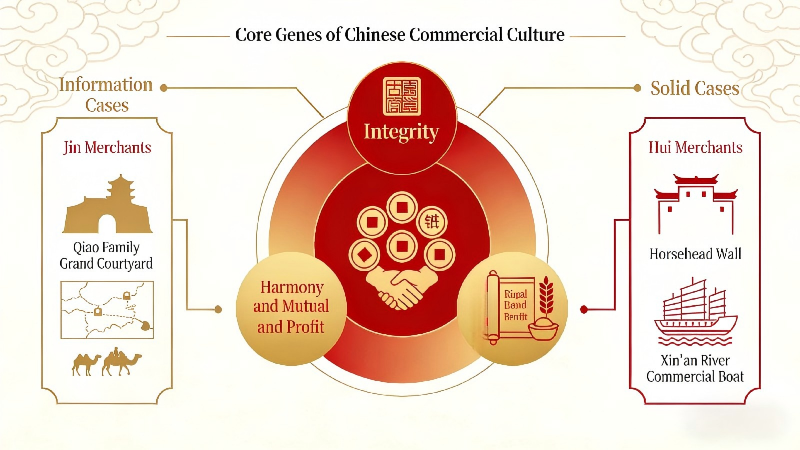
The traditional core gene of business culture in china (integrity, harmony, and justice) The corresponding relationship between the core gene of traditional business culture in china and historical practice

business culture in china is not a single-dimensional concept, but a complex system integrating traditional cultural genes, the characteristics of the times, and regional economic characteristics. From the trade exchanges of the ancient Silk Road to the vigorous rise of the contemporary digital economy, this cultural system has always been iterative in its inheritance, which has a profound impact on the business logic and market consumption behavior of enterprises. I mean, to understand business culture in china, we should not only trace its historical roots, but also grasp its specific presentation in the modern business environment – for cross-border entrepreneurs, local business operators, and even industry researchers, it is the key to grasping the pulse of China’s market.

The core context from traditional genes to modern transformation

The core gene of traditional business culture in china is inseparable from the three cores of “integrity”, “harmony”, and “justice and benefit”. As the People’s Forum Network described in the same and different management of Shanxi merchants and Anhui merchants, the rise of Shanxi merchants and Anhui merchants in the Ming and Qing Dynasties was guided by the Confucian concept of justice and benefit, and integrity was regarded as the core business principle. On this basis, the early business cooperation mode with its own characteristics was formed — Shanxi merchants carried out the stock system and top body stock system with clear property rights, and Anhui merchants built a collective property rights type cooperation system relying on the clan (People’s Forum Network, 2,020). This gene is not immutable. In the wave of market economy after the reform and opening up, it gradually integrated the modern elements of efficiency first, and innovation-driven.

From the perspective of industry observation, in the past ten years, business culture in china has shown a significant “double track integration” feature: on the one hand, the traditional culture of “relationship marketing” and “long-term doctrine” still plays a role in commercial activities, such as the establishment of long-term cooperative relations between enterprises, rather than simply pursuing short-term interests; On the other hand, the development of digital economy has given birth to a new business culture of “transparency” and “user center”. The rise of new formats such as live e-commerce and community marketing is just an intuitive embodiment of this transformation.

The core of traditional business culture and historical practice

“Based on honesty” is the cornerstone of traditional business culture in china. In ancient times, most of the trade names used “Xinyi” as their signboard, such as the Shanxi ticket shop “Rishengchang”. With its strict credit system, it realized cross-regional financial circulation and became a model of commercial trust system at that time. This kind of integrity culture is not simply a moral constraint, but transformed into specific business rules – such as commodity prices, after-sales guarantee commitments, etc., which are internally consistent with the concept of “compliance management” in modern business.

“Harmony and symbiosis” reflects the collaborative thinking of business culture in china. The early formation of traditional commercial clusters, such as the small commodity market in Yiwu, Zhejiang Province, is based on the mutual cooperation between neighbors and clans, forming a commercial ecology of “division of labor and complementary resources sharing”. Some scholars believe that this collaborative gene has laid a cultural foundation for the development of contemporary industrial clusters in china, and also made “industrial chain synergy” one of the important characteristics of business culture in china.

Iteration and innovation in the digital era

Entering the era of the digital economy, business culture in china has ushered in a new iteration of opportunity. The popularity of Internet technology has broken the regional barriers, making “inclusive commerce” and “data-driven” become a new cultural label. As the Chinese Academy of Communication and Communication put forward in the “digital trust industry map”, digital trust is the expansion of interpersonal trust and institutional trust, and it is the inevitable requirement of trusted data circulation, and digital technology is the key support for building this new trust mode (China Academy of Communication and Communication, 2,024).

The key is that this iteration is not a negation of tradition, but a fusion and upgrading. For example, in live e-commerce, the “emotional connection” between the anchor and fans is essentially a digital extension of traditional “relationship marketing”; And the platform’s qualification verification and after-sales service specifications for merchants are the specific landing of “integrity culture” in the digital scene. In actual cases, it is found that enterprises with traditional credit genes and modern digital thinking are often more advantageous in market competition.

Typical characteristics of business culture in china in the digital scene

User-centeredness highlights: enterprises pay more attention to user experience and demand feedback, such as the “personalized recommendation” of the e-commerce platform and “7 days of no reason to return”, which are cultural embodiments with the user as the core.

Innovation and rapid iteration: the “agile development” mode of Internet enterprises in china is just the modern transformation of “following the trend and flexible response” in business culture, which can quickly respond to market changes.

Social responsibility integrated into operation: more and more enterprises incorporate the “ESG concept” into their development strategies, such as the green production of new energy enterprises and the Rural Revitalization and agricultural assistance project of the Internet platform. This is not only the result of policy guidance, but also the contemporary upgrading of the traditional “justice and benefit” culture.

Practical value and application suggestions

For business operators, understanding business culture in china is not only a theoretical study but also a practical business strategy. From the perspective of industry observation, enterprises that successfully integrate into the local business culture tend to open up the market more quickly. For example, when cross-border brands enter the Chinese market, if they can combine the “relationship marketing” thinking, build an emotional connection with KOL and consumers, and adhere to the “integrity” principle to do a good job in product quality, it is easier to get recognition.

At the digital marketing level, with the help of the internal chain layout function of WordPress, this paper can be associated with the relevant content in the station such as “China consumer market trend” and “cross-border e-commerce localization strategy”, so as to improve the length of users’ stay; At the same time, the external chain can point to the official website of China Academy of information technology https://www.caict.ac.cn/ To enhance the authority of the content.

The core strategy for enterprises to adapt to the business culture in china

First, stick to the bottom line of integrity and improve the compliance system. This is not only the requirement of cultural adaptation, but also the basis for the long-term development of the enterprise — it can pass the signal of integrity through the way of publicizing product qualifications and clarifying after-sales policies. Secondly, pay attention to localized cooperation and integrate into the industrial ecology. For example, small and medium-sized enterprises can rely on the advantages of regional industrial clusters to achieve complementary resources; On the other hand, cross-border enterprises can cooperate with the local supply chain to improve response speed.

Moreover, we should take commercial interests and social responsibility into account. Public welfare elements can be integrated into the operation, such as consumption donation public welfare, green product certification, etc., with the help of social media communication, to enhance brand goodwill. Finally, keep flexible iteration ability and adapt to market changes. For example, pay attention to new formats such as live e-commerce and community marketing, and adjust marketing strategies in a timely manner to fit the “strain” gene in business culture in china.

An analysis of the core differences between business culture in china and Western commercial cultures

Comparison of business culture in china and Western commercial cultures: focusing on the core differences of business culture in china

There is a core difference between Western commercial culture and business culture in china: the former pays more attention to contractual rigidity and individualism, and commercial cooperation is based on clear terms and pursues the maximum short-term benefits; The latter focuses on relationship trust and collective symbiosis, focusing on long-term cooperation and benefit sharing. In short, Western business is more like “doing things according to rules”, and Chinese business is “trust first, then cooperation”. This difference is also reflected in the way of communication – Chinese business communication is more implicit and euphemistic, while the West is more direct and frank.

The differences between business culture in china and Western business culture, business culture in china vs Western business culture
Visual comparison of core differences between business culture in china and Western business cultures

Practical suggestions for foreign friends to adapt to business culture in china

For foreign friends to do business in China, understanding and adapting to business culture in china is the key. It is suggested to establish emotional connection through business banquets, industrial exchanges and other scenes, respect the “face” culture, and avoid public questioning or denying partners; When negotiating, listen more and be less impatient, fully understand the long-term cooperation demands of the other party rather than focusing on short-term interests; It can build a trust bridge with the help of local intermediaries or partners, and integrate into the local business ecosystem more quickly.

Guide for foreign friends to do business in China
Schematic diagram of the practical guide for foreign friends to adapt to Chinese business culture

Future development trend and thinking

With the deepening of globalization and digitization, business culture in china will continue to present the trend of “integration and innovation”. On the one hand, the excellent core of traditional culture will be further inherited and upgraded, and become an important support for differentiated competition of enterprises; On the other hand, advanced concepts in international business culture will also be absorbed and integrated to form a more inclusive business ecosystem.

The possible development directions include: Data ethics will become an important part of business integrity, and enterprises need to pay attention to user data protection; Green business culture will be more popular, and low-carbon operation and circular economy will become the industry consensus; In cross-border commercial exchanges, the international influence of Chinese commercial culture will also gradually increase, forming a unique “Chinese business paradigm.”.

What experiences do you have in the practice of business culture in china in enterprise management? Or what adaptation problems have you encountered? Welcome to share your opinions.

Reference

People’s Forum Network (2020-06-10). The same and different management of Shanxi merchants and Anhui merchants. Retrieved from http://www.rmlt.com.cn/2020/0610/583135.shtml

China Academy of information and communication (2024). Digital trust industry map, Beijing: China Institute of Information and Communication

Leave your comments with us

TOP