Chery solid-state battery development just took a major leap forward. On March 18, 2026, the Wuhu-based automaker held its “Battery Night 2026” event and formally introduced the Rhino battery technology platform — with its flagship all-solid-state Rhino S cell sitting at the very center of the announcement. The numbers are aggressive. The timeline is bold. And for a company that built China’s first independently developed car engine, the move feels entirely deliberate.
The Rhino Battery Platform: More Than Just One Cell
The Rhino battery system is Chery’s full proprietary energy lineup. It covers three stages of electrolyte technology:
- Rhino E — liquid electrolyte, for near-term production models
- Semi-solid — a transitional hybrid format
- Rhino S — full all-solid-state, the headline act
The platform also spans multiple cell formats: short blade, prismatic, and large cylindrical. Hybrid models fall under the H series; pure EVs under the E series; and solid-state applications under the S series. This is not a one-product announcement. Chery unveiled the Rhino battery product matrix covering both LFP and ternary cathode systems across three structural formats. The approach signals a long-term supply chain strategy, not a one-off lab demo.
Rhino S Specs: What Chery Is Actually Claiming
Energy Density and Range
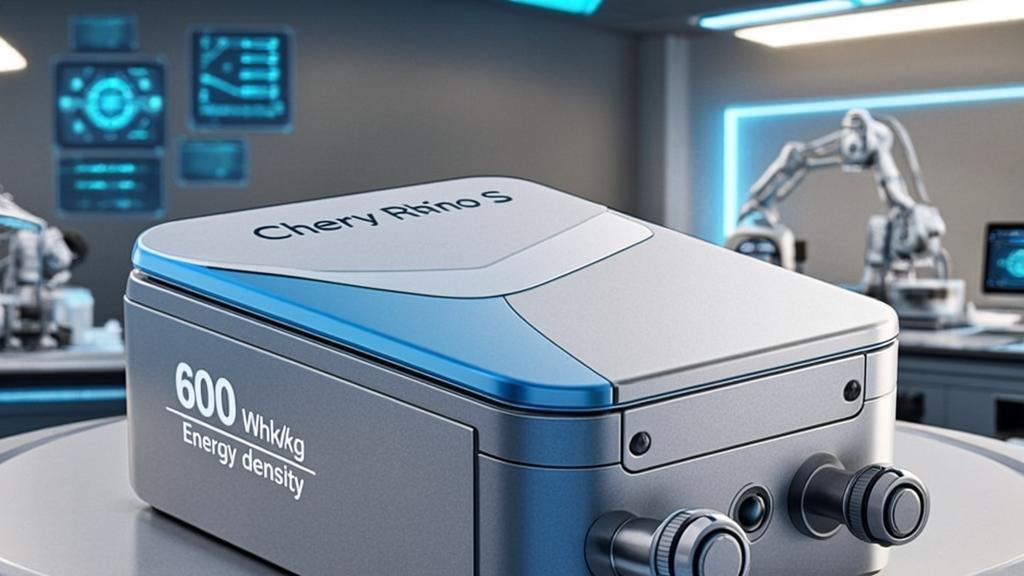
Chery unveiled the Rhino S with an energy density of up to 600 Wh/kg, with the technology expected to begin vehicle validation this year and achieve large-scale commercialization in 2027.
For context, mainstream high-nickel ternary cells today sit around 180 Wh/kg. LFP chemistry runs even lower. The Rhino S, at 600 Wh/kg, is roughly three times denser. Chery targets over 1,500 kilometers of driving range when the 600 Wh/kg battery is installed in a vehicle.
There are actually two variants in the S series:
- 450 Wh/kg — sulfide-based solid electrolyte + high-nickel ternary cathode
- 600 Wh/kg — in-situ polymerized solid electrolyte + lithium-rich manganese cathode
Both are under active development. The 450 Wh/kg sulfide route has already reached pilot production, with a 0.5 GWh intermediate test line running. Reported yield sits at 92%, which Chery says meets automotive-grade standards.
Safety and Cold-Weather Performance
The battery design removes flammable liquid components, which are common in today’s lithium-ion batteries. In safety demonstrations, Chery cut a fully charged solid-state cell at a corner — and it kept discharging normally. That alone signals a meaningful departure from liquid-electrolyte chemistry.
The company claims the battery can deliver up to 1,500 kilometers of range in extreme cold, maintaining reliable operation down to −30°C. Cold-weather degradation is capped at under 15%, according to Chery’s figures. For markets in northern China, Russia, or Scandinavia, that detail matters a lot.
How Chery Is Solving the Hard Problems
Solid-state batteries have been “almost ready” for years. Three persistent issues hold them back: low ionic conductivity, lithium dendrite growth along grain boundaries, and unstable solid-solid interfaces. In plain terms: slow charging, short lifespan, and unpredictable failure.
Chery’s strategy is a dual-track approach rather than betting on a single chemistry.
For the sulfide route, Chery dopes the electrolyte with active iodine, which reacts with lithium metal during cycling to form a stable, high-conductivity interface layer (LiI), suppressing side reactions and dendrite growth while balancing interface stability and ionic conductivity.
For the 600 Wh/kg polymer route, the team combines oxide and polymer electrolytes at the nanoscale with ceramic doping. The result reportedly brings ionic conductivity to roughly 10⁻³ S/cm — on par with liquid electrolytes.
Chery’s patent portfolio covers the entire technology chain, including solid electrolyte materials, interface optimisation, lithium anode protection, battery cell structures, and manufacturing processes. Total filings now exceed 217 patents.
Notably, Chery is not going it alone. In 2025, Chery and CATL jointly established “Shidai Chery” with a registered capital of 2 billion yuan, focusing on the mass production of solid-state batteries. CATL also achieved mass production of 500 Wh/kg condensed-state cells in early 2026, so this partnership brings real manufacturing weight to the table.
The Business Case: Why Chery Had No Choice
This is where the story gets interesting. Chery’s Battery Night was held on the same day the company released its first-ever annual report as a listed company.
Strong Revenue, Thinning EV Margins
Chery’s net profit for 2025 jumped 34.6% year-on-year to 19.02 billion yuan ($2.77 billion), with total revenue growing 11.3% to reach 300.29 billion yuan. Those are solid numbers. But zoom in, and a tension emerges.
New energy vehicle sales grew 72.5% to 826,500 units. Yet the gross margin for that EV business sat at just 8.8%. Traditional combustion vehicles, by contrast, still carried a 15% gross margin. More EVs meant lower blended profitability.
Battery Costs Are the Problem
The Chinese EV industry has a running joke — or rather, a running complaint — that automakers are just factories working for battery suppliers. Former GAC chairman Zeng Qinghong said it bluntly: “We’re all working for CATL.” Battery packs represent 30–40% of a vehicle’s bill of materials. At Chery’s volume, that is a staggering cost exposure.
Self-developed solid-state batteries, if they scale, offer a path to supply chain independence. This move promotes Chery’s transformation from a “battery user” to a “battery definer,” intensifying competition with enterprises such as CATL and BYD. That framing is deliberate. It’s a margin play as much as a technology play.
The 2027 Roadmap and What Comes Next
Chery has laid out a specific timeline:
- 2026 — Deploy Rhino S in designated operational vehicles (taxis, ride-hailing fleets) for real-world data collection; complete 60 Ah cell continuous production
- 2027 — Launch GWh-scale mass production line (target: 2–5 GWh), covering around 200,000 household vehicles; complete vehicle integration testing for the Exeed ES8
- 2028 — Reach 30% solid-state battery penetration across all Chery NEV models
The first model to receive the technology will be the Exeed Liefeng shooting brake under the Exeed premium brand, marking one of the earliest real-world uses of solid-state batteries in a passenger EV.
Still, skepticism is fair. Industry analysts note that large-scale production of solid-state batteries still faces major hurdles, including manufacturing processes, cost control, and long-term reliability, with the key window for breakthroughs likely to come after 2030. Moving from a 0.5 GWh pilot line to a 2–5 GWh commercial line involves challenges that lab yield rates don’t fully predict.
Industry experts believe the 2026 to 2027 period will be critical in determining whether solid-state batteries can be successfully integrated into mainstream vehicles. Chery is betting on being on the right side of that window.
Global Race, Chinese Pace
Chery is not the only one pushing. Toyota and CATL both target 2027. QuantumScape in the US has Volkswagen backing. Factorial has drawn investment from Mercedes-Benz and Stellantis. After Toyota, CATL, and Samsung set 2027 as the year for mass solid-state battery production, Chery has appeared as a new competitor threatening to one-up their efforts.
What makes Chery’s position unusual is the combination of in-house R&D, a strategic CATL partnership, upstream materials investment (including a sulfide electrolyte startup backed by Temasek affiliate Vertex Ventures), and a commercial vehicle deployment plan that generates real data before the mass-market launch. That is a more complete industrial strategy than most announcements of this kind.
Whether the Rhino S delivers on its 1,500 km promise by 2027 remains to be seen. But Chery solid-state battery development is no longer a concept slide — it’s a funded, piloted, and publicly committed program with a product attached to it.
References
CnEVPost. (2026, March 18). Chery targets 1,500 km range with new solid-state battery, Exeed ES8 to test next year. https://cnevpost.com/2026/03/18/chery-targets-1500-km-range-new-solid-state-battery/
Electrek. (2026, March 18). A solid-state EV battery that can achieve 800 miles of driving range — It’s becoming a reality. https://electrek.co/2026/03/18/solid-state-ev-batteries-with-800-miles-range-become-reality/
Interesting Engineering. (2026, January 20). Chery claims solid-state battery EV can hit 932 miles at minus 22°F. https://interestingengineering.com/transportation/chery-to-launch-first-ev-with-solid-state-battery
Shanghai Metals Market (SMM). (2026, March). Rhino all-solid-state battery, sprinting toward 600 Wh/kg: Chery Battery Night revealed its solid-state battery strategy. https://news.metal.com/newscontent/103814708-Rhino-All-Solid-State-Battery-Sprinting-Toward-600-Whkg-Chery-Battery-Night-Revealed-Its-Solid-State-Battery-Strategy
Yicai Global. (2026, March 19). Chery joins China EV battery race with solid-state tech planned for 2027. https://www.yicaiglobal.com/news/chery-joins-china-ev-battery-race-with-solid-state-tech-planned-for-2027
NotebookCheck. (2025, October 21). Solid-state battery with record 600 Wh/kg energy density set to power 800-mile Chery EV in 2027. https://www.notebookcheck.net/Chery-Rhino-S-solid-state-battery-with-record-energy-density-set-to-power-800-mile-EV-in-2027.1142523.0.html
Battery-Tech Network. (2026, January 20). Chery’s Exeed Liefeng to debut solid-state battery in 2026. https://battery-tech.net/battery-markets-news/cherys-exeed-liefeng-to-debut-solid-state-battery-in-2026/