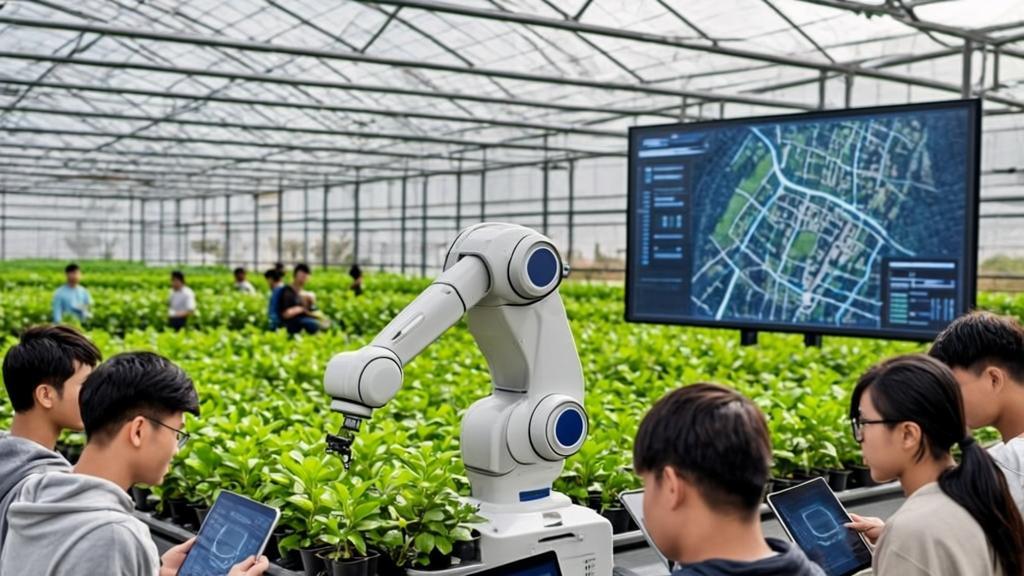
China Agricultural University — most people picture soil samples and greenhouses. But walk into its College of Information and Electrical Engineering today, and you might find students training machine learning models to predict crop disease outbreaks before they happen.
That gap between expectation and reality is, honestly, the whole point of this article.
CAU is not just China’s top agricultural institution. As of 2025, it ranks #1 in the world in Agricultural Sciences by three independent rankings simultaneously: the Academic Ranking of World Universities (ARWU), the U.S. News Best Global University Ranking, and the Performance Ranking of Scientific Papers for World Universities (Wikipedia, 2025). That kind of consistency is rare. And yet, it remains almost entirely off the radar for international students who aren’t already working in the agricultural sector.
So here’s the question worth asking: what does it actually mean to study agriculture at a university that is also building AI systems to feed the world?
What China Agricultural University Is Actually Building With AI
In October 2025, CAU launched the Shennong Large Model 3.0 at the World Agrifood Innovation Conference in Beijing. The model is China’s first large-scale AI system trained on a fully agricultural dataset (Xinhua, 2025).
The numbers behind it are striking:
- Over 10 million agricultural knowledge graph entries
- 50 million records of modern agricultural production data
- 20,000 agricultural monographs in its core database
- 36 specialized intelligent agents covering everything from wheat breeding to pest identification
One of those agents — the pest and disease identification tool — can recognize over 600 types of crop diseases, and it responds in seconds via a mobile app (China Daily, 2025).
This matters for international students, because Shennong is not just a showcase project. Students in CAU’s engineering and agronomy programs actively contribute to its development. That means research opportunities here are not abstract. They connect directly to something being deployed at scale, across Chinese farmland right now.
How This Compares to Agricultural AI Education in the West
Here’s a useful contrast. In most Western agricultural universities — Wageningen in the Netherlands, Cornell in the United States, Harper Adams in the UK — AI and precision farming are studied primarily as topics. Students read case studies, work with commercial platforms, and may run experiments in university test plots.
At China Agricultural University, the difference is one of proximity. CAU researchers built Shennong from scratch. They spent seven months scanning over 3,000 agricultural books from their own library just to construct the foundational database (People’s Daily, 2026). Then they traveled to more than 20 provinces to collect real-world soil, irrigation, and pest outbreak data.
That’s a different kind of education. It’s closer to apprenticeship than coursework.
Part of this comes from a deep philosophical difference in how Chinese agricultural education is designed. The concept of 学以致用 (xuéyǐ zhìyòng) — roughly, “learn in order to apply” — shapes how programs are structured. Theory and practice are not separated into different phases. They run in parallel from the beginning.
Western university models, by contrast, tend to separate foundational learning from applied work. You study the science first, then apply it later — in internships, placements, or postgraduate roles. Neither approach is objectively better, but the CAU model does mean that students encounter real-world agricultural problems much earlier.
What International Students at China Agricultural University Actually Study
CAU currently offers international students access to 144 Master’s programs and 95 Doctoral programs, taught in either English or Chinese (CAU International Office, 2022).
English-taught programs span four colleges:
- College of Agronomy and Biotechnology
- College of Humanities and Development
- School of Engineering
- School of Economics and Management
Subjects available in English include crop science, plant protection, agricultural engineering, food science, veterinary science, and agricultural economics — among others. For students who want to go deeper into Chinese-language programs, HSK Level 4 certification is required.
The university has also partnered with 207 institutions across 44 countries, including Purdue University and Wageningen University, giving international students access to a broader research network from day one (BestEduChina).
The China-Africa Science and Technology Backyard: A Program Unlike Anything Elsewhere
One program at CAU deserves special attention — not because it’s well-known in the West (it isn’t), but because it represents something genuinely rare in global agricultural education.
The China-Africa Science and Technology Backyard program, launched in 2019, places African graduate students in a three-year cycle:
- Year 1 — Theory and practical skills at CAU in Beijing
- Year 2 — Applying Chinese agricultural techniques directly in African farming communities
- Year 3 — Back at CAU to complete research and dissertation
The program is backed by the World Bank, the Bill and Melinda Gates Foundation, and the UN Food and Agriculture Organization. Since 2019, it has recruited 91 students from 12 African countries. Of the 36 who have graduated, many now work on the front lines of agricultural research in their home countries (China Daily, 2024).
One participant, a student from Malawi named Samson, described it this way: China’s agriculture is highly modernized. If the techniques could be brought back home, it would make a significant difference to agricultural production there (Study China / China Daily, 2022).
The program is pragmatic by design. It assumes that agricultural knowledge is only useful if it transfers — not just across disciplines, but across continents and contexts.
Robots in Cornfields: What CAU Research Looks Like in Practice
A professor at China Agricultural University, Chen Jian, leads a team that uses robots to observe and photograph cornfields — automating the early screening of crop breeding candidates. A single robot can inspect roughly 0.17 hectares per hour. With multiple robots running simultaneously, breeding cycles that once took years are now being compressed significantly (People’s Daily, 2025).
The goal, as Chen put it, is to help wheat and corn adapt to environments like plateaus, deserts, and saline-alkali soil — places that standard crops simply cannot grow in today.
For international students considering a research degree, this is worth sitting with. These are not theoretical projects. They connect to questions about feeding a planet where arable land is expected to expand by only 4% by 2050, even as the global population surpasses 9.7 billion (Molotoks et al., 2021, as cited in DCZ-China AI in Agriculture Report, 2025).
Practical Information for International Students
Here’s what to know if you’re considering applying:
Scholarships available:
- Chinese Government Scholarship (CGS) — fully funded, covers tuition, accommodation, and a monthly stipend
- CSC Application system: campuschina.org (Agency No: 10019, Program Type B)
- CAU application portal: apply.cau.edu.cn
Language requirements:
- English-taught programs: IELTS 6.0 or TOEFL 90
- Chinese-taught programs: HSK Level 4 certificate (CAU Admissions, 2025)
Campus locations:
- Two campuses in Beijing (Haidian District)
- One campus in Yantai, Shandong Province
Best time to apply: Applications for the 2026 intake typically close in February or March. Check the official admissions site at admissions.cau.edu.cn for current deadlines.
Why This Might Be the Right Place — For the Right Person
Not everyone who studies agricultural science wants to end up in a field with a tablet and a soil sensor. That’s worth saying clearly. CAU is genuinely specialized. If food systems, plant science, biotechnology, or agricultural engineering are not central to your interests, there are probably better-fit universities.
But if those fields do interest you — and especially if you want to work on the intersection of AI, climate resilience, and global food security — then China Agricultural University sits at an unusual intersection. It is simultaneously one of the world’s top-ranked research institutions and a place actively deploying the technology it builds, at scale, in real farming environments.
That combination is rarer than it might seem.
References
China Agricultural University. (2025, October 11). 2026 China Agricultural University international student admission information for undergraduate. Retrieved from https://admissions.cau.edu.cn/art/2025/10/11/art_48600_1084208.html
China Agricultural University. (2025, October 29). Chinese Government Scholarship (CGS) 2026: Admission to Chinese Government Scholarship “High Level Postgraduate Program”. Retrieved from https://admissions.cau.edu.cn/art/2025/10/29/art_48608_1087246.html
China Agricultural University. (2022). Admission to graduate programs of China Agricultural University. Retrieved from https://www.cau.edu.cn/tzgg/884440.htm
China Agricultural University. (2025). University launches AI model to aid farming, global research. Retrieved from https://news.cau.edu.cn/mtndnew/0baf45e22c134e4c9a7214b197dc4f54.htm
People’s Daily Online. (2025, April 7). AI drives agriculture toward high-quality development. Retrieved from https://en.people.cn/n3/2025/0407/c90000-20298620.html
People’s Daily Online. (2026, February 10). AI model streamlines agriculture, boosts efficiency. Retrieved from https://en.people.cn/n3/2026/0210/c90000-20424351.html
Xinhua News Agency. (2025, October 13). Chinese university unveils new AI model for agriculture. Retrieved from https://english.news.cn/20251013/332aeaf057234f6898e391d8d4786018/c.html
China Daily. (2024, September 20). Sci-tech program mirrors deepened Sino-African agricultural cooperation. Retrieved from https://global.chinadaily.com.cn/a/202409/20/WS66ecd1d3a3103711928a8d38.html
Study China / China Daily. (2022, November 4). Overseas students dig in to learn modern agricultural techniques. Retrieved from https://studychina.chinadaily.com.cn/s/202211/04/WS6364bc77498ea274927a7849/overseas-students-dig-in-to-learn-modern-agricultural-techniques.html
Wikipedia. (2025). China Agricultural University. Retrieved from https://en.wikipedia.org/wiki/China_Agricultural_University
DCZ-China. (2025). Artificial intelligence in Chinese agriculture: Applications and prospects. Retrieved from https://www.dcz-china.org/wp-content/uploads/2025/02/Study_AI-applications-in-agriculture_2025-01_FINAL.pdf