A fossil site in southwest China has just upended one of biology’s oldest timelines. Researchers working in Yunnan Province recovered more than 700 fossil specimens that push the origin of complex animal life back by at least 4 million years — well before the event scientists had long treated as the starting gun for animal diversity.
The study, published April 3, 2026, in the journal Science, was led jointly by Oxford University’s Museum of Natural History and Yunnan University in China. The findings are already being described as one of the most significant paleontological discoveries in decades (University of Oxford, 2026).
What Scientists Found at the Jiangchuan Biota
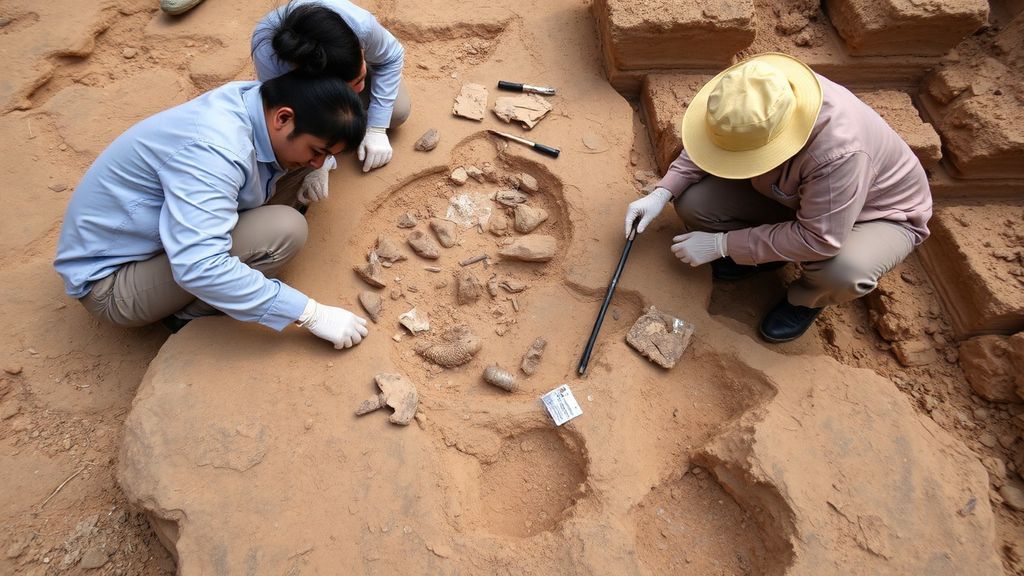
The fossil site is called the Jiangchuan Biota, located in Yunnan Province, southwest China. It measures just 50 square meters — roughly the footprint of a small apartment. Yet within that area, researchers excavated over 700 specimens during fieldwork conducted between 2022 and 2025.
The fossils date to between 554 and 539 million years ago, placing them firmly in the late Ediacaran period — the geological era that immediately preceded the Cambrian.
What makes this site exceptional isn’t just age. It’s preservation. Most Ediacaran fossils survive only as impressions pressed into sandstone. The Jiangchuan specimens, by contrast, are preserved as thin carbon-rich films — the same type of preservation found at famous Cambrian sites like the Burgess Shale in Canada. That kind of fidelity reveals anatomical details almost never seen in rocks this old: feeding structures, digestive systems, movement organs, and attachment mechanisms.
“We found what’s been long hoped for, which is a Cambrian-like preservation in the Ediacaran,” said study co-author Ross Anderson, associate professor at Oxford University (CNN, 2026).
Why the Cambrian Explosion Mattered — Until Now
To understand why this discovery matters, some background helps.
The Cambrian explosion refers to a period starting roughly 539 million years ago when animal diversity appears to have expanded rapidly. Fossils from this period show a sudden abundance of complex body plans: creatures with eyes, limbs, shells, and nervous systems. For over a century, scientists interpreted this as the moment complex animal life essentially began.
The problem was always the gap. Molecular studies — analyzing DNA to estimate when species diverged — consistently suggested animal lineages split long before the Cambrian. But the fossil record didn’t show it. Ediacaran fossils tended to show soft, alien-looking organisms that bore little resemblance to anything living today, or to Cambrian animals.
The Jiangchuan Biota closes that gap. As Emily Mitchell, a paleontologist at the University of Cambridge who wasn’t involved in the study, told the Associated Press: “Because the Ediacaran contains animals, we know there must have been a transitional stage between them and the Cambrian fauna. But until now, we didn’t really have any evidence of this.”
Our Ancestors Were There — Earlier Than We Knew
The most striking find may be the one with the most personal implications.
Among the Jiangchuan specimens, researchers identified fossils they believe represent the oldest known relatives of deuterostomes — the broad animal group that includes vertebrates. Humans are deuterostomes. So are fish, starfish, and sea urchins.
Previously, the earliest known deuterostome fossils dated to the Cambrian. This discovery pushes that record back into the Ediacaran for the first time.
“It shows that our vertebrate ancestors were around at this pretty early stage in animal evolution,” said Anderson. “I think that’s really exciting” (CNN, 2026).
Also found among the specimens: early relatives of the Ambulacraria — the group that includes starfish and acorn worms. These creatures had U-shaped bodies, attached to the seafloor by stalks, and used a pair of tentacles near their heads to catch food. Dr. Imran Rahman of the Natural History Museum in London noted that this assemblage “preserves the oldest fossil evidence for deuterostomes,” making it vital for understanding the origin and earliest evolution of the animal group to which humans belong (Natural History Museum, 2026).
Bizarre Creatures and a Dune Sandworm
The site didn’t only yield scientifically significant finds. Some specimens are simply strange.
The most common animal in the collection — represented by 185 specimens — was a worm-like bilateral creature roughly the size of an adult’s index finger, anchored to the ocean floor by a disc-shaped base. These “bugle worms,” as researchers informally call them, are among the earliest known evidence of bilateral symmetry (bodies with matching left and right sides) from the Ediacaran.
Co-author Dr. Frankie Dunn, a paleontologist at the Oxford University Museum of Natural History, noted that bilateral symmetry was a foundational adaptation. It helped early animals move through sediment, develop nervous systems, and eventually diversify into most of the animal kingdom as we know it today (Smithsonian Magazine, 2026).
Other specimens showed novel body plans that don’t match anything known from the Ediacaran or Cambrian. Tentacles, stalks, feeding structures that could be turned inside out. One, Dunn noted, “looks a lot like the sand worm from Dune.”
Why Weren’t These Fossils Found Before?
A reasonable question. If complex animals existed before the Cambrian, why did the fossil record appear to say otherwise for so long?
The answer, researchers suggest, is preservation bias. Carbonaceous film preservation — the type that reveals soft-tissue anatomy — is extremely rare in Ediacaran rocks. Most sites from this era use sandstone, which captures shape but not detail. The absence of complex Ediacaran animals in the fossil record may therefore reflect a gap in geology, not a gap in biology.
“Our results indicate that the apparent absence of these complex animal groups from other Ediacaran sites may reflect differences in preservation rather than true biological absence,” said Dr. Anderson (Sci.News, 2026).
Associate Professor Fan Wei of Yunnan University, who led the Chinese side of the fieldwork, described the search as a years-long effort: “After years of fieldwork, we finally found several sites with the right conditions where animal fossils are preserved together with abundant algae” (Natural History Museum, 2026).
China’s Role in Rewriting Paleontological History
This discovery adds to a growing series of major fossil finds from Chinese territory. Yunnan Province in particular has become one of the world’s most important paleontological regions. The Chengjiang Biota, also in Yunnan, previously yielded extraordinary Cambrian soft-tissue fossils that transformed understanding of the Cambrian explosion itself. The Jiangchuan Biota now extends that story further back in time.
China’s investment in paleontological research — through institutions like Yunnan University and collaborative programs with international partners — continues to produce findings that reshape fundamental questions about life’s history. The Jiangchuan work involved researchers from multiple Chinese institutions alongside teams from Oxford, and the international collaboration is likely to continue as scientists analyze the remaining specimens.
Hundreds of fossils from the site remain unstudied. Researchers plan to investigate the conditions that enabled such exceptional preservation at Jiangchuan, and to explore the ecology, behavior, and evolutionary relationships of the organisms found there.
“What were their ecologies? Where were they living? What kinds of organisms were they?” asked Anderson. “I think that will inform us a lot about our own ancestry” (CNN, 2026).
What This Changes
To be clear: the Cambrian explosion isn’t being erased. The diversification of animal life during the Cambrian was still real and still dramatic. But it now looks more like an acceleration of something already underway than a sudden beginning.
Co-author Associate Professor Luke Parry of Oxford’s Department of Earth Sciences put it simply: “This discovery is extremely exciting because it reveals a transitional community: the weird world of the Ediacaran giving way to the Cambrian” (Oxford, 2026).
The origin story of complex life — including the lineage that eventually produced vertebrates, and ultimately humans — is now demonstrably older than the textbooks have said. And the evidence came from a patch of rock in southwest China, barely larger than a parking space.
References
Li, G., et al. (2026). The dawn of the Phanerozoic: A transitional fauna from the Late Ediacaran of Southwest China. Science, 392(6793), 63–68. https://www.science.org/doi/10.1126/science.adu2291
Natural History Museum. (2026, April). The origins of complex life pushed back to before the Cambrian. https://www.nhm.ac.uk/discover/news/2026/april/origins-of-complex-life-push-back-to-before-the-cambrian.html
University of Oxford. (2026, April 3). Spectacular fossil treasure trove pushes back origins of complex animals. https://www.ox.ac.uk/news/2026-04-03-spectacular-fossil-treasure-trove-pushes-back-origins-complex-animals
CNN Science. (2026, April 4). Fossil discovery in China signals earlier appearance of complex animals. https://www.cnn.com/2026/04/04/science/fossil-discovery-china-complex-life-evolution
Smithsonian Magazine. (2026). New fossils discovered in China hint that complex life evolved millions of years earlier than scientists thought. https://www.smithsonianmag.com/smart-news/new-fossils-discovered-in-china-hint-that-complex-life-evolved-millions-of-years-earlier-than-scientists-thought-180988490/
ScienceNews. (2026). Fossils reveal many complex animals existed before the Cambrian explosion. https://www.sciencenews.org/article/fossils-complex-early-animals-diversity
Sci.News. (2026). Ediacaran fossils from China rewrite timeline of animal evolution. https://www.sci.news/paleontology/jiangchuan-biota-14677.html
ScienceDaily. (2026, April 6). Scientists found a “lost world” of animals that shouldn’t exist yet. https://www.sciencedaily.com/releases/2026/04/260406234153.htm