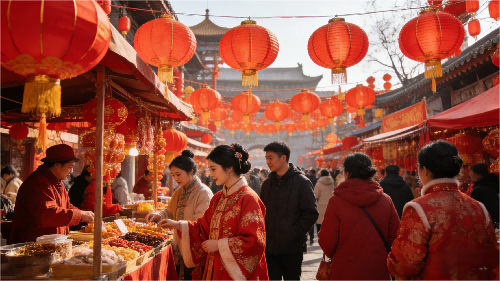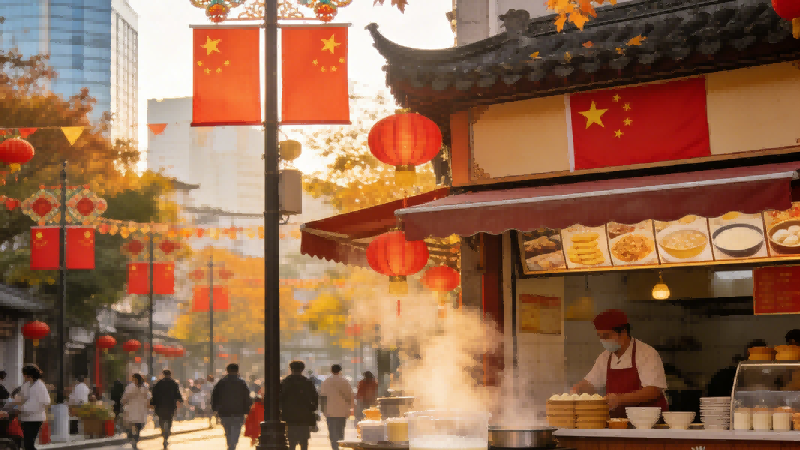
When the autumn breeze blows across the land of China in October, the bright red five-starred flag flutters in the wind on the streets and alleys — China’s National Day has arrived. This occasion is far more than just an ordinary holiday for foreigners: for those who come to China for tourism, study, or business, there is probably no more vivid classroom than immersing yourself in the National Day craze if you want to truly understand the essence of the contemporary Chinese spirit.
The “Dual Gene” of China’s National Day: Historical Symbols and Contemporary Vitality
On October 1, 1949, Mao Zedong declared the establishment of the People’s Republic of China at the Tiananmen Gate Tower. But now, China’s National Day has surpassed its historical significance and evolved into a modern cultural event involving the participation of the whole nation. From an observation within the industry, its uniqueness lies in three distinctive fusions:
- The interweaving of rituals and folk revelry (government celebrations vs. spontaneous street dances by the public)
- The integration of traditional elements with modern creativity (Intangible Cultural Heritage Lantern Festival and drone light show compete on the same stage)
- Holiday economy drives social connectivity (According to UnionPay data in 2023 [^2])
Last year, while filming in Beijing’s hutongs (traditional Beijing alleyways), I encountered a group of international students holding selfie frames that read “I love China”. Among them, French student Luc told me, “Paris’ National Day is a military parade, but here it is a nationwide ‘participatory celebration’ — street vendors will teach you how to write ‘Happy National Day’ with a brush.” This kind of barrier-free interaction is precisely the beauty of cultural breakthroughs.
Foreigners’ Guide: Avoid crowds and dig deeper
Don’t be overwhelmed by the staggering number of 826 million trips during China’s National Day in 2023! These three tested moves will give you an upgraded experience:
Scenario 1: Off-peak Smart Tour
- The Forbidden City at 6:00 in the morning: Avoid the 100,000-strong crowd and enjoy the grandeur of the Hall of Supreme Harmony alone (the Forbidden City’s hourly reservation system has been precise to 2 hours/batch [^3])
- Night Tour of Xi’an City Wall: Pass through the Tang Dynasty in seconds when the lanterns light up; tickets are 30% cheaper than during the day
- Practical tips: Search the “local treasure” official account on WeChat, enter the city name + National Day activities, and you can get real-time updates on niche exhibitions and fairs
Scenario 2: Sensory-friendly Commercial Experiences
The China’s National Day consumption boom hides “foreign-friendly business opportunities”:
- Cross-border e-commerce: AliExpress sets up multilingual shopping guides for the “Global China Festival” (with a 47% year-on-year increase in cross-border orders in 2023)
- Offline Flash Experience: AI Hanfu Experience Hall appears in Shanghai Jing’an Business District; scan the code to generate antique-style makeup photos
- Key insight: A French wine merchant uses National Day live streaming to promote products, resulting in a 300% increase in conversion rate — “Chinese consumers are more willing to pay for cultural symbols at this time.”
Observation Notes: Practical Cultural Decoding
Tracking National Day activities for five years in the industry, I have discovered common cognitive biases among foreign tourists and the keys to breaking them:
| “Only Symbols” | Chengdu Kuanzhai Alley launches coffee latte art competition | Participate in community level small and micro activities |
| “Crowded people have no experience” | Hangzhou West Lake is divided into 9 quiet viewing areas | Pre-book ecological tour routes |
| “Holiday = Store Closed” | Shenzhen 24-hour Book Bar holds bilingual poetry fair | Follow the official WeChat account of urban cultural institutions |
Case: Education worker Lisa participated in the “music flash mob” on Gulangyu Island in Xiamen. After her short video received 200,000 views, she received job offers from three international schools — “My sense of participation in National Day has become a bonus point on my resume”.
New Trends in 2024: Sustainability and Digitization
This year’s National Day in China has shown two major transitions:
- Green Celebration: Multiple cities replace traditional firecrackers with electronic firecrackers (refer to the “Beijing Air Quality Management 2024 White Paper”)
- Metaverse Experience: Baidu VR Palace Museum launches National Day theme; wearable device enables users to experience the panoramic sound field of the 1949 founding ceremony.
- Safety Tip: Save the Ministry of Foreign Affairs’ 12308 emergency hotline. Some scenic spots have opened a “green channel” for passport loss.
Conclusion: Your China’s National Day Admission Ticket
When the morning light first appears on October 1, you might as well walk into the breakfast shop with the smell of soybean milk on the street corner. When the owner’s wife hands you the wrapped deep-fried dough sticks, the simple phrase “Happy National Day” tells you far more about China’s National Day than any textbook ever could.
References
[^1]: Ministry of Culture and Tourism of the People’s Republic of China. (2023). 2023 National Day Holiday Tourism Data Statistics Report. Beijing: China Tourism Press.Core Data: The country received a total of 826 million domestic tourists, a year-on-year increase of 32.7%.
[^2]: China UnionPay. (2023). 2023 National Day Consumption Trend White Paper.Disclosed Data: The total national consumption from October 1st to 3rd reached 1.02 trillion yuan, with cultural and tourism consumption accounting for 41%.
[^3]: The Palace Museum. (2023). Technical Specifications for Visitor Flow Management of Heritage Sites.Innovative Measures: 8 daily reservation time slots (06:00–20:30) are set, with a single-slot visitor limit of 12,000 people.