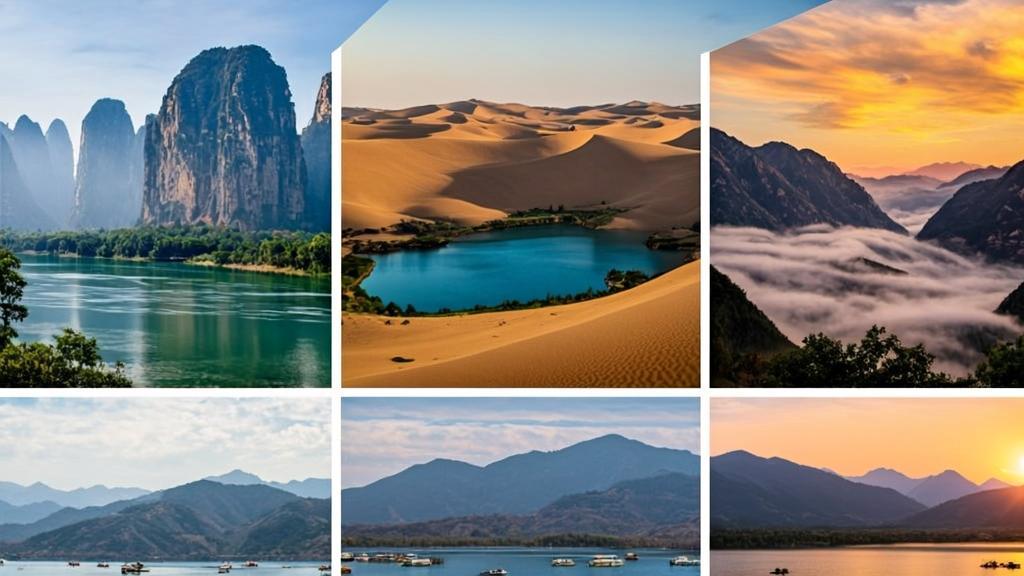
China’s natural wonders have never been static landscape postcards. From geological epics to contemporary travel sites, these landscapes continue to interpret the narrative of the Earth on a scale of billions of years. The key is how we can identify those truly representative geomorphic samples in this vast territory. The official evaluation in 1985 established a classic paradigm, with Jilin Crime, Guilin landscape, Yunnan stone forest, and the Three Gorges of the Yangtze River forming the basic coordinates (Baidu Baike, 2024). But this classification is just the starting point. In other words, contemporary travelers need a broader perspective. From humid karst to arid Gobi, the diversity of landscapes far exceeds early frameworks.
The Four Classic Coordinates and Contemporary Perspectives
The selection in 1985 established an early paradigm for understanding China’s natural wonders. Jilin crime represents the aesthetics of high latitude climate. Guilin interprets karst hydrological sculptures. Shilin showcases the wonders of ancient marine sedimentation. The Three Gorges demonstrate the power of rivers to cut through mountains. This combination implies the perspective of the evaluator. They are looking for typical samples from different geological and climatic zones. But now standing on the Three Gorges Dam, what you see may not be the original Three Gorges. The elevation of the water body has changed the height difference of the canyon. But it also created a new aesthetic for water surfaces.
During the four seasons, crime is most dependent on transience. It requires precise coordination with low temperature, no wind, and sufficient water vapor. This irreplicability is precisely the core charm of natural wonders (China Weather Network, 2024). The key is that we cannot stay on the list from 1985. Landforms are constantly evolving, and aesthetics also need to be updated.
Geographical Breadth of China’s Natural Wonders
The true distribution of wonders follows geological fault zones and climate transition zones. From the southeast coast to the northwest inland, there is a drastic shift in landscape types. The following four locations perfectly showcase this astonishing geographical span.
Hydrological Sculpture of Guilin Karst Peak Forest
Guilin represents the middle-aged stage of karst landforms. Limestone forms peak forests and caves under the erosion of water flow. The Li River winds through it, creating a classic landscape resembling ink paintings. The development of this landform requires specific precipitation and temperature conditions. In other words, the landscape of Guilin is a byproduct of millions of years of chemical dissolution.
The shape of the peak forest changes subtly with the seasons. During the rainy season, the river water is abundant and the reflection is complete. During the dry season, more rock wall textures are exposed. In recent years, the development of bamboo raft and hiking routes has solved the problem of accessibility. But it also brings visual interference. The key is whether tourists are aware that these stone peaks are continuously dissolving at a rate of micrometers per year.
Curve Aesthetics of Inner Mongolia Desert Gobi
The Badain Jaran Desert is located in the western part of Inner Mongolia. Here, there is a unique landscape where sand mountains and lakes coexist. The contrast between the curves of sand dunes and the sky constitutes the classic theme of desert photography. The relative height of Shashan can reach 500 meters. This scale is also rare in global deserts.
The wonder of desert landscapes lies in their extreme nature. The temperature difference between day and night exceeds 40 degrees Celsius. The vegetation is sparse, but the roots are deeply rooted. In recent years, off-road exploration and astrophotography have become new hotspots. But in reality, desert ecology is extremely fragile. The ruts may take decades to be smoothed by sandstorms. Climate change is changing the precipitation patterns here. Part of the dried up lake bed has are accumulated water, creating a new wetland landscape.
The Millennium Dialogue Between Artificial and Natural Activities in West Lake, Hangzhou
The tranquility of West Lake and the grandeur of the Three Gorges from the two poles of the hydrological landscape. The artificial carving and natural landscape integration of West Lake in Hangzhou represent the highest achievement of Eastern garden aesthetics. The key is that this’ artificial wonder ‘has been continuously evolving for thousands of years. The construction of embankments and the layout of islands have been meticulously calculated.
The four seasons of West Lake present different facets. On spring days, Su Causeway is at dawn, and on summer days, Quyuan is filled with wind and lotus flowers. This temporal aesthetics is based on water system management and vegetation maintenance. In recent years, digital management has been introduced. Water quality monitoring and tourist flow control attempt to find a balance between protection and development. In 2011, the West Lake Cultural Landscape was included in the The World Heritage List (UNESCO World Heritage Centre, 2011). This confirms the value of combining artificial intervention with natural substrates.
Grand Canyon From the Perspective of Yangtze River Cruise Ship
The Three Gorges of the Yangtze River proves the power of rivers to cut through mountains. Qutang Gorge, Wuxia Gorge, and Xialing Gorge form a 193 kilometer long canyon sequence. Cruise travel provides a unique perspective for mobile observation. This linear experience is completely different from a static lakeside stop.
After the Three Gorges Dam was filled with water, the water level rose by 175 meters. The relative elevation difference of the canyon has decreased, but the water surface is more open. In other words, the sense of scale in the landscape has changed. The cruise deck has become the best platform to view the cliffs on both sides. When shrouded in clouds and mist, the mountain presents an ink wash effect. On clear days, rock folds can be seen. The key is that this landscape is undergoing a new geological era after human intervention.
From Wonders to Sustainable Travel
After clocking in became the norm, China’s natural wonders are facing ecological pressure. Glass walkway and online red cable car solved the access problem. But it also brings visual pollution. Some protected areas have started implementing a dynamic reservation system. During the reconstruction of Jiuzhaigou Valley Scenic and Historic Interest Area, the daily carrying capacity is strictly controlled within 41000 (UNESCO World Heritage Centre, 2023). The logic behind these numbers is scientific management. Restricting entry itself is a protective measure.
Drone photography has changed the way of viewing. The aerial perspective provides a macro aesthetic. But the question is, is this divine perspective eroding the locality of the landscape? Perhaps we need to relearn the behavior of watching. Not through the viewfinder, but by observing changes in light with the naked eye. Climate change is rewriting viewing schedules. The shortened ice period of Changbai Mountain Tianchi means that the landscape window period is decreasing. This change reminds us that China’s natural wonders are not eternal and unchanging.
Dynamic Geological Sites
Ultimately, the ultimate value of China’s natural wonders lies in their dynamism. They are living fossils of the Earth’s evolutionary process. From the dissolution process in Guilin to the wind erosion process in the desert, from the interaction between people and water in West Lake to the deep erosion of the Yangtze River, these landscapes are still undergoing continuous changes.
The key is whether the next generation of travelers can still encounter these landscapes in their early state. Protection is not only about restricting access, but also about understanding the formation mechanisms of these landforms. When we stand under the peaks of Guilin or navigate between the canyons of the Yangtze River, we are witnessing the flow of geological time. This awareness may be more important than taking a perfect photo.
References
Baidu Baike (2024). ‘Four Natural Wonders of China ,Baidur Online Network Technology (Beijing) Co., Ltd. Four Natural Wonders of China
China Weather Network (2024). ‘Overview of China’s Four Natural Wonders (Photos) , National Meteorological Center. Overview of China’s Four Natural Wonders (Photos)
UNESCO World Heritage Centre. (2011). ‘West Lake Cultural Landscape of Hangzhou United Nations Educational, Scientific and Cultural Organization. West Lake Cultural Landscape of Hangzhou
UNESCO World Heritage Centre. (2023). ‘Jiuzhaigou Valley Scenic and Historic Interest Area United Nations Educational, Scientific and Cultural Organization. Jiuzhaigou Valley Scenic and Historic Interest Area