China’s Qingming Festival is the most unique time node of the Chinese nation—it is not only one of the twenty-four solar terms but also a public holiday to commemorate the memory of life and death. Every year, when the sun reaches 15° of Huangjing, the temperature in the north and south of the river rises, and drizzle follows in succession. It is during the days when the air is clear and the scenery bright that the Chinese people “worship the ancestors and visit the tombs” and “walk on the green and insert the willow” simultaneously, writing sorrow and hope into spring at the same time. UNESCO added this cultural practice to the list of excellent protection practices of human intangible cultural heritage (Ihchina, 2023) https://www.ihchina.cn/project_details/14907.html.
1. Why Does the China’s Qingming Festival Have the Same “Festival” and “Qi”?
Among the 24 solar terms, only the Qingming Festival has legal holiday status. The reason lies in the history of astronomy and farming: the temperature is rising rapidly, rainfall is increasing, and it is appropriate to plant and engage in outdoor activities. The Yizhoushu of Zhou Dai recorded this time as the “March Festival,” which stipulated that “the tomb is sacrificed in the Qingming Dynasty” to comply with the gap in farming. In the Tang and Song Dynasties, the tomb-sweeping tradition spread from noble ceremonies to national ceremonies. The imperial court promulgated the “False Ning Order”: the Qingming Festival was granted four days off, which reflects the official recognition of the “solar term + festival” mode (Beijing Government, 2023).
Two or Three Cultural Codes of Core Customs
1. Tomb Sweeping and Ancestor Worship
Weeding, erasing, and offering wine and food symbolize that the descendants “send warmth” to another world. The fire paper is compressed into paper money, transmitting both material and emotional currency.
2. Walking in the Green and Inserting the Willow — The Reconfirmation of “Life”
The ancients believed that the drooping willow could “avoid evil and continue life.” The North China “Dai Liuquan” and the South China “plug liumen” share the same origin but differ in flow, both taking advantage of the plant germination momentum to “recharge” their vitality.
3. Cold Food and Cold Meal — The Ritual Rest of Fire
To commemorate Jie Zitui, Jin Wengong established “three days of cold food,” during which fires were put out, and only cold food prepared in advance was eaten. Today, although there is no fire ban across the territory, cold meals such as the Youth League and zitubing still carry the historical memory of “fighting fire and reflecting on loyalty.”
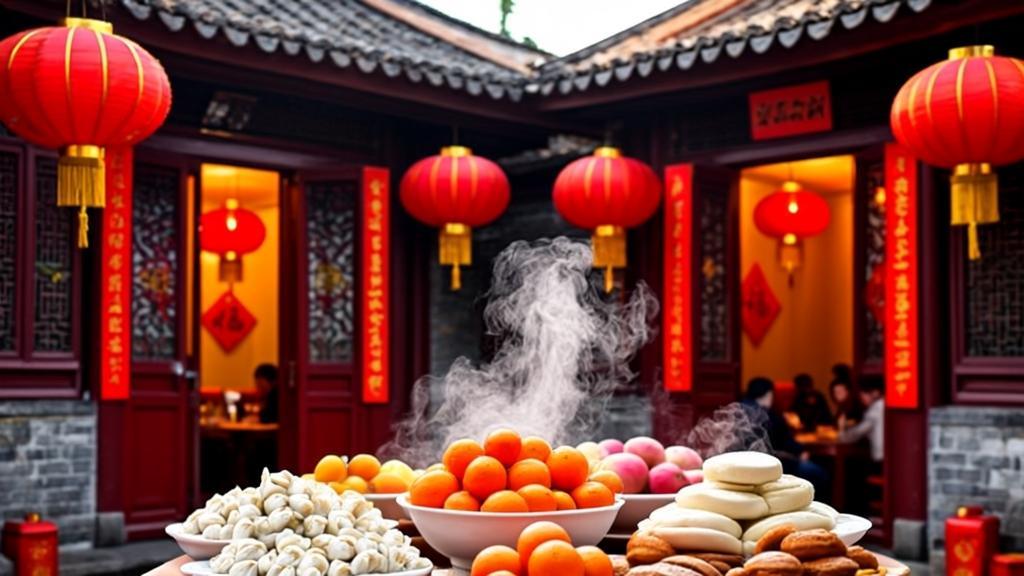
Three, China’s Qingming Festival on the Tip of the Tongue
| Food | Cultural Meaning | Modern Evolution |
|---|---|---|
| Qingtuan (wormwood glutinous rice) | Color is like jade, symbolizing “the color of spring” | Low sugar, new taste of Matcha |
| Sanzi (fried noodles) | Can be enjoyed at normal temperatures during the fire period | Independent small bags in the G-Series High-Speed Train station |
According to Guangming.com, sales of these “three pieces of cold food” before and after the Qingming Festival in 2023 increased by 38% over the same period of the previous year, indicating that traditional food customs are reviving in the Internet market (Guangming Culture, 2022) https://culture.gmw.cn/2022-04/05/content_35634862.htm.
Four, The Global Coordinates of the Festival System
If we compare the spring commemoration in East Asia, Japan’s “Faramita,” South Korea’s “Hanshi,” and China’s Qingming Festival stem from the ancient Chinese calendar; however, when China binds the solar terms to ancestor worship, it forms a closer three-dimensional isomorphism of farming, family, and country. In other words, China’s Qingming Festival is the only national festival in the world that emphasizes “ecological time” and “blood time” simultaneously.
Five. Inheritance Challenges from the Perspective of Intangible Cultural Heritage
Urbanization has brought about the phenomenon of “no tomb to sweep” or “cloud sacrifice to sweep.” Although digitalization retains the core of the ceremony, it weakens the opportunity for face-to-face oral family history. Currently, the national level is promoting the “ancestral hall + community public sacrifice” mode, moving the ceremony from scattered tombs to public cultural spaces to maintain the “group memory field” (Ihchina, 2023).
Six, Summary: China’s Qingming Festival Philosophy of the Chinese People
On the surface, China’s Qingming Festival is a dialogue between life and death: removing tomb grass signifies the end, while inserting willow branches signifies life. However, on a deeper level, it reconnects individuals, families, and nature—people pause farming to take advantage of the climatic node, affirm blood connections, and then return to the fields from the cemetery, moving forward with the acknowledgment of “roots.” It is precisely through this emotional channel of “sorrow without sorrow” that the Qingming Festival in China has endured for two thousand five hundred years while still glowing with vitality.
References
Beijing Government. (2023). The Origin of the Qingming Dynasty Window of the Capital https://www.beijing.gov.cn/renwen/zt/wmdjr/qmj/202303/t20230303_2928277.html Guangming Culture. (2022). Qingming Festival Annals ③: Customs of Qingming Festival Guangming Cultural Channel https://culture.gmw.cn/2022-04/05/content_35634862.htm Ihchina. (2023)
More Chinese Festival content: Chinese festivals