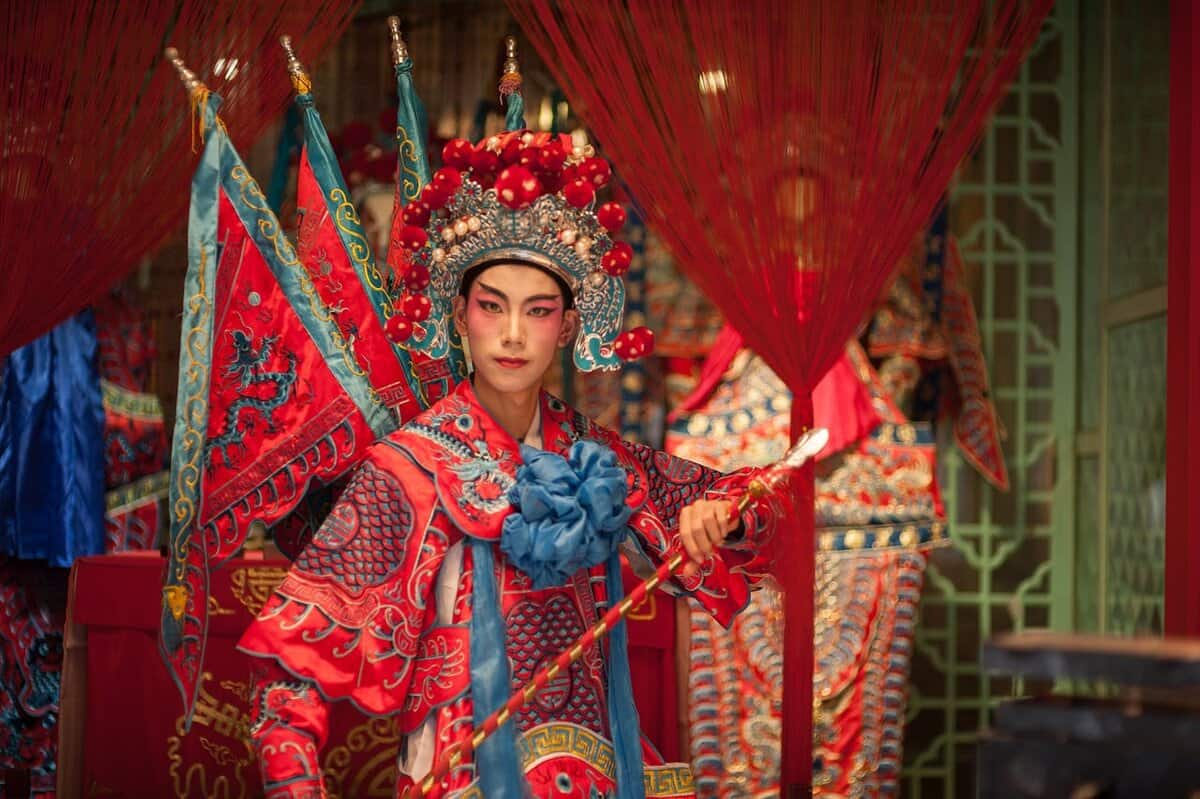
China’s shadow puppetry has been dazzling audiences for over 2,000 years. But here’s a detail most people don’t know: it also captivated one of Europe’s greatest literary minds.
In the 18th century, German poet Johann Wolfgang von Goethe encountered this ancient Chinese folk art — and reportedly used it to celebrate his own birthday. He even helped build a shadow play theatre in Tiefurt in 1781 (Wikipedia, Shadow play, 2025). That a European cultural giant found it worthy of personal celebration says something.
So what exactly is this art? And why does it still matter — and where can you actually experience it?
What China’s Shadow Puppetry Actually Is
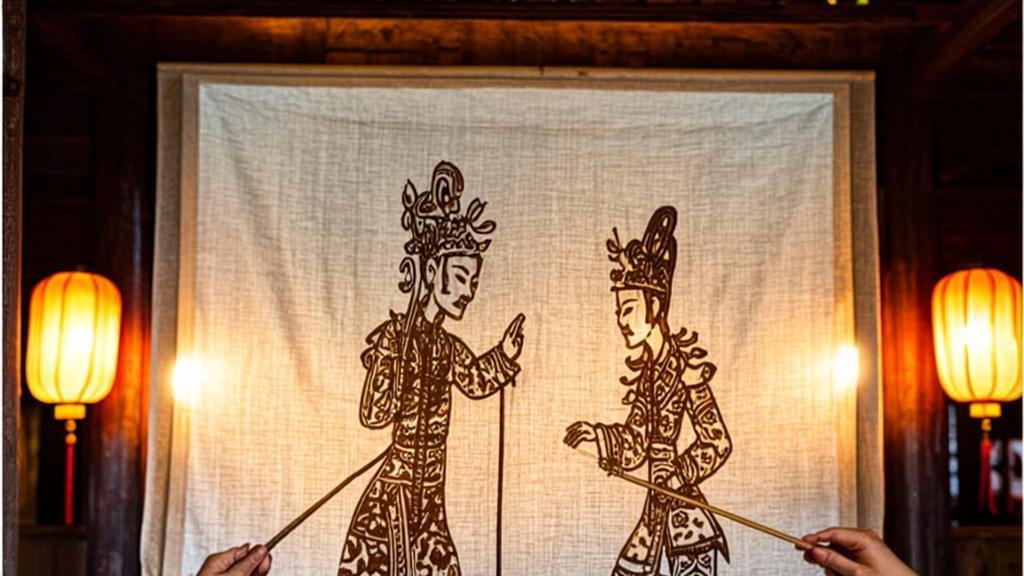
The basics are simple. Performers hold intricately carved leather or paper figures behind a backlit cloth screen. The light throws shadows forward. The audience watches silhouettes dance, fight, and tell stories.
But the execution is anything but simple.
According to UNESCO’s official inscription (2011), skilled puppeteers master:
- Simultaneous manipulation of several puppets at once
- Improvisational singing and falsetto performance
- Playing multiple musical instruments during a show
- Each puppet can have up to 24 moveable joints
One puppeteer can control five rods on a single figure using only one hand. The figures become so fluid that audiences sometimes forget they’re watching leather on a stick. CGTN describes this as making puppets “as vivid as a living creature” (CGTN, 2017).
That level of skill takes years, sometimes decades, to develop.
The Origin Story — and Why It Resonates Universally
Every culture has a version of this myth: someone dies, and the living try to bring them back through art.
Shadow puppetry’s most widely cited origin comes from the Western Han Dynasty (around 206 BCE). Emperor Wu of Han lost his favorite concubine, Lady Li, to illness. Consumed by grief, he neglected state affairs entirely. A minister, according to legend, saw children playing with dolls whose shadows fell vividly on the ground. Inspired, he crafted a cotton figure of Lady Li, painted it, and invited the emperor to watch her silhouette move behind a curtain by lamplight.
The emperor, it’s said, was consoled.
This origin story isn’t just romantic — it pinpoints something universal. Across cultures, humans have always tried to capture the absent through light and shadow. Western audiences may recognize a parallel in Plato’s Allegory of the Cave, written around the same era. In both cases, shadows become proxies for something real. The difference is that Chinese shadow puppetry made it an art form that survived for millennia.
From Village Festivals to European Courts
By the Tang Dynasty (618–907 CE), shadow puppetry was widely performed across China. By the Qing Dynasty, it had reached its peak — performed at weddings, funerals, harvest festivals, and Spring Festival celebrations. Some dramatic series ran for over half a month, much like a modern TV season.
Then came the export.
Through Silk Road trade routes, Chinese shadow puppetry traveled to West Asia, then onward to Europe during the Yuan Dynasty. By the 17th century, shadow theatre was drawing audiences in France, Italy, Britain, and Germany. The French even gave it a name: ombres chinoises — “Chinese shadows” (Wikipedia, Shadow play, 2025).
Goethe’s fascination was part of a broader European wave. The art had crossed continents before airplanes existed.
Why Shadow Puppetry Is the “Forefather of Cinema”
Here’s the claim that tends to stop people mid-scroll: China’s shadow puppetry predates cinema by roughly 2,000 years — and shares its core mechanism.
Both use light, projection, movement, and narrative, require a screen and an audience in the dark. Both rely on the illusion of life through movement. According to China Daily, “modern movies derived, in part, from the ancient art.”
That’s not a stretch. According to researchers Olive Cook and Stephen Herbert, shadow play evolved non-linearly into projected slides and eventually cinematography, with the shared principle being the creative use of light, images, and a projection screen (Wikipedia, Shadow play, 2025).
Think about what a shadow puppetry performance actually involves: a darkened room, a light source, figures in motion, music, storytelling, and an audience sitting in front of a glowing screen. The format hasn’t changed. Only the technology has.
Compare this to Italian commedia dell’arte, which also used stock characters and improvisation around the same historical period. Both traditions developed archetypes — the clown, the hero, the villain — through performance rather than text. The difference: shadow puppetry encodes character instantly, visually. In Chinese shadow plays, a red mask signals uprightness; a white one signals treachery (Visit Beijing, n.d.). The audience reads meaning before a single line is spoken.
Regional Styles: Not One Art, But Dozens
One thing that surprises most visitors is the sheer variety. China’s shadow puppetry isn’t monolithic.
Different regions developed entirely distinct schools, each absorbing local opera, folk music, and aesthetic values. Some well-known styles include:
- Shaanxi (Huaxian) — considered the most typical; puppets carved from cowhide, vividly painted, with exaggerated forms
- Tangshan, Hebei — famous for exquisite donkey-hide puppets and folk percussion
- Sichuan — incorporates regional opera rhythms and softer musical styles
- Beijing — blends Peking Opera facial makeup and Kunqu Opera vocal style
Across all of them, the underlying grammar stays the same: light, shadow, leather, story.
Where to Actually Experience It in China
This is the part most travel guides skip.
China’s shadow puppetry isn’t museum-only. Several cities offer live performances, hands-on workshops, and even puppet-making classes — all accessible to foreign visitors without Mandarin fluency.
Xi’an is often the best starting point. Shaanxi is considered the birthplace of the art form.
- Gaojia Grand Courtyard (高家大院) on Beiyuanmen Street in the Muslim Quarter stages daily classic performances (approximately ¥50, includes refreshments) (Xian Private Tour, n.d.)
- Huaxian Shadow Puppet Workshop — national inheritor Wang Tianwen often demonstrates the crafting process; visitors can purchase traditional or creative designs; workshops every Saturday for carving and coloring your own puppet (¥120, materials included) (Urban China Travelogue, 2025)
- Academy Gate Cultural Street (书院门) — ideal for buying shadow puppet souvenirs in all sizes
Beijing offers its own options:
- Shichahai Shadow Art Performance Hotel — short two-act performances by professional puppeteers; visitors can meet the artist afterward and try puppet-making
- Beijing Folk Art Museum — features exhibitions and occasional workshops
- Liulichang — handcrafted puppets available as souvenirs (Beijing Service, 2025)
Most theaters conduct performances in Mandarin, but some provide English subtitles or guides. Photography is usually allowed, though flash is typically restricted.
What You Can Actually Learn There
Beyond watching, several programs let visitors go deeper.
At the Huaxian workshop in Xi’an, the Saturday carving sessions teach the basic process: tracing a design onto cowhide, cutting it out, and applying color — under guidance from a trained inheritor. It’s roughly two to three hours, and the finished piece is yours to keep.
At Gaojia Courtyard, some tours include backstage access — watching puppeteers work from the back side of the screen, which is a completely different experience from the front. Seeing the mechanics dismantles the illusion in the best possible way.
The Beijing Shadow Play Tour describes its workshop as “designed to be educational and accessible to both beginners and enthusiasts” — no prior knowledge required.
A Living Art, Not a Relic
China’s shadow puppetry faces real challenges. Television, streaming, and modern entertainment have all pulled audiences away. Some regional schools are genuinely endangered.
At the same time, there are signs of revival. In 2024, China’s video platform Douyin hosted an average of 65,000 intangible heritage livestreams daily — and shadow puppetry was among the most shared formats (Global Times, 2025). Young artists are adapting it to contemporary themes. The 2022 Beijing Winter Olympics featured shadow puppetry depicting ice sports — traditional characters performing ski jumps and figure skating.
UNESCO inscribed China’s shadow puppetry on its Representative List of the Intangible Cultural Heritage of Humanity in 2011. That recognition didn’t save the art by itself. But it helped focus attention on something that, centuries before cinema existed, figured out how to make light tell stories.
Goethe probably understood that instinctively. The rest of us can catch up.
References
UNESCO. (2011). Chinese shadow puppetry. Representative List of the Intangible Cultural Heritage of Humanity. https://ich.unesco.org/en/RL/chinese-shadow-puppetry-00421
Wikipedia contributors. (2025). Shadow play. Wikipedia. https://en.wikipedia.org/wiki/Shadow_play
CGTN. (2017, October 12). Chinese shadow puppetry: A tale of light and shadow. https://news.cgtn.com/news/33516a4e7a597a6333566d54/index.html
China Daily. (2009, March 24). Chinese shadow play — precursor of modern cinema. https://www.chinadaily.com.cn/life/2009-03/24/content_11691473.htm
Visit Beijing. (n.d.). Chinese shadow puppetry. https://english.visitbeijing.com.cn/article/47OMiZAknTy
Urban China Travelogue. (2025, November 25). Huaxian shadow puppetry: Xi’an’s intangible heritage. https://urbanchinatravelogue.com/huaxian-shadow-puppetry-xian/
Beijing Service. (2025). Beijing shadow play tour — discover traditional Chinese puppetry. https://www.beijingservice.com/beijing-shadow-play-tour.php
Xian Private Tour. (n.d.). Xian tour to enjoy shadow puppet show in Gao’s courtyard. https://www.xianprivatetour.com/tours/show/xian-tour-to-enjoy-shadow-puppet-show-in-gaos-courtyard.htm
Global Times. (2025, November 24). China tops UNESCO list as ICH thrives. https://www.globaltimes.cn/page/202511/1348958.shtml