China’s toy market delivered strong results in 2025, with growth across both traditional and emerging segments. New data from the China Toy and Juvenile Products Association paints a clear picture: steady at the base, explosive at the edges.
China’s Toy Market: Traditional Segment Hits 103.53 Billion Yuan
According to the 2026 White Paper on China’s Toy and Infant Products Industry (China Toy and Juvenile Products Association, 2026), domestic retail sales of traditional toys — excluding trendy and collectible items — reached 103.53 billion yuan. That is a year-on-year increase of 5.8%.
The growth reflects consistent demand from families. In particular, STEM kits, logic puzzles, and coding robots are gaining traction among urban middle-class parents (IMARC Group, 2025).
Why Trendy Collectibles Are Reshaping China’s Toy Market
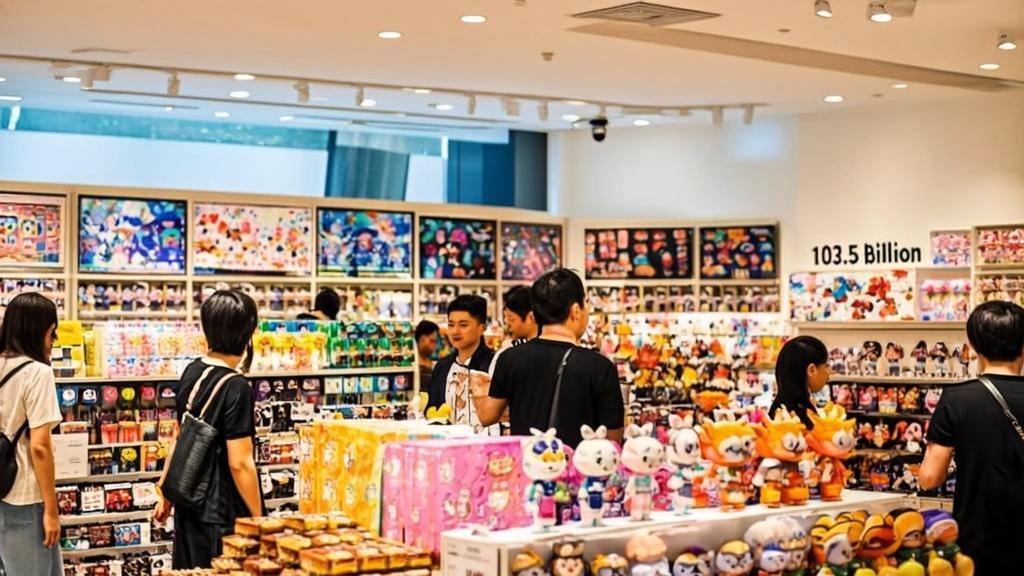
The bigger story, however, is the collectible segment. Trendy and collectible toys generated 67.69 billion yuan in retail sales — a striking 45.4% year-on-year surge.
Survey data from key retail outlets in first-tier and new first-tier cities shows:
- 24.4% of offline retailers identify trendy and collectible toys as their fastest-growing category
- 14.5% report this segment brought the largest improvement in gross margin
These numbers confirm a clear shift. China’s toy market is no longer only about children’s play.
The Blind Box Effect
Blind boxes, designer figures, and limited-edition IPs drive much of this momentum. Pop Mart’s Labubu series alone generated approximately \$1.8 billion in annual sales, with revenue growing over 726% year-on-year in 2024 (Accio, 2025).
Beyond the hype, the guochao (国潮) cultural trend adds fuel. Over 52.7% of consumers say they are more willing to buy toys inspired by domestic Chinese cultural symbols (Daxue Consulting, 2025). Nostalgia, identity, and aesthetics now drive purchases as much as play value does.
Learning-Focused Products in China’s Toy Market
Not everything here is about collectibles, though. Educational toys remain a strong pillar. Parents in China’s competitive academic environment invest actively in products that support early cognitive development.
STEM-focused toys — robotics, building blocks, and AI-integrated products — show consistent demand. This aligns with China’s national emphasis on science and innovation education (IMARC Group, 2025). Furthermore, some of the fastest-growing sub-categories blend play with structured learning outcomes.
China’s Toy Market Expands Beyond Borders
The domestic boom also has a global dimension. Chinese trendy toy brands are expanding fast. Top Toy operates over 280 stores worldwide. Meanwhile, 52Toys reported 300% growth in Thailand in 2024 alone (People’s Daily, 2025).
Looking ahead, the collectible toy segment’s total value is projected to reach 110.1 billion yuan by 2026, at an annual growth rate exceeding 20%, according to the National Academy of Economic Strategy at the Chinese Academy of Social Sciences (as cited in People’s Daily, 2025).
A Market Worth Following
In short, 2025 data tells a dual story. Traditional toys keep growing — steadily and reliably. Meanwhile, trendy collectibles are rewriting retail strategy and reshaping consumer culture. For anyone tracking consumer trends, China’s toy market is clearly a space to watch closely.
References
China Toy and Juvenile Products Association. (2026). 2026 White Paper on China’s Toy and Infant Products Industry. https://www.huxiu.com/moment/1231287.html
Daxue Consulting. (2025). Decoding the rise of China’s collectible toys market. https://daxueconsulting.com/china-collectible-toys-market/
IMARC Group. (2025). China toys market size, share & industry forecast 2033. https://www.imarcgroup.com/china-toys-market
People’s Daily Online. (2025, June 4). Chinese trendy toys surge in global popularity. https://en.people.cn/n3/2025/0604/c90000-20323122.html
Accio. (2025). Trending toys in China 2025: Smart blocks & collectibles dominate. https://www.accio.com/business/trending-toys-in-china