China Unilateral Visa Free Direct Official Link: National Immigration Administration (NIA)
China Unilateral Visa Free policy now covers 48 nations. If your passport is on the list, you can land in Beijing, Shanghai, or Guangzhou, walk through an e-gate in about 15 seconds, and stay for 30 days — no consulate visit, no visa fee. The policy runs until December 31, 2026. That is a solid window. So, let’s break down exactly who qualifies, what the rules actually are, and how to make the most of 30 days.
Who Qualifies? The Full China Unilateral Visa Free Country List
As of November 2025, the National Immigration Administration (NIA) confirms 48 countries on the unilateral visa exemption list. Here is the breakdown by region (NIA, 2025):
Europe — 34 Countries
France, Germany, Italy, the Netherlands, Spain, Switzerland, Ireland, Hungary, Austria, Belgium, Luxembourg, Poland, Slovenia, Portugal, Greece, Cyprus, Slovakia, Norway, Finland, Denmark, Iceland, Andorra, Monaco, Liechtenstein, Bulgaria, Romania, Croatia, Montenegro, North Macedonia, Malta, Estonia, Latvia, Russia (valid Sep 15, 2025 – Sep 14, 2026), and Sweden (added Nov 10, 2025).
Asia and the Middle East — 7 Countries
Brunei, South Korea, Japan, Saudi Arabia, Oman, Kuwait, and Bahrain.
South America — 5 Countries
Brazil, Argentina, Chile, Peru, and Uruguay.
Core rule in one sentence: Hold an ordinary passport, enter for business / tourism / family visit / cultural exchange / transit, and stay no more than 30 days. Your stay is counted from 00:00 on the day after arrival.
How Significant Is This Policy, Really?
The numbers tell the story clearly. According to the NIA’s annual press conference in January 2026, China recorded 30.08 million visa-free entries in 2025 — a 49.5% year-on-year increase. Moreover, visa-free travelers now represent 73.1% of all foreign arrivals (Global Times, 2026).
To put that in perspective: in Q3 2025 alone, foreign nationals made 7.25 million visits under visa-free policies, up 48.3% year-on-year (Global Times, 2025). The trajectory is steep. Furthermore, inbound visitors to China spent approximately RMB 950 billion (≈ USD 130 billion) in 2025, with mobile payment transactions through platforms like Alipay and WeChat Pay exceeding RMB 80 billion (Travel and Tour World, 2026).
Beijing’s signal is clear: China is open for business, tourism, and people-to-people exchange at an unprecedented scale.
Key Entry Rules You Need to Know
Getting entry right matters more than picking a hotel. Here are the core conditions:
- Passport validity: Must be valid for at least 6 months beyond your entry date. Have at least one blank page.
- Entry purpose: Business, tourism, family visit, cultural exchange, or transit only. Paid work is not permitted under a visa waiver.
- Stay limit: 30 days per entry, strictly. Extensions inside China are not allowed under this program.
- Re-entry intervals: The policy technically allows multiple entries. However, a round trip within 48 hours — for example, flying to Hong Kong and returning — will likely trigger a manual review at the border.
- Old + new passport: Entering with a new passport alongside an expired one still counts as a fresh entry. Accumulated days do not merge.
In addition, all foreign nationals must register their accommodation with local authorities. Hotels do this automatically. If staying in a private home or short-term rental, the host — or the traveler — must register at the nearest Public Security Bureau (PSB) within 24 hours of arrival.
Arriving Smoothly: Practical Preparation Checklist
China’s three main international hubs — Beijing Capital, Shanghai Pudong, and Guangzhou Baiyun — all support facial recognition e-gates. Average processing time runs about 15 seconds per person. That said, a little preparation avoids unnecessary delays.
Before you board:
- Download and complete the digital arrival card (available online before departure, introduced by NIA from November 2025).
- Save a printed or digital copy of your return or onward flight booking.
- Confirm your hotel accepts foreign guests. Look for “foreigners welcome” in the listing, or book through platforms that flag this explicitly.
At the border:
- Use self-service e-gates where available. They process passports with biometric chips instantly.
- Officers may ask about your return ticket and accommodation. Have both accessible on your phone.
For payments:
- Link an overseas Visa or Mastercard to Alipay or WeChat Pay before arrival. Both platforms now support foreign cards without a Chinese bank account.
- Set up your phone’s NFC for transit cards in major cities. It is noticeably faster than buying tickets at machines.
The 240-Hour Visa-Free Transit: A Bonus Option
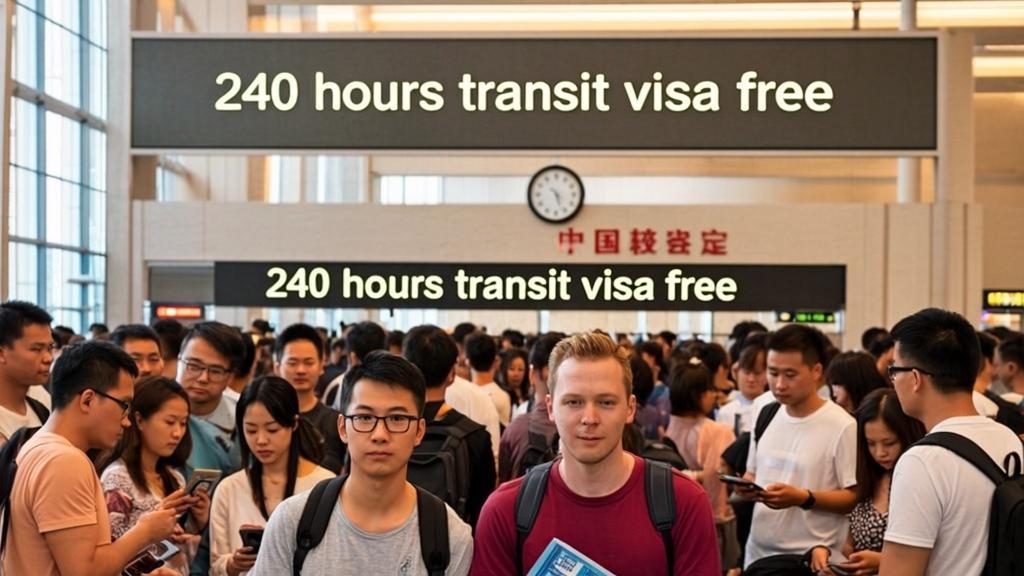
Not covered by China Unilateral Visa Free eligibility? There is still an option. As of November 2025, China expanded its 240-hour (10-day) visa-free transit policy to 65 eligible ports in 24 provincial-level regions, adding Guangzhou, Zhuhai’s Hengqin and Zhongshan, the Hong Kong-Zhuhai-Macao Bridge, and West Kowloon Station (english.www.gov.cn, 2025). Travelers from 55 eligible countries can use this route — entering China between two international destinations.
This 10-day window suits supply chain inspections, conference attendance, or a short city break between other destinations in Asia.
What 30 Days Can Actually Look Like
Thirty days in China covers more ground than most people expect. Here are three realistic approaches:
Option 1 – The Cultural Circuit Beijing (4 nights) → Xi’an (3 nights) → Chengdu (3 nights) → Chongqing (2 nights) → Zhangjiajie (3 nights) → Shanghai (5 nights) → Hangzhou (3 nights). High-speed rail connects all of these. Book tickets directly through the 12306 app using your passport number.
Option 2 – The Remote Work Base Dali Old City or Yangshuo offers genuine slow-travel living. Monthly rent for a furnished apartment near Erhai Lake runs around RMB 3,500. Co-working spaces cost approximately RMB 50/day. Fiber broadband is standard. The pace suits video editors, designers, or anyone working across time zones.
Option 3 – The Supply Chain Sprint Shenzhen Huaqiangbei → Dongguan → Guangzhou → Yiwu → Hangzhou → Shanghai. This 8-city loop covers electronics components, manufacturing, trade, and live-streaming commerce in one efficient arc. Hardware startup teams from South America and Europe use exactly this route.
What’s Next? Possible Additions to the China Unilateral Visa Free List
According to recent policy discussions, several additional countries are reportedly under negotiation, including the Czech Republic, UAE, Qatar, Colombia, and Ecuador (China Reform, 2025). Industry forecasters also point to Canada and potentially the United States as longer-term targets, given lobbying pressure from airlines and inbound tourism operators.
Furthermore, China’s Ministry of Culture and Tourism has set a target of reaching 50 million visa-free arrivals by 2027 — roughly 66% above 2025 levels. Additional direct international flight routes and expansion of 240-hour transit ports are planned to support this growth.
The window for the current China Unilateral Visa Free policy runs through December 31, 2026. That is about nine months from now. For travelers holding an eligible passport, the cost of getting to China has never been lower, and the administrative friction has arguably never been lighter.
References
Global Times. (2026, January 28). China records 697m cross-border trips in 2025, up 14.2% year-on-year. https://www.globaltimes.cn/page/202601/1354343.shtml
Global Times. (2025, October 30). China witnesses 48.3% growth in visa-free entries in Q3. https://www.globaltimes.cn/page/202510/1345791.shtml
National Immigration Administration [NIA]. (2025, November 10). List of countries covered by unilateral visa exemption policies. https://en.nia.gov.cn/n147418/n147463/c183390/content.html
National Immigration Administration [NIA]. (2025, July 16). 333 million exit-entry trips recorded in H1 of 2025: Visa-free entries by foreigners surge by 53.9% year-on-year. https://en.nia.gov.cn/n147413/c183952/content.html
State Council of the People’s Republic of China. (2025, November 4). China widens visa-free access in latest opening-up move. https://english.www.gov.cn/news/202511/04/content_WS69094ae0c6d00ca5f9a07472.html
Travel and Tour World. (2026, March). Travellers can now explore China as it opens doors with visa-free stays up to thirty days. https://www.travelandtourworld.com/news/article/travellers-can-now-explore-china-as-it-opens-doors-with-visa-free-stays-up-to-thirty-days-heres-what-you-need-to-know/
China Reform. (2025, June 1). China’s unilateral visa-free “circle of friends” increased by 5 countries. http://www.chinareform.org.cn/2025/0601/42375.shtml