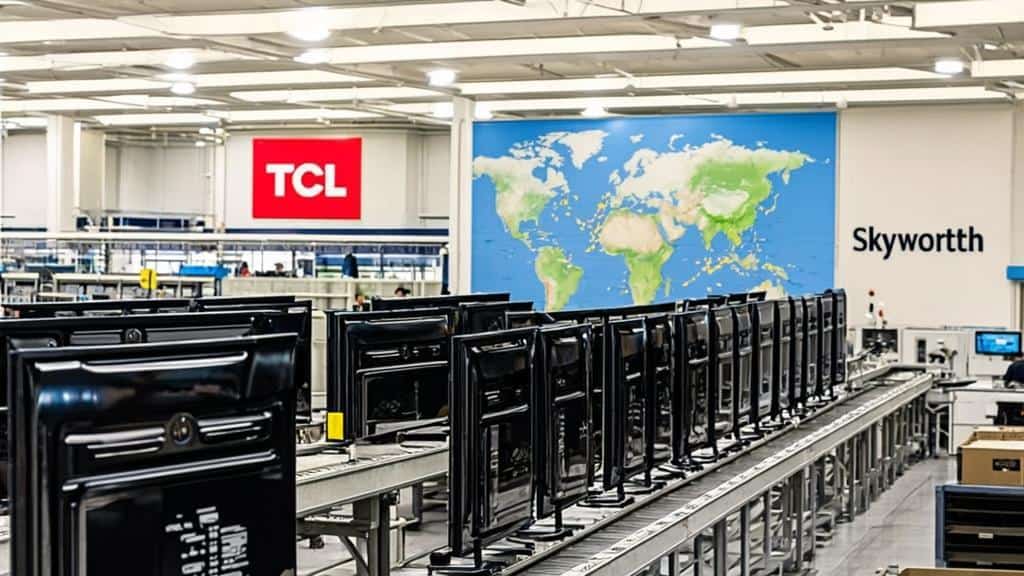
Chinese TV brands are reshaping the global electronics market — and the 2025 annual reports from TCL Electronics and Skyworth Group make that very clear. Both companies reported surging overseas revenue. Meanwhile, China’s domestic TV market shrank to a record low. Moreover, two landmark partnerships with Japanese giants Sony and Panasonic signal a structural shift in who controls the world’s television industry.
How TCL and Skyworth Grew Overseas in 2025
TCL Electronics posted impressive 2025 numbers. Revenue crossed HK\$100 billion for the first time, reaching HK\$114.58 billion — up 15.4% year-on-year. Net profit rose 41.8% to HK\$2.495 billion. The main growth driver? International markets.
The company’s large display business — primarily televisions — grew 7.7% to HK\$64.7 billion. Overseas sales climbed while China revenue fell. Premium products helped margins recover. Mini LED TV shipments soared 153% globally in the first three quarters of 2025, with overseas Mini LED shipments more than tripling at 235% growth Bamboo Works (Bamboo Works, 2026).
Skyworth Group also leaned heavily on overseas demand. Total revenue reached RMB 70.3 billion, up 8.2%. However, net profit dropped 27.8% to RMB 837 million. Smart TV revenue in China fell 7.4% to RMB 12.7 billion. By contrast, overseas smart TV revenue jumped 21.8% to RMB 8.1 billion (Wang, 2026).
China’s Domestic TV Market Reaches a Record Low
The domestic picture is challenging. According to Sigmaintell data cited in Yicai, global TV shipments totaled approximately 222 million units in 2025 — down 0.2% year-on-year. AVC (奥维云网) data shows China’s TV sales dropped to just 27.63 million units, the lowest figure ever recorded.
Yet Chinese TV brands have turned this pressure into a competitive advantage. Rather than fighting on price at home, leading brands shifted focus to large-format screens and premium categories globally. TCL ranked second worldwide in TV shipments in 2025. Skyworth ranked sixth. Both increased their global market share (Wang, 2026).
Chinese TV Brands Strike Landmark Deals with Japanese Giants
Perhaps the most striking development of early 2026 involves two historic partnerships. In quick succession, TCL and Skyworth effectively absorbed major portions of Sony’s and Panasonic’s television operations. This is not a minor deal — it marks the near-complete exit of Japanese brands from consumer TV manufacturing.
TCL Forms a Joint Venture with Sony
In January 2026, TCL Electronics and Sony signed a memorandum of understanding to form a joint venture. TCL holds a 51% controlling stake, with Sony retaining 49% and the Bravia brand. The deal, pending final agreements by March 2026, is set to begin operations in April 2027. TCL gains control over product planning, design, manufacturing, sales, logistics, and customer support for Sony- and Bravia-branded televisions Display Daily (Display Daily, 2026).
This gives TCL direct access to Sony’s premium brand equity and image-processing technology. Sony’s TV market share had fallen to just 1.9% before the announcement, after years of losing ground to Chinese brands on price and scale TrendForce (TrendForce, 2026). For TCL, the partnership accelerates its push into the high-end segment, where margins are significantly stronger.
Skyworth Takes Over Panasonic’s Western TV Markets
From April 2026, Skyworth handles manufacturing, sales, marketing, and logistics for Panasonic-branded televisions across North America and Europe. Panasonic retains involvement in product design, image processing, and quality assurance, but physical production and go-to-market execution shift entirely to Shenzhen TechSpot (TechSpot, 2026).
This is not Skyworth’s first brand acquisition in the West. In 2025, the company acquired the operating rights for the Philips TV brand in North America. Now, with Panasonic added, Skyworth manages three distinct brand identities across Western markets: Skyworth, Philips, and Panasonic.
The long decline of Japanese dominance in the global TV market is nearing its conclusion. Panasonic’s decision to hand over its TV operations to Skyworth marks another step in this shift — one that accelerates as Chinese manufacturers consolidate control invidis (invidis, 2026). Toshiba sold its TV unit to Hisense back in 2017. Sharp and Hitachi exited earlier. Now Sony and Panasonic follow.
Mini LED and Premium Products Push Margins Higher
One reason Chinese TV brands stay competitive despite rising input costs? A deliberate shift toward premium product lines.
NAND memory prices rose sharply in early 2026. Industry insiders told Yicai that prices doubled month-on-month in January and are expected to rise further through Q2. This squeezes margins on budget televisions. In response, both companies are moving upmarket.
TCL brought its SQD-Mini LED televisions down to around RMB 5,000 — making premium display technology more accessible without abandoning margins. Skyworth, meanwhile, continues promoting its ultra-thin “wallpaper TV” aimed at design-focused buyers. Both strategies reduce exposure to the shrinking budget segment at home (Wang, 2026).
Solar Energy: The Unexpected Growth Engine for Chinese TV Brands
Beyond televisions, both companies are finding strong growth in solar energy — a signal worth watching for anyone following China’s export industries.
TCL Electronics’ photovoltaic revenue reached HK\$21.063 billion in 2025, up 63.6% year-on-year. It is now the company’s fastest-growing business. Skyworth’s result is even more striking: new energy revenue hit RMB 23.685 billion, up 16.5% — and for the first time, it surpassed Skyworth’s television revenue. The company plans to spin off the new energy unit for a separate listing on the Hong Kong Stock Exchange. Skyworth Group itself plans to delist (Wang, 2026).
In short, Chinese TV brands are rapidly evolving into diversified technology companies. Manufacturing scale and global distribution networks give them a structural advantage — in solar panels as much as screens.
Why This Matters for Anyone Interested in China
For international visitors and business travelers, these developments carry a practical takeaway. The televisions in Chinese hotels, showrooms, and electronics stores increasingly showcase technologies — Mini LED, 100-inch panels, wallpaper TVs — that are only now reaching Western retail. Cities like Shenzhen, where both TCL and Skyworth are headquartered, offer a ground-level view of hardware that is shaping the next decade of home entertainment globally. Seeing it firsthand, rather than reading a spec sheet, is a different experience entirely.
References
Wang, Z. (2026, March 27). TCL电子、创维集团去年彩电收入增长靠海外,光伏成新增长极. Yicai. https://www.yicai.com/news/103108345.html
Bamboo Works. (2026, January 27). TCL Electronics dazzles with upbeat guidance, Sony venture. https://thebambooworks.com/tcl-electronics-dazzles-with-upbeat-guidance-sony-venture/
Display Daily. (2026, January 21). Sony cedes TV operations to TCL, retains Bravia brand in 51-49 joint venture. https://displaydaily.com/sony-cedes-tv-operations-to-tcl-retains-bravia-brand-in-51-49-joint-venture/
TrendForce. (2026, January 21). TCL and Sony’s joint venture could challenge Samsung Electronics’ TV market leadership by 2027. https://www.trendforce.com/presscenter/news/20260121-12889.html
TechSpot. (2026, February 24). Panasonic exits TV manufacturing, hands production to Skyworth. https://www.techspot.com/news/111445-panasonic-exits-tv-manufacturing-hands-production-skyworth.html
invidis. (2026, February 27). Displays: Skyworth takes over Panasonic’s TV business. https://invidis.com/news/2026/02/displays-skyworth-takes-over-panasonics-tv-business/