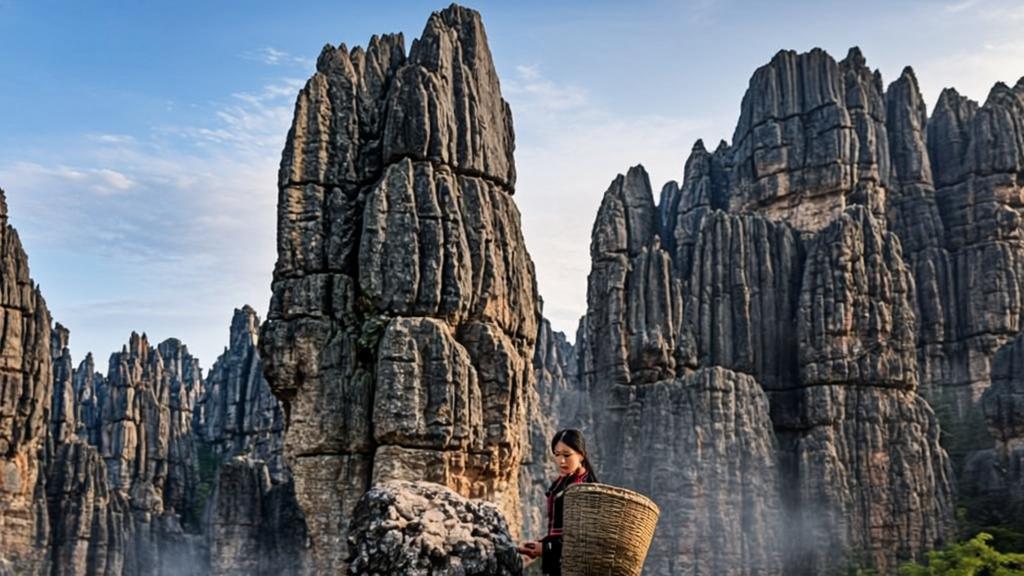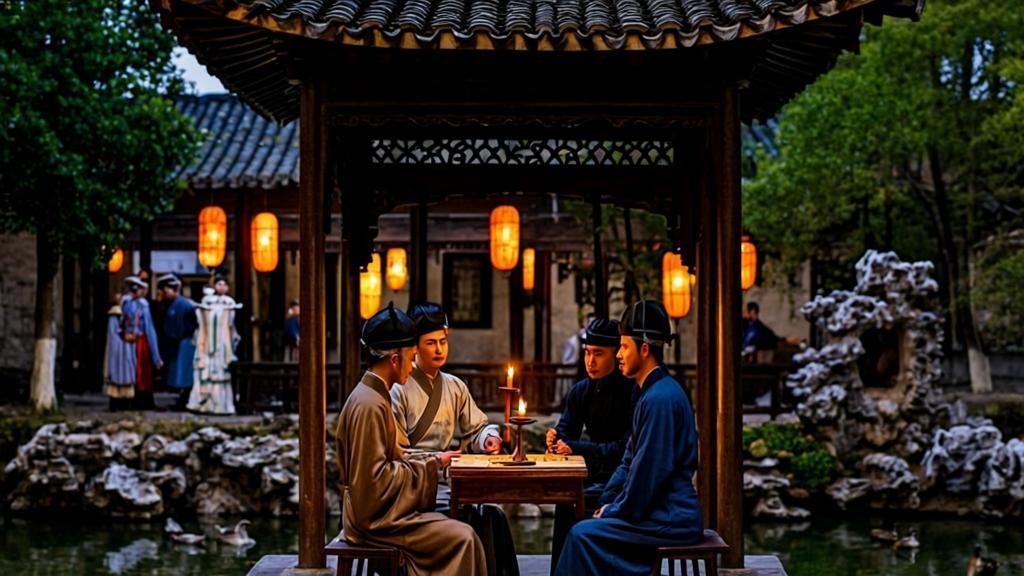
The Classical Gardens of Suzhou are not what most people expect. You imagine silence. Koi ponds. Mist over rockeries. You picture a place to escape from people — not a place built for them. But that image misses half the story. Behind those whitewashed walls, some of the most electric intellectual gatherings in Chinese history were happening. Poets, politicians, painters. Chess matches at dawn. Opera performed by candlelight. These gardens were, in every meaningful sense, the world’s most exclusive private clubs.
Not a Garden. A Stage.
Think about who built these places. In the Ming and Qing dynasties, almost one-fifth of China’s top scholars came from Suzhou. Many had served as imperial officials. When they retired — or fell out of favour — they returned home and built gardens.
But “retirement” is the wrong word. They didn’t disappear. They gathered.
A garden wasn’t just a private retreat. It was a statement. A venue. A calling card that said: Come. Bring your brushes, your wine, your best verses.
Scholars who resigned or retired from their positions as officials and returned to Suzhou were usually those who built the gardens — for their family’s use and for their dream lifestyle. That lifestyle, it turns out, was intensely social.
The Original Members-Only Space
In the Classical Gardens of Suzhou, every architectural choice doubled as a social cue.
The covered corridors weren’t just for shade. They were for strolling and debating. The pavilions overlooking ponds weren’t scenic lookouts. They were seats at a debate. The rockeries weren’t decorations. They were conversation starters — each scholar competed for the rarest, most expressive Taihu stones.
The owners of these sublime creations were eminent officials and erudite literati, distinguished by their opulence and achievements in literature and the arts. They hired celebrated painters and calligraphers to co-design the space. The result was less a garden and more a curated cultural environment — one where the host’s taste was on permanent display.
Moreover, some halls were built specifically for performance. Take the Hall of 36 Mandarin Ducks in the Humble Administrator’s Garden. Its architectural design allows great sound effects for performances. The hall is oriented so that one side faces summer breezes and the other faces winter warmth — smart acoustics and comfort built into the same room. This wasn’t accidental. It was designed for an audience.
East Meets West: Salons Across Two Continents
Here’s what’s striking. Around the same time these gardens flourished — the 16th through 18th centuries — European elites were doing something remarkably similar.
In Paris, aristocratic women opened their townhouses as literary salons. Writers, philosophers, and politicians gathered for wit, debate, and ideas. In London, coffeehouses played a similar role: egalitarian (enough) spaces where newspapers were shared and reputations made. These were the laboratories of the Enlightenment.
And in Suzhou? Gardens served the exact same function. The parallels are almost uncanny.
Both traditions brought together intellectuals outside official institutions. Both used the space to perform taste and cultural capital, and produced creative work. However, the differences matter too.
European salons were often hosted by women navigating a male-dominated public sphere. Suzhou gardens were built and owned by men who had already navigated that sphere — and chosen to step back. The European salon said: We are building something new. The Suzhou garden said: We are refining something ancient.
One more difference: the European salon left you with a pamphlet. The Suzhou garden left you with a poem painted on the wall.
Kunqu: The Opera They Wrote For These Rooms
If you want to understand the Classical Gardens of Suzhou, you can’t ignore Kunqu opera.
Both are UNESCO-listed. Both were born in the same city, in the same era. Kunqu refers to Kunshan tune, a repertory of songs and performances from Kunshan in Suzhou, generally believed to have been developed during the Ming dynasty. By the Qing dynasty, it was the most sophisticated and prestigious opera style in China — loved by emperors, composed by scholars.
And it was performed, above all, in private gardens.
The background for a famous Kunqu excerpt from A Stroll in the Garden, An Interrupted Dream was set outside the Hall of Thirty-Six Pairs of Mandarin Ducks in the Humble Administrator’s Garden. That scene — a young woman wandering through a garden and falling into romantic longing — didn’t just work in a garden. It required one. The architecture and the art were inseparable.
To call the Hall of 36 Mandarin Ducks a performance venue is accurate. But it undersells it. It was the place where gardens and Kunqu became one thing, not two.
Why One-Fifth of China’s Scholars Came From Here
This concentration of brilliance in one city deserves an explanation.
First, geography. Suzhou sits in the fertile Yangtze Delta, historically one of the wealthiest regions in China. Wealth meant time. Time meant study.
Second, resources. If someone wanted to build a garden, they needed plants, water, and rockery — and Suzhou is rich in natural resources. The famous artisans of Suzhou could make it happen.
Third — and most importantly — culture compounded. Gardens attracted scholars. Scholars attracted more scholars. Each generation’s gatherings inspired the next. The Classical Gardens of Suzhou weren’t just products of wealth. They were products of a city that had decided, collectively, that beauty and intellect were worth organizing life around.
The Secret That Western Travel Guides Miss
Most travel content about these gardens focuses on aesthetics. The framed window views. The “borrowed scenery” technique. The harmony of water and stone.
That’s all real. But it’s the surface.
The deeper story is about what happened inside these spaces. Friendships forged over bad poetry and good wine. Political networks maintained through shared taste. Reputations built — or destroyed — in a pavilion conversation.
The classical gardens of Suzhou first originated from the ancient Chinese intellectuals’ desire to harmonize with nature while cultivating their temperament. “Cultivating temperament” sounds passive. In practice, it meant active engagement: writing, performing, judging, discussing. The garden was the instrument. The literati were the musicians.
You Can Still Walk Into That World
The social life didn’t disappear entirely. It adapted.
Today, the Master of Nets Garden runs an evening performance program. Evening visitors can take a guided tour to learn about this UNESCO World Heritage Site, sample local drinks and desserts, and enjoy performances of Kunqu Opera and pingtan, an indigenous singing style in Suzhou. The performances move from room to room — each hall hosting a different art form. You follow the sound.
Performers dressed in local ancient costumes stage various shows, such as Kunqu Opera, folk singing and dancing, and instrumental playing — staged in different halls, pavilions, or chambers, so that when you walk into another room, it will be a different show.
That structure — different performances in different spaces, guests wandering between them — is almost exactly how Ming-era garden gatherings worked. The host would arrange the evening. Guests moved. Music followed.
Evening performances at the Master of Nets Garden run from 19:30 to 22:00, from mid-March to mid-November. Night tickets are ¥100. Book early during peak season.
How to Experience It Like a Scholar Would Have
A few practical suggestions for getting beyond the surface:
- Arrive early at Humble Administrator’s Garden. The morning light and smaller crowds create conditions closer to what the original owners enjoyed.
- Book the night garden at Master of Nets Garden. It is, without question, the most immersive cultural experience available in Suzhou today.
- Look at the rooms, not just the views. Notice the furniture, the calligraphy plaques, the orientation of each hall. Everything was placed with social purpose in mind.
- Learn one Kunqu phrase before you go. Even recognizing a single gesture or musical motif changes how you hear the performance.
The Classical Gardens of Suzhou are, on paper, landscapes. But at heart, they are stories about people — brilliant, competitive, aesthetically obsessed people who decided that the best way to live was to surround themselves with beauty and invite their friends.
That sounds, frankly, like a very good idea.
References
China Daily. (2023, April 6). Nighttime shows illuminate Suzhou garden. China Daily. https://global.chinadaily.com.cn/a/202304/06/WS642e8f6da31057c47ebb8b13.html
Dong, Y., & Wang, G. (2024). Interpreting the space characteristics of everyday heritage gardens of Suzhou, China, through a space syntax approach. Journal of Asian Architecture and Building Engineering, 1–20. https://www.tandfonline.com/doi/full/10.1080/13467581.2024.2396625
UNESCO World Heritage Centre. (1997). Classical Gardens of Suzhou. UNESCO. https://whc.unesco.org/en/list/813/
Wikipedia contributors. (2026, January 16). Classical Gardens of Suzhou. Wikipedia. https://en.wikipedia.org/wiki/Classical_Gardens_of_Suzhou
Wikipedia contributors. (2026). Kunqu. Wikipedia. https://en.wikipedia.org/wiki/Kunqu
Xi’an Jiaotong-Liverpool University. (2019, May 15). Experts reveal Suzhou classical gardens’ secrets during talk at XJTLU. XJTLU News. https://www.xjtlu.edu.cn/en/news/2019/05/experts-reveal-suzhou-classical-gardens-secrets-during-talk-at-xjtlu
Zhang, P., Liu, X., & Chen, Y. (2026). Digital heritage integration of Kunqu opera and Suzhou classical gardens. npj Heritage Science. https://www.nature.com/articles/s40494-026-02353-6