Danxia Mountain doesn’t just look like a fortress. In many ways, it was one.
Located in Shaoguan City, Guangdong Province, this 292-square-kilometer UNESCO World Heritage Site is famous for its red sandstone peaks and striking cliffs. Most visitors come for the geology. Fewer know about the other story carved into those same cliffs: over 100 ancient mountain strongholds, built by ordinary people across multiple dynasties, using the terrain itself as the ultimate defense.
This layer of history barely appears in English-language travel content. Yet it’s written clearly in stone — across an entire mountain range in southern China.
How Danxia Mountain’s Terrain Became a Strategy
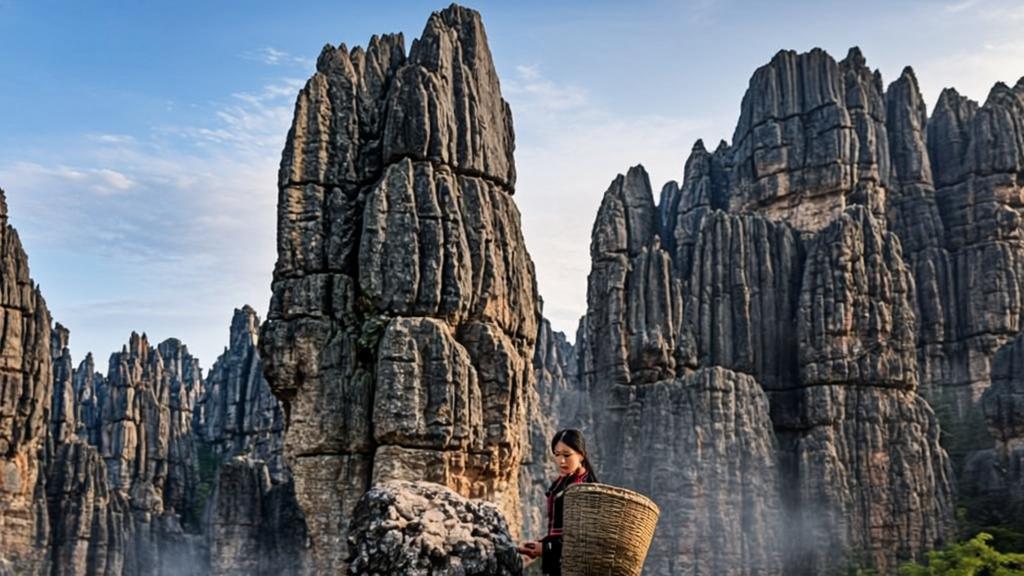
The landform here follows a specific pattern: flat tops, near-vertical walls, and gentle slopes below. Geologists call it mature Danxia landform. Communities living near these cliffs, however, called it something else: safety.
The ancient Baiyue people — ancestors of many southern Chinese communities — were among the first to recognize this. They used the natural caves carved into the red sandstone as initial shelters. Over time, those caves became fortified settlements. A saying, passed down across generations, captures the logic precisely. The Shaoguan City government tourism records preserve it this way: “Every mountain has a village, there is a door in the village, and every door is difficult to break” (Shaoguan Municipal Government, 2018).
That phrase reads more like a tactical manual than a travel description. It is both.
UNESCO’s evaluation confirms this depth. Alongside its geological value, Danxia Mountain holds “considerable cultural and archaeological value,” with ancient villages, temples, and tombs reflecting a “long-standing interaction and harmony between people and the natural environment” (UNESCO International Geoscience and Geoparks Programme, n.d.).
Why Danxia Mountain’s Cliffs Made Perfect Defenses
Understanding the logic requires looking at the rock itself.
The sandstone peaks erode in a precise way. Water cuts deep vertical joints. The result is sheer drops on all sides. Reaching the top often means climbing near-vertical rock faces — sometimes approaching 90 degrees.
For attackers, that was near-impossible without help from above. For defenders, a single person at the summit could hold off a group below. This wasn’t just geography. It was a social structure built around stone.
Furthermore, the terrain provided natural watchtowers. Nothing approached without being visible from above. Nothing passed unseen through the valley corridors.
The terrain, in short, did most of the defensive work. The people simply had to get there first.
Ximei Village: A Ming Dynasty Clifftop Stronghold
Of all the fortress sites on Danxia Mountain, Ximei Village is the most complete — and the most accessible.
According to historical records, it was first built during the Ming Dynasty (1368–1644). A community came here specifically to escape war. They used natural cave formations as foundations, then built stone shelters above. Later, during the Qing Dynasty, a wealthy family reinforced the walls again — adding another layer of history to the stone (China Today, 2022).
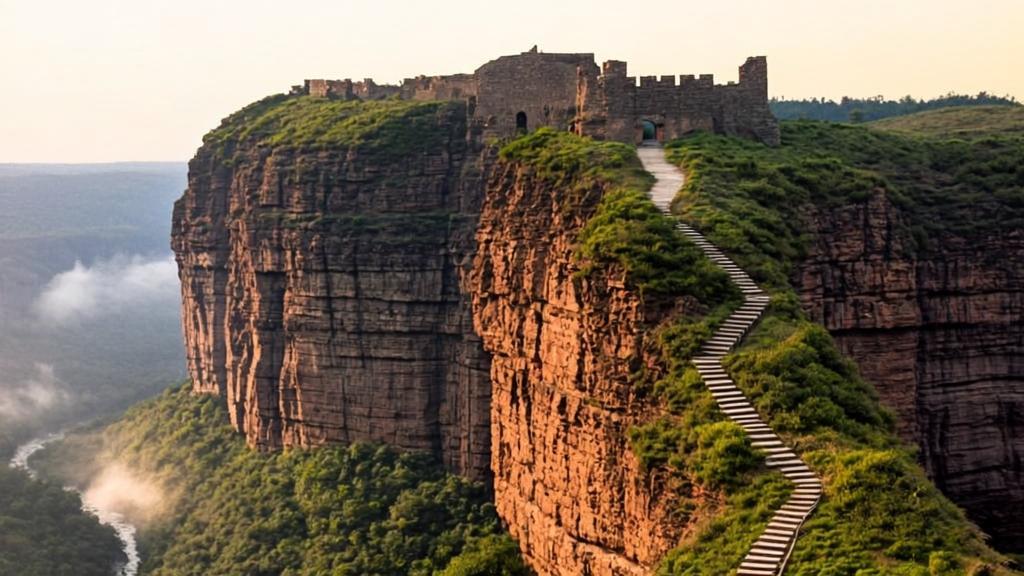
The result was a village effectively unreachable by force. Today, Ximei Village sits abandoned at the summit of Yangyuan Mountain. The walls still stand. The views stretch across the Jinjiang River corridor far below.
To reach it, visitors climb the Sky Stair — Jiǔjiǔ Tiāntī (九九天梯) in Chinese. The name translates roughly to “ninety-nine heaven ladder.” It is a near-vertical stairway cut directly into smooth sandstone, with iron railings on both sides and open air below. As China Today describes it, the stairway “was carved out of a completely smooth and steep cliff face” and is considered as challenging as the famous Red Ladder trail nearby (China Today, 2022).
Standing at the top, the logic of this fortress becomes immediately obvious. Nothing approaches without being seen. Nothing reaches the summit without cooperation from those already there.
East and West: The Same Survival Strategy in Stone
Here is where the story gets genuinely interesting.
This pattern — people moving upward in response to danger — appears across many cultures. In southern France, the medieval village of Les Baux-de-Provence perches on an isolated limestone plateau, its castle walls flush with sheer drops. In Portugal, Monsanto was built into massive granite boulders; the houses themselves are wedged between rocks. And in Greece, the Meteora monasteries rose on near-vertical sandstone pillars during the Byzantine era.
The driving logic was nearly identical: when the flatlands are unsafe, gain height. Control the summit, and control survival.
Yet the cultural interpretations differ meaningfully. European cliff settlements are largely explained through feudal power — fortification as a statement by lords and rulers. The Danxia Mountain fortresses, by contrast, reflect something more grassroots. They were built by ordinary communities — farmers, villagers, local gentry — responding to recurring instability across multiple dynasties. No single ruler commissioned this network. Instead, the terrain simply invited it, again and again.
That distinction says something important about the relationship between landscape and society in southern China. The mountain didn’t belong to one dynasty. It belonged to whoever needed it.
Danxia Mountain’s Fortresses as a Cultural Archive
Beyond defense, these sites preserved culture across centuries.
Danxia Mountain contains hundreds of rock carvings from the Tang and Song Dynasties, dating back roughly 1,000 to 1,500 years. Many cluster along the routes connected to ancient settlement paths. The oldest surviving inscription was carved during the Southern Song Dynasty (1127–1279) by the official Zhao Rulei — just two Chinese characters, Jin and Yan, which have endured nearly 900 years of subtropical weather (China Today, 2022).
These carvings are not decorative additions. They are records of presence. Someone climbed the cliffs, wanted the fact noted, and committed it to stone.
The UNESCO evaluation highlights this continuity: the site reflects centuries of human presence, from prehistoric cave dwellers to Hakka communities who settled the Jinjiang River plains over a thousand years ago (UNESCO International Geoscience and Geoparks Programme, n.d.). Moreover, the site records 30,000-year-old human remains — a skull fragment of “Maba Man,” found on the southwestern margin of the Danxia basin (Wikipedia contributors, 2025).
The geological record and the human record, here, are inseparable.
Planning Your Danxia Mountain Fortress Visit
The fortress trail offers a genuinely different experience from standard mountain tourism. It rewards visitors who look past the geology into the history layered above it.
Recommended route for the fortress experience:
- Start at the Yangyuan Mountain entrance
- Climb the Sky Stair to reach Ximei Village ruins (allow 3–4 hours)
- Visit before 10 am for the best light on the red cliff faces
- Combine with the Jinjiang River cruise for a ground-level view of cliff heights
Additional sites worth including:
- Changlou Peak area: the densest concentration of Tang and Song rock carvings
- Shaoshi Mountain zone: hanging coffin sites and prehistoric rock paintings
- Biechuan Temple: built in 1662, once housed over 1,000 monks at its peak
Practical information:
- Best season: October to November (clear skies, temperatures 18–22°C)
- Entry tickets: approximately ¥100–160 depending on areas selected
- Getting there: high-speed rail to Shaoguan, then connecting bus to the scenic area entrance
- Official tourism information available at the Shaoguan Municipal Government portal
Why Danxia Mountain Rewards a Closer Look
Most visitors come for the red cliffs and the unusual geological formations. That makes sense. The landscape is genuinely spectacular.
But the fortress layer reframes the site entirely. Each flat-topped peak becomes a potential watchtower. Every vertical wall reflects a deliberate choice. Each carved staircase is evidence of someone deciding that the view from above was worth the climb — and that reaching the top without permission should be as hard as possible.
That story is largely absent from English travel content. Yet it’s written in stone across this mountain range in Guangdong Province. Danxia Mountain was inscribed as a UNESCO World Heritage Site for its geology. The fortresses are the reason to stay a little longer — and look a little closer.
References
China Today. (2022, March 11). Danxia Mountain: The red rock park. China Today. http://www.chinatoday.com.cn/ctenglish/2018/tourism/202203/t20220311_800279280.html
Shaoguan Municipal Government. (2018). Danxia Mountain. Beautiful Shaoguan Official Tourism Portal. https://en.sg.gov.cn/html/2018/travel_0908/11.html
Trip.com. (2026). Danxiashan World Geopark travel guide & travel experiences. Trip.com. https://www.trip.com/moments/poi-mount-danxia-10773677/
UNESCO International Geoscience and Geoparks Programme. (n.d.). Danxiashan UNESCO Global Geopark. United Nations Educational, Scientific and Cultural Organization. https://www.unesco.org/en/iggp/danxiashan-unesco-global-geopark
Wikipedia contributors. (2025, November 30). Mount Danxia. Wikipedia. https://en.wikipedia.org/wiki/Mount_Danxia