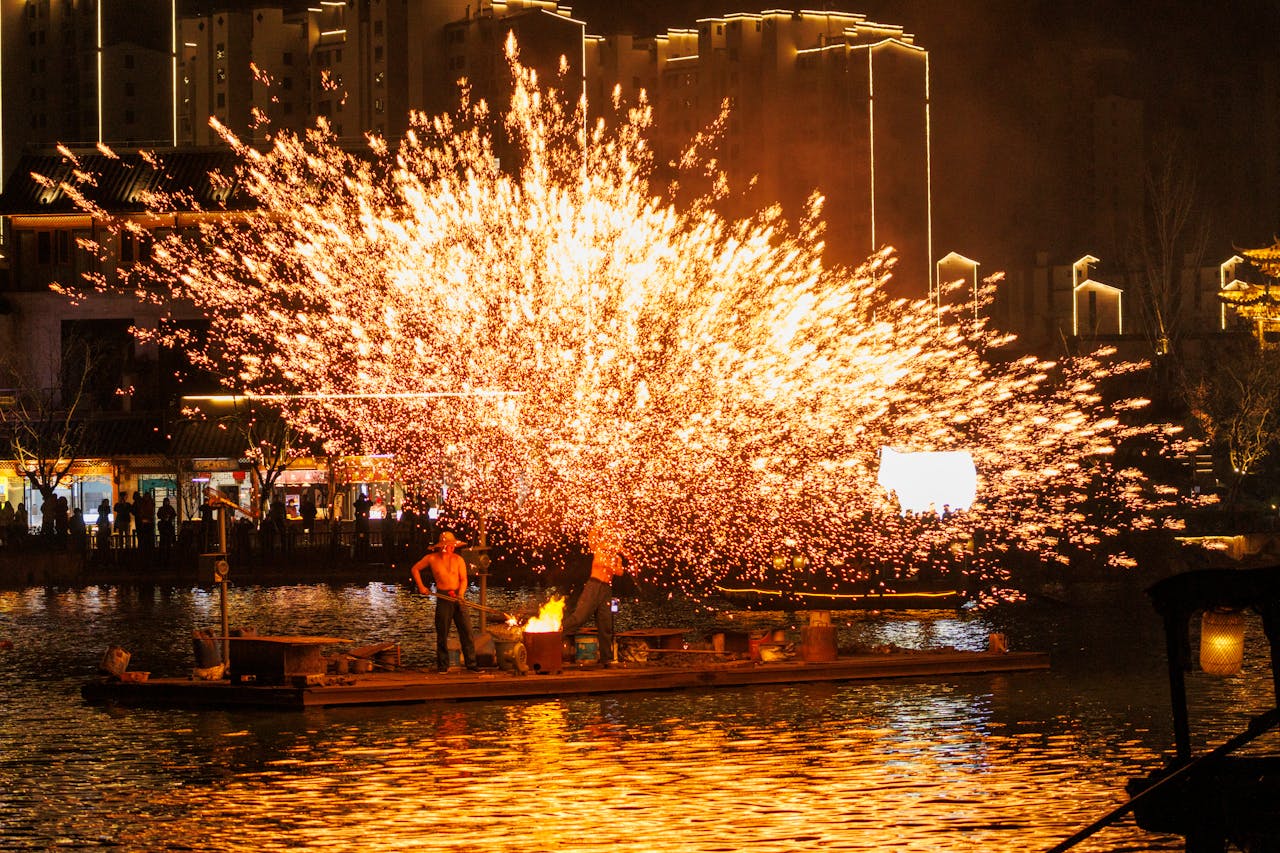
Datiehua (打铁花) is one of the most visually stunning — and least-known — spectacles in Chinese folk culture. Shirtless craftsmen scoop molten iron heated to 1,600°C, then hurl it skyward against wooden structures. The result? A cascade of thousands of sparks exploding across the night sky. No CGI. No safety net. Just fire, iron, and a thousand-year-old tradition.
It looks dangerous because it is. And that’s exactly why people can’t stop talking about it.
What Datiehua Actually Is
The name literally means “striking iron flowers” (打 = strike, 铁 = iron, 花 = flower). Performers use a wooden ladle to scoop liquid iron from a furnace, then slam it against a plank or throw it upward. The molten iron scatters, oxidizes on contact with air, and bursts into a shower of brilliant orange sparks — blooming like a chrysanthemum, then falling like a meteor shower.
The chemistry is real: the iron heats past 1,538°C (its melting point), and carbon impurities ignite on contact with oxygen. Each throw is a controlled explosion.
Compare this to Western fire performance traditions — juggling torches, fire poi — and the scale is incomparable. Those traditions emphasize individual precision. Datiehua is collective, industrial, almost architectural.
Where It Comes From
The tradition originates in the Northern Song Dynasty (960–1127 AD), primarily in Queshan County, Henan Province — a region historically dense with ironworkers and Taoist temples (Wikipedia, Iron Flower).
The origin story is surprisingly human. Ancient blacksmiths couldn’t afford conventional fireworks for Spring Festival. So they improvised — throwing scrap iron sparks against castle walls. Over time, the display outgrew its improvised roots. By the Ming and Qing dynasties, it had become a formal ceremonial art tied to Taoist ritual, business openings, and harvest celebration (China Daily, 2018).
Think of it as the original “poor man’s fireworks.” There’s something quietly poetic about that origin.
In June 2008, the State Council of China officially added Queshan iron flower to the second national intangible cultural heritage list, under heritage number X-88 (Beijing Municipal Bureau of Culture and Tourism).
The Performance: What You’ll Actually See
A typical datiehua show follows a ritual sequence:
- Performers erect a 10-meter double-layered shed covered with fresh willow branches, fireworks, and firecrackers
- A furnace melts scrap iron collected from local communities
- Craftsmen dress in straw hats and thick sheepskin to guard against burns
- They perform shirtless for major moments — a display of both skill and fearlessness
- The throws create named formations: “Two Dragons Playing with a Pearl,” “Fire Tree and Silver Flowers,” “Hand-Held Thunder”
- After the show, performers kowtow before the furnace — a gesture of gratitude and prayer
The entire sequence lasts roughly 20–40 minutes. During peak moments, more than a dozen craftsmen work simultaneously, each throw adding to a continuous arc of light overhead.
For reference: the sparks reach temperatures above 1,000°C and can burn through clothing at distance. Audience members at Hangzhou performances have reported minor singeing of their coats — and called it worth it (RADII, 2024).
Why It’s Going Viral Right Now
Datiehua has recently exploded among young Chinese audiences. The hashtag #打铁花 has accumulated 95 million views on Xiaohongshu. A related hashtag — “Datiehua is a romance, Chinese-style” — hit 84 million views on Weibo (RADII, 2024).
Why the sudden surge? A few things are converging:
- Intangible heritage content is booming on Douyin and Xiaohongshu, driven by a new generation of culturally-focused creators (see: Liu Yaqing’s 50M followers)
- Immersive tourism is replacing passive sightseeing — and datiehua is participatory by nature
- Henan Province’s cultural tourism push has put datiehua front and center, particularly at the Unique Henan: Land of Dramas complex in Zhengzhou, which drew 10,000+ visitors on New Year’s Eve alone
This isn’t nostalgia. It’s a genuine aesthetic reappraisal. Chinese Gen Z isn’t just watching datiehua — they’re describing it as “中式浪漫” (Chinese-style romance). That phrase carries real cultural weight.
Where Foreigners Can See It
Datiehua performances happen across several provinces, though Henan remains the heartland. Key venues and occasions:
Henan Province
- Unique Henan: Land of Dramas (只有河南·戏剧幻城), Zhengzhou — large-scale shows, especially around Spring Festival and New Year’s Eve
- Queshan County — the original birthplace; smaller, more traditional performances
- Kaifeng — known as home to one of the top ten folk arts in the Yellow River Basin
Hebei Province
- Nuanquan Town, Yuxian County — hosts the related dashuhua (打树花) tradition, where molten iron is thrown against stone walls instead. The spring Lantern Festival is prime time (Xinhua, 2019)
Best timing:
- Spring Festival (Chinese New Year) — late January to mid-February
- Lantern Festival — 15 days after Spring Festival
- Qingming holiday (early April) — Henan Satellite TV has featured datiehua in its annual cultural gala
No specialist booking required for most public performances. General festival entry applies.
A Practical Note for Visitors
A few things worth knowing before you go:
- Stand behind marked boundaries. The heat is real, and sparks travel further than expected.
- Wear older clothes. Synthetic fabrics melt. Natural fibers fare better.
- Arrive early. Popular shows at Unique Henan sell out, especially during national holidays.
- No need to speak Mandarin. Datiehua is entirely visual. The performance communicates across every language barrier.
For foreign visitors navigating festival travel in Henan more broadly, China’s 240-hour visa-free transit policy (available to nationals of 55 countries) makes a short dedicated trip entirely feasible without a full tourist visa.
The Deeper Cultural Logic
One question worth sitting with: why did this tradition survive?
Conventional fireworks came to dominate Chinese celebration culture long ago. Yet datiehua persisted — not because it was practical, but because it preserved something else. The ritual connection to Laojun (the Taoist deity of fire and metalwork), the communal pooling of scrap iron, the shared danger — these elements encode a social contract that ordinary fireworks can’t replicate.
Western fire traditions tend to center the individual performer. Datiehua centers the community. The blacksmiths don’t perform for an audience exactly — they perform with one. The sparks land on everyone.
That’s perhaps why Chinese Gen Z has latched onto the phrase “Chinese-style romance” to describe it. There’s no equivalent English term. But watching iron bloom into fire in the dark, surrounded by strangers who drove four hours to be there — the feeling probably translates.
References
Iron flower. (2026, January 2). Wikipedia. https://en.wikipedia.org/wiki/Iron_flower
Dashuhua. (2026, January 19). Wikipedia. https://en.wikipedia.org/wiki/Dashuhua
China Daily. (2018, September 17). Da Shuhua – China’s unique molten iron throwing tradition. https://www.chinadaily.com.cn/a/201809/17/WS5b9f6931a31033b4f46567c3.html
RADII. (2024). Ringing in the New Year with Iron Flowers. https://radii.co/article/ringing-in-the-new-year-with-iron-flowers
Xinhua. (2019, February 19). Across China: Throwing molten iron — a dangerous and dazzling firework art. http://www.xinhuanet.com/english/2019-02/19/c_137834095.htm
Beijing Municipal Bureau of Culture and Tourism. (n.d.). Large-scale traditional folk fireworks: Beating Iron Flowers. https://english.visitbeijing.com.cn/article/4Dlzuie9zjg
China Vistas. (2025, February 5). Henan’s Magical Iron Flower: A Sparkling Tradition of China’s Intangible Heritage. https://www.chinavistas.com/post/henan-s-magical-iron-flower-a-sparkling-tradition-of-china-s-intangible-heritage