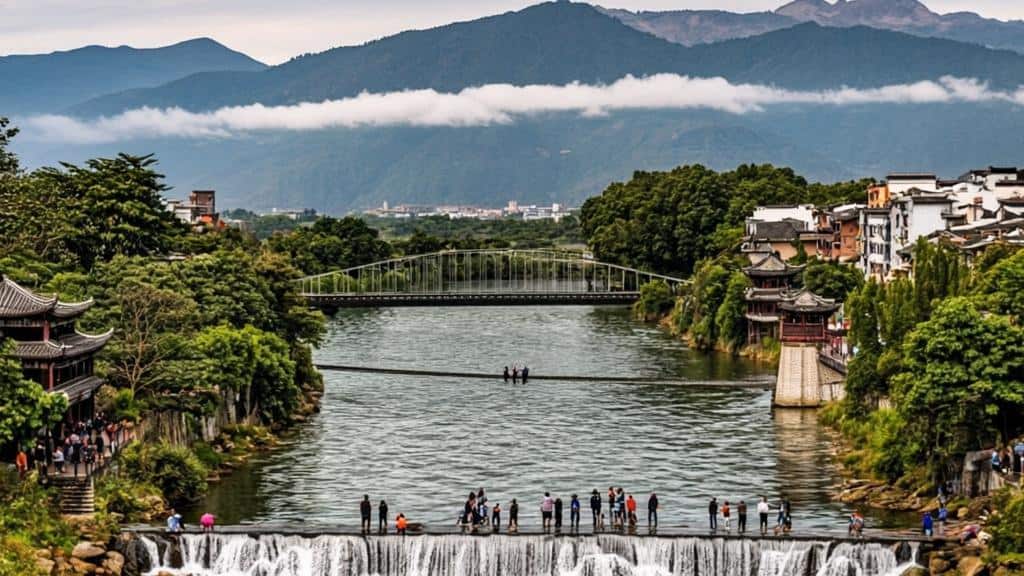
Dujiangyan should not exist. Not because it’s physically impossible — but because everything it achieves, without a single dam, is exactly what modern hydraulic engineers have spent centuries trying to solve with walls, barriers, and brute force. Yet here it is: a 2,300-year-old water system in Sichuan, China, still running today, still irrigating over 5,300 square kilometers of farmland, still feeding tens of millions of people. And still, in a quiet way, making Western engineers uncomfortable.
If you’ve heard of it at all, you probably know it as a UNESCO World Heritage Site. But that label barely scratches the surface. Dujiangyan isn’t just a historical monument. It’s a live demonstration of a philosophy so different from the Western engineering tradition that visiting it genuinely changes how you think.
The Problem Dujiangyan Was Built to Solve
Picture the Min River rushing down from the mountains in early spring. Snowmelt from the Tibetan Plateau turns a calm river into a wall of water. Below, the Chengdu Plain — flat, fertile, and completely defenseless — floods every year. Crops destroyed. People displaced. The region that would become one of China’s most productive agricultural heartlands was, back in 256 BC, a nightmare.
The Qin governor of Shu, a man named Li Bing, studied the problem carefully. He noticed something important. The river didn’t need to be stopped. It needed to be redirected. So instead of building a dam — which would have blocked military supply ships and ignored the river’s natural behavior — Li Bing and his son designed something entirely different.
They worked with the river. They read it. And then they shaped it.
The result was Dujiangyan Irrigation System: the world’s oldest and only surviving large-scale dam-free water diversion project, still in full operation today (UNESCO World Heritage Centre, 2000).
How the “No-Dam” Genius Works — And Why It Still Stuns Scientists
The Three Components of Dujiangyan’s Design
The entire system relies on three interlocking structures, each doing a precise job:
- Yuzui (Fish Mouth Levee) — A fish-shaped island divides the Minjiang River into an inner and outer channel. In flood season, roughly 60% of water flows out (the outer channel). In dry season, about 60% flows inward (the inner channel). This ratio flips automatically — no human intervention required. No sensors. No computers.
- Feishayan (Flying Sand Weir) — This spillway controls overflow and, more cleverly, uses centrifugal force to expel sand and silt outward. It essentially self-cleans. Ancient engineers without fluid dynamics textbooks somehow worked out a solution that modern hydraulics confirm is theoretically optimal.
- Baopingkou (Bottle-Neck Channel) — A narrow channel cut through Yulei Mountain regulates inflow to the Chengdu Plain with precision, acting like a permanent throttle valve.
These three elements work together continuously, adapting to seasonal changes through physics alone. No moving parts. No maintenance systems.
Scientists who have studied Dujiangyan describe it as a system whose design philosophy aligns with modern hydraulic science remarkably well, especially in its elegant handling of sediment transport and flow distribution (Chen et al., 2009).
Dujiangyan vs. the Western Dam Tradition: A Genuine Philosophical Divide
Here’s what makes Dujiangyan so intellectually interesting for foreign visitors: it reveals a genuine difference in how ancient Chinese and Western traditions approached nature.
Western engineering, broadly speaking, has historically favored control. Build a dam. Stop the flood. Hold the water. The Hoover Dam, the Aswan High Dam — these are monuments to the idea of human will overcoming natural force.
Dujiangyan represents a different idea entirely. Li Bing’s philosophy, often described as “following the nature” and “guiding according to the situation,” assumes that rivers have their own logic. The goal isn’t to overpower that logic. The goal is to understand it well enough to redirect it slightly.
Interestingly, modern environmentalists increasingly echo this view. After major floods in 1998, China’s government shifted away from relying exclusively on structural flood barriers toward more integrated approaches — a shift that, in hindsight, Dujiangyan had already modeled for two thousand years (Chen et al., 2009).
This isn’t a uniquely Chinese idea, either. The Roman aqueduct tradition also worked with gravity and terrain. But Dujiangyan’s scale, longevity, and environmental sensitivity are arguably unmatched anywhere on earth.
Visiting Dujiangyan: What Actually Happens When You Get There
Let’s be honest: some UNESCO sites are better on paper than in person. Dujiangyan is not one of them.
What You’ll See at Dujiangyan Scenic Area
The scenic area is organized around the three main hydraulic structures, but there’s far more to explore than diagrams suggest. Allow four to five hours for a complete visit. English signage is available throughout, which makes independent navigation genuinely manageable (China Xian Tour, 2025).
A recommended walking route for first-time visitors:
- Lidui Park entrance → Fulong Temple (where a Han Dynasty stone statue of Li Bing was excavated from the river in 1974)
- → Baopingkou channel (where you can actually see the water narrowing — it’s more dramatic than you expect)
- → Feishayan spillway (the self-cleaning weir — try to watch the water movement carefully)
- → Yuzui Fish Mouth Levee (the clearest view of the division point)
- → Anlan Suspension Bridge (swaying over the river; originally built before the Song Dynasty, rebuilt in 1974)
- → Erwang Temple (dedicated to Li Bing and his son; stunning views of the whole system from here)
One practical tip worth taking seriously: consider hiring a guide (around ¥50 per group for a manual guide, or ¥20 for an audio device). Without context, it’s easy to walk through and feel vaguely impressed without fully understanding what you’re seeing. The engineering is subtle. Its genius is in the why, not just the what.
Getting There from Chengdu
Dujiangyan sits about 60 kilometers northwest of Chengdu. Options include:
- High-speed rail from Chengdu Xipu Station to Qingchengshan-Dujiangyan Station (around 45 minutes, very affordable)
- Long-distance bus from Chadianzi Bus Station (buses depart every 5–10 minutes, roughly 45 minutes’ ride)
- Taxi or private car from central Chengdu (approximately 1 to 1.5 hours depending on traffic)
Once in the city, local buses (routes 1, 2, and 6) cover the main attractions for ¥2 per ride. Taxis between sites cost around ¥20–40.
Dujiangyan as a Window Into Chinese Intellectual History
This is perhaps the least obvious reason to visit — and maybe the best one.
Dujiangyan is a physical artifact of how ancient Chinese thinkers approached the relationship between humanity and nature. The Taoist principle of wu wei — acting in accordance with nature’s flow rather than against it — is usually discussed in philosophy books. Here, it’s made concrete in stone, water, and bamboo baskets.
The nearby Mount Qingcheng, also a UNESCO World Heritage Site inscribed alongside Dujiangyan in 2000, is considered one of the birthplaces of Chinese Taoism (UNESCO, 2000). Visiting both in a single day creates an unusually coherent picture: the philosophical tradition and its engineering expression, side by side.
For foreign visitors, this pairing can be genuinely revelatory. Ideas about “harmony with nature” often feel abstract. At Dujiangyan, they feel engineered.
Beyond the Irrigation System: What Else Dujiangyan Offers
Dujiangyan City holds three World Heritage designations in close proximity — the irrigation system, Mount Qingcheng, and the Giant Panda Sanctuaries of Sichuan. That density is unusual even by China’s standards.
A two-day itinerary works well:
- Day 1: Dujiangyan Irrigation System (half day) + Guanxian Ancient Town for lunch + Mount Qingcheng Front Mountain (half day)
- Day 2: Dujiangyan Panda Base — where a full-day “Panda Volunteer” program lets you work alongside keepers, feed pandas, and clean enclosures (only 20 visitors per session, so book in advance)
The best seasons to visit are spring (March–May) and autumn (September–November). Summer heat in Sichuan can be intense, though Dujiangyan runs slightly cooler than Chengdu, with the hottest month averaging around 25.6°C (78°F) (China Xian Tour, 2025).
A Final Thought
There’s a specific moment that many visitors describe — standing on Anlan Bridge, water rushing below, watching the river split precisely as Li Bing designed it to 23 centuries ago — when the scale of what you’re looking at suddenly lands.
This isn’t a ruin. It isn’t a reconstruction. It’s a working machine, older than the Roman Colosseum, older than most of the world’s famous monuments. And it survives not because it fought the river, but because it listened to it.
That idea — patient, observant, working with rather than against — is perhaps the most useful thing Dujiangyan teaches. And you can only really feel it by standing there, on the swaying bridge, watching the ancient water move.
References
Chen, J., Zhong, P., & Liu, W. (2009). Dujiangyan irrigation system — A world cultural heritage corresponding to concepts of modern hydraulic science. Journal of Hydrodynamics, 4, 3–12. https://www.sciencedirect.com/science/article/abs/pii/S1570644309000719
China Xian Tour. (2025). Dujiangyan travel guide: Ancient irrigation Taoist heritage. https://www.chinaxiantour.com/dujiangyan-travel-guide
Trip.com Moments. (2025, October). Recommended itinerary in Dujiangyan Irrigation System. https://www.trip.com/moments/theme/poi-dujiangyan-irrigation-system-98277718-itinerary-999195/
UNESCO World Heritage Centre. (2000). Mount Qingcheng and the Dujiangyan irrigation system. https://whc.unesco.org/en/list/1001
Wikipedia. (2025). Dujiangyan. https://en.wikipedia.org/wiki/Dujiangyan