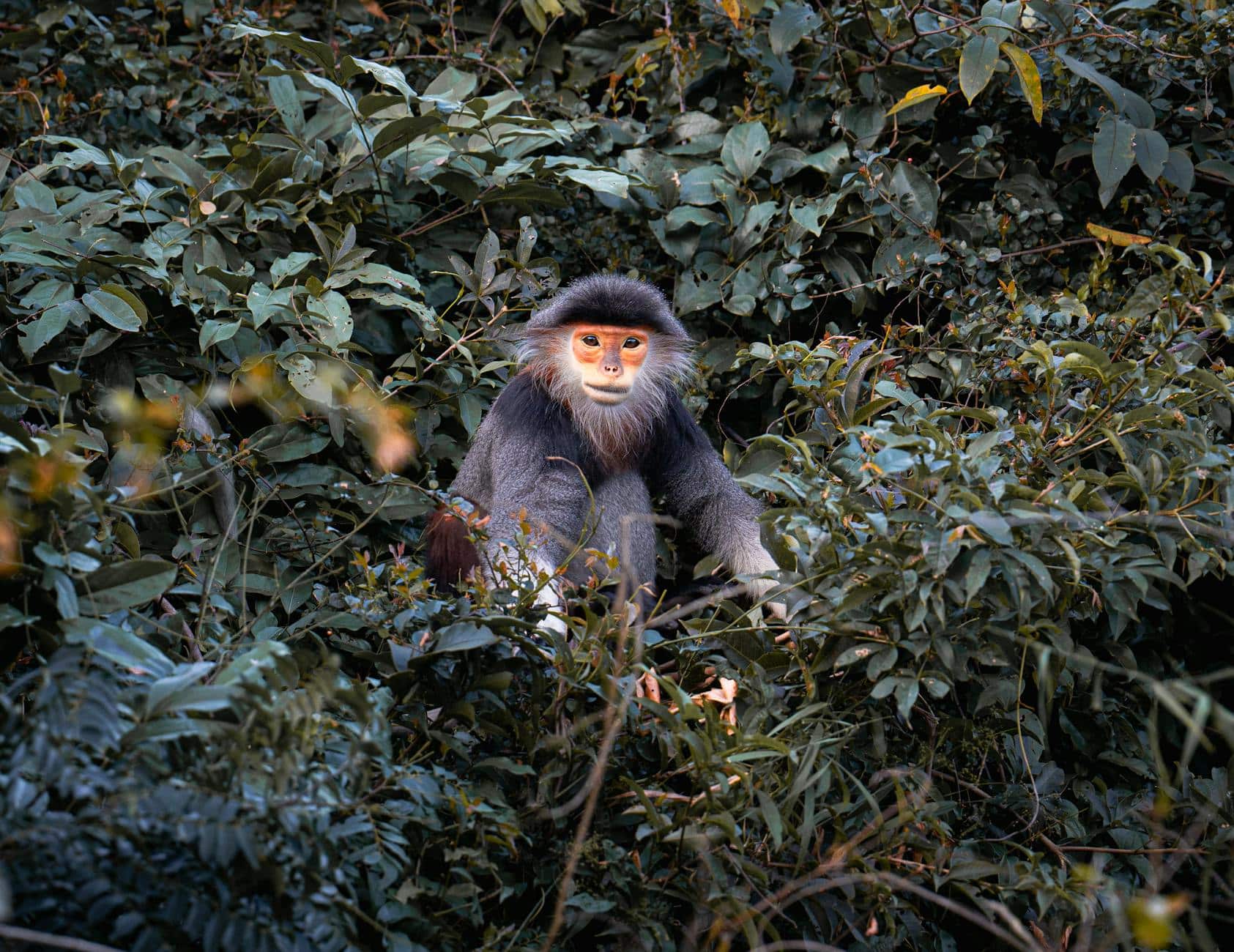
Fanjingshan does not get the attention it deserves. Most visitors to China head straight for panda reserves or the Great Wall. Yet deep in the mist-covered mountains of Guizhou Province, something far rarer is watching from the treetops — the Guizhou golden snub-nosed monkey (Rhinopithecus brelichi), a critically endangered primate found nowhere else on Earth. Its total wild population? Around 800. The giant panda, by comparison, now numbers over 1,800 in the wild. So yes — this creature is statistically rarer than China’s most famous animal, and very few Western travelers have even heard of it. That’s precisely why Fanjingshan is worth your attention.
What Exactly Is the Guizhou Golden Snub-Nosed Monkey?
First, a clarification. The name is a little misleading. Adult monkeys are not actually golden — their fur is mainly dark brown to black, with a white patch between the shoulder blades. However, newborns are born with striking golden coats. During breeding season (September through November), you can sometimes spot mothers carrying glowing golden infants through the forest canopy. It’s one of those sights that’s genuinely hard to forget.
Scientifically, the species is called Rhinopithecus brelichi, or the gray snub-nosed monkey. In Chinese, it’s known as the 黔金丝猴 (Qián jīnsīhóu) — the “Guizhou golden silk monkey.” Of the three golden snub-nosed monkey species endemic to China, this one has:
- The smallest population
- The narrowest habitat range
- The least ecological data collected by scientists
According to a 2020 study published in ScienceDirect, the monkeys are confined to roughly 27.8 km² of usable habitat inside the Fanjingshan National Nature Reserve — that’s only 6.6% of the reserve’s total area. Think about that: one of the world’s rarest primates lives within a forest patch not much larger than Manhattan.
Why Fanjingshan? The Island Effect Explained
Here’s something that might surprise you. Fanjingshan is not a typical mountain. It’s described by UNESCO as “an island of metamorphic rock in a sea of karst.” Geologically, this isolation has lasted millions of years — the mountain hosts plant and animal species that date back to the Tertiary period, between 65 million and 2 million years ago.
Think of it like the Galápagos Islands, but on a mountaintop in Southwest China. Isolation drives evolution and endemism. That’s why Fanjingshan has not only the golden snub-nosed monkey, but also the endemic Fanjingshan Fir (Abies fanjingshanensis), the Chinese Giant Salamander, the Forest Musk Deer, and Reeve’s Pheasant — all endangered or endemic species found in the same reserve.
In Western conservation terms, this is comparable to places like the Daintree Rainforest in Australia or the cloud forests of Costa Rica — ancient ecosystems with irreplaceable biodiversity. The difference is that Fanjingshan remains remarkably under the radar for international travelers.
The Rarer-Than-a-Panda Story — and Why It Matters
Most people outside China have never heard of the Guizhou snub-nosed monkey. In contrast, giant pandas are globally recognized conservation icons. They appear in logos, merchandise, and children’s books worldwide. But consider this comparison:
| Species | Wild Population | IUCN Status |
|---|---|---|
| Giant Panda | ~1,800+ | Vulnerable |
| Guizhou Snub-Nosed Monkey | ~800 | Critically Endangered |
The giant panda was downlisted from “Endangered” to “Vulnerable” in 2021 after decades of conservation work (Wikipedia, Giant Panda). Meanwhile, the Guizhou monkey remains critically endangered, confined to a single mountain, with habitat continuing to face pressure from tourism infrastructure and human activity.
Why the disparity in global awareness? Partly because the Sichuan golden monkey — a visually flashier, more numerous cousin — tends to steal the spotlight even within China. The Guizhou monkey is timid. Researchers from the Fanjingshan reserve administration have noted that studying these animals in the wild often requires waiting patiently for days before getting a single sighting (China Daily, 2023). That elusiveness, paradoxically, is part of what makes the encounter so extraordinary if it happens.
What to Expect at Fanjingshan as a Foreign Visitor
Getting There
The nearest city is Tongren (铜仁), in northeastern Guizhou Province. Tongren has both an airport and a high-speed rail connection to the rest of China. From Tongren, you can take a bus to Jiangkou (江口) county, then a taxi or shuttle to the park entrance. Alternatively, direct minivans depart from Tongren’s train station to the park gate. Many travelers also combine Fanjingshan with nearby Fenghuang Ancient Town or Zhangjiajie, which are both within a few hours’ drive.
Going Up the Mountain
Two options exist:
- Cable car: About 10 minutes, saves your knees, gets you to the top faster.
- Hiking: Approximately 8,888 steps (yes, really). Allow 3–5 hours. The scenery along the trail is fairly consistent, so the cable car is fine unless you specifically want the full trek experience.
At the summit, the famous Red Clouds Golden Summit (红云金顶) is the main draw. Two Buddhist temples — the Buddha Temple and Maitreya Temple — sit atop a narrow rock pillar, connected by a stone bridge over a gorge. The view in fog can look like something out of a Chinese ink painting. The view on a clear day is equally dramatic.
Best Time to Visit
April to November generally works best for weather. That said, fog and clouds are frequent year-round, and they actually enhance the atmosphere rather than ruin it. Avoid Chinese national holidays at all costs — visitor numbers can make the ascent painfully slow.
Spotting the Monkey
To be direct: a casual tourist visit does not guarantee a sighting. The monkeys are wild, timid, and scattered across a large forest area. However, visitors have occasionally encountered them near mountain trails or even on access roads, particularly in the northern sections of the reserve. The Fanjingshan National Nature Reserve also operates a small research center with nine captive individuals (all rescued from injuries in the wild), which may offer closer observation opportunities depending on access arrangements at the time of your visit (CGTN, 2024).
Even without a sighting, the forest itself is extraordinary. The reserve contains the largest and most continuous primeval beech forest in the subtropical region — according to UNESCO’s official listing.
The Buddhist Dimension: More Than Just Wildlife
Fanjingshan isn’t only an ecological wonder. It’s also a sacred Buddhist mountain with over 1,300 years of religious history. The Tang Dynasty brought Buddhism here in 639 AD. Today, the mountain is considered the seat of Maitreya Buddha and ranks as the Fifth Sacred Buddhist Mountain of China.
For Western visitors, it’s useful to understand the cultural parallel: this is somewhat like visiting both Yellowstone and a cathedral at the same time. The spiritual and natural elements are inseparable here. Local Tujia and Miao ethnic communities also have deep ties to the mountain through their own traditions and rituals.
Conservation Progress — and What Still Needs Work
The good news is real. The wild population has roughly doubled since conservation measures were introduced in 1979, growing from around 400 individuals to approximately 800 today (Mongabay, 2008). The reserve has partnered with the Chinese Academy of Sciences and Beijing Forestry University to establish a formal conservation research committee. Local counties near Fanjingshan are also building ecological corridors — planting trees the monkeys depend on to gradually expand their available habitat.
However, challenges remain. The construction of the cable car and access roads has reduced the effective habitat area. Tourism infrastructure, if not carefully managed, continues to fragment the forest. UNESCO itself noted at the time of inscription that “growing tourism demand must be carefully managed to avoid negative impacts” on the site’s outstanding value.
This tension between accessibility and preservation is not unique to China. Many of the world’s great natural sites — from the Galápagos to the Amazon — face the same dilemma. Fanjingshan is simply navigating it in real time.
Practical Tips for International Travelers
- Visa: Many Western countries now have visa-free or simplified visa access to China. French, German, Italian, Spanish, and UK passport holders enjoy 30-day visa-free stays. US passport holders can enter for 6 days without a visa under the transit waiver program.
- Language: English signage at Fanjingshan is limited. Download an offline translation app before your visit.
- Tickets: Entrance tickets can be purchased on-site. Present your original passport at the turnstile. Tickets do not include the cable car (purchased separately).
- Weather: Pack layers. The summit area is significantly cooler than the base, and fog is common at any time of year.
- Accommodation: No lodging exists inside the scenic area. Stay in Jiangkou county or Tongren city. Staying near the park entrance helps you start early and beat the crowds.
Final Thought
Fanjingshan offers something genuinely rare in modern travel: a place that is spectacular and significant, but not yet crowded with foreign visitors. The Guizhou golden snub-nosed monkey is the kind of creature that could become as iconic as the giant panda — if more people simply knew it existed.
A visit here isn’t just a hiking trip. It’s a chance to witness one of the planet’s most precarious wildlife stories while it’s still being written.
References
China Daily. (2023, August 18). Across China: Rare golden monkeys thrive at Chinese world heritage site. https://www.chinadaily.com.cn/a/202308/18/WS64df20b6a31035260b81cf5d.html
CGTN. (2024, March 30). Rare golden monkey born at Chinese world heritage site. https://news.cgtn.com/news/2024-03-30/Rare-golden-monkey-born-at-Chinese-world-heritage-site-1so331edoFq/p.html
New England Primate Conservancy. (2024). Gray snub-nosed monkey. https://neprimateconservancy.org/gray-snub-nosed-monkey/
Xiang, Z. F., et al. (2020). Habitat estimates reveal that there are fewer than 400 Guizhou snub-nosed monkeys remaining in the wild. Global Ecology and Conservation, vol. 23. https://www.sciencedirect.com/science/article/pii/S2351989420307228
UNESCO World Heritage Centre. (2018). Fanjingshan. https://whc.unesco.org/en/list/1559/
Mongabay. (2008, September 8). Rare monkeys double in number in China but remain under threat. https://news.mongabay.com/2008/09/rare-monkeys-double-in-number-in-china-but-remain-under-threat/
Wikipedia. (2024). Giant panda. https://en.wikipedia.org/wiki/Giant_panda
Asia News Network. (2024, January 24). Meet Guizhou’s rare monkeys. https://asianews.network/meet-guizhous-rare-monkeys/