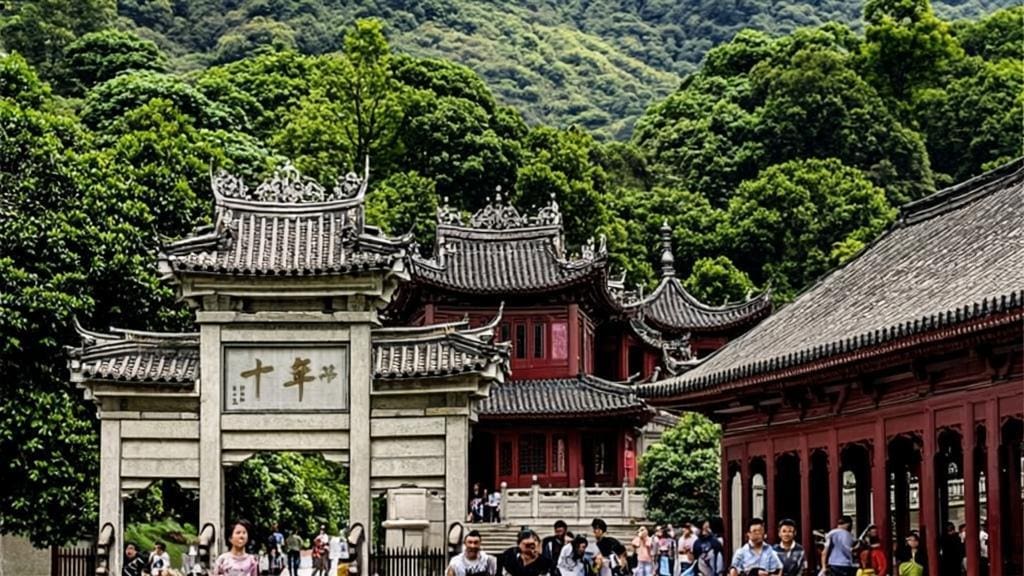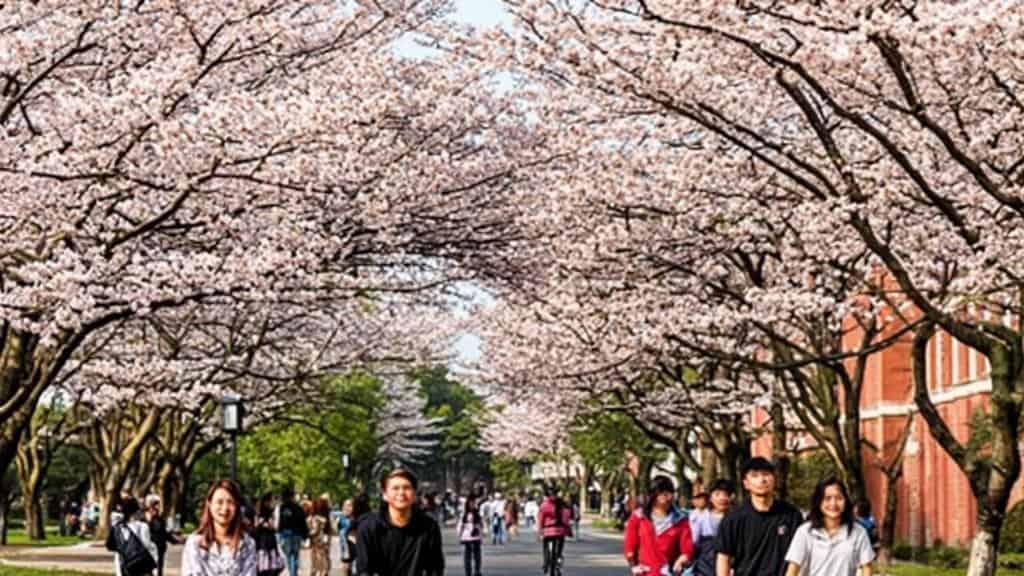
Huazhong University of Science and Technology does not look like a typical engineering school. Walk through its south gate in mid-March, and the first thing that hits you is not the smell of a laboratory. It is the scent of cherry blossoms.
Pink and white petals drift across footpaths. Students cycle beneath arching branches. Somewhere between the lecture halls and the research centers, thousands of flowering trees turn a world-ranked STEM campus into something that honestly looks more like a nature park.
That combination — serious academic prestige wrapped inside a 72% green-covered “Forest University” — is exactly what makes this place so quietly remarkable. And surprisingly few international visitors seem to know about it yet.
Why the Cherry Blossom Season at Huazhong University of Science and Technology Matters
The cherry blossom season at HUST runs from mid-March to early April each year. Both the East and West campuses light up with blooms during this window (China Daily, 2025).
Visitors can enter by scanning a QR code at the gate. No elaborate booking system. No ticket queue. Just show up with your ID and walk in.
In Japan, cherry blossom season carries deep cultural weight — the concept of mono no aware, the bittersweet beauty of things that don’t last. Wuhan has its own version of that feeling. The blossoms peak for barely ten days. Then the petals fall like snow, carpeting the ground in white.
The difference is this: in Japan, people pause their lives to watch the blossoms. At HUST, students keep studying around them. You can sit under a flowering tree and open a textbook. That overlap — productivity and beauty coexisting — is oddly striking.
The “Forest University” That Ranks in the Global Top 100
Before we go further — what exactly is Huazhong University of Science and Technology?
It is a public research university in Wuhan, Hubei, directly under China’s Ministry of Education. It was formally established in 2000 through the merger of three institutions, with roots tracing back to 1952 (Wikipedia, 2025).
The numbers speak clearly:
- 73rd globally in the 2025 Academic Ranking of World Universities (ARWU)
- 91st globally in the 2025 U.S. News Best Global University Rankings
- 300+ partner universities across 41 countries and regions (HUST Official, 2024)
Academically, HUST is particularly strong in engineering, medicine, optoelectronics, and management. Its Optics Valley spin-off helped transform the area around its campus into one of China’s leading high-tech zones.
But arguably the most memorable statistic: its campus covers over 7,000 mu (roughly 1,140 acres) with a green coverage rate of 72% — officially earning it the nickname “Forest University” (Baidu Baike, 2025).
What Studying at a Forest University Actually Feels Like
Here is something that rarely appears in English-language content about HUST: what it is like to spend a semester — or four years — in a campus that genuinely feels like a forest.
The four seasons each bring something distinct:
- Spring (March–April): Cherry blossoms and magnolias bloom in sequence. The campus trails become walking galleries.
- Summer (June–August): Pink lotus flowers open across the campus ponds. The greenery turns deep and heavy.
- Autumn (September–November): Osmanthus trees release a fragrance that drifts across entire districts. Ginkgo leaves turn gold along the main avenues.
- Winter (December–February): Wintersweet blossoms near the pavilions, understated and fragrant, in the style of classical Chinese poetry.
Compare this to many Western university campuses — well-maintained but largely functional in design. The idea that a top-ranked technical university would frame its academic identity around seasonal natural beauty is, perhaps, distinctly Chinese. Nature and scholarship are not treated as opposites here.
Yujiasan: The Mountain Inside the Campus
Here is one detail about Huazhong University of Science and Technology that tends to stop people mid-sentence.
There is a mountain on the campus.
Yujiasan (喻家山) rises 149.5 meters above sea level — the highest peak in central Wuhan. It sits inside the northern edge of the main campus. Students hike it in the mornings. Alumni get married on it in autumn (Baidu Baike, 2025).
From the summit platform, Fengfei Tai, you can see HUST’s entire campus, East Lake, and stretches of the Jiufeng Forest Park beyond. The geology is old — the mountain formed during the Yanshan orogeny, giving it a geological age of over 100 million years.
That said, perhaps the most unexpected fact about Yujiasan: in 1983, HUST used a tunnel inside the mountain — an old air defense shelter — as a physics laboratory to measure the gravitational constant (Baidu Baike, 2025). Possibly the only experiment in Chinese academic history conducted inside a mountain, inside a university campus.
The Study Culture: “Learning at HUST” Has a Reputation
Within China, there is a phrase: 学在华工 — “studying at Hua Gong.” It predates the current name and reflects a genuine academic culture that HUST has cultivated for decades.
The curriculum is rigorous, particularly in engineering and medicine. The campus library is large and heavily used. Study habits here lean intensive rather than casual.
For international students, this culture has an interesting side effect: academic competition is taken seriously, and the peer environment pushes hard. This can be demanding — or energizing, depending on your temperament.
Contrast this with many Western university cultures where the “work hard, play hard” balance is more explicitly modeled. At HUST, the balance tends toward “work hard, then walk in the forest.”
Both models produce excellent outcomes. They just feel different.
The Wutong Study Center: Soviet Architecture Meets Specialty Coffee
The Wutong Study Center (梧桐语问学中心) is one of those campus spaces that quietly becomes someone’s favorite place. It opened in 2019, converted from a cluster of 1960s Soviet-style red brick buildings — the kind of architecture you find in Moscow, Minsk, or Berlin’s eastern districts (Wikipedia HUST, 2025).
Inside, the function is entirely different from the exterior. There is a specialty coffee shop, a small cinema, a bookstore selling both academic texts and HUST-branded merchandise, and quiet reading rooms on the upper floors.
This contrast — Cold War-era architecture repurposed into a calm, contemporary study space — is perhaps an unintentional metaphor for HUST itself. Old forms, new content.
Former German Chancellor Angela Merkel gave a speech in this complex during a campus visit. That history did not stop students from turning it into their preferred afternoon study spot.
Practical Details for Visitors and Prospective Students
For visitors:
- Entry requires ID card scanning at the gate (no advance online booking required as of 2025)
- Recommended visit route: South Gate → History Museum → Wutong Study Center → Yujiasan
- Full walk takes approximately 4 hours
- Metro Line 2 stops directly at “Huazhong University of Science and Technology” station, Exit D
Cherry blossom timing:Cherry blossoms bloom in the East and West campuses of Huazhong University of Science and Technology from mid-March to early April. Peak bloom typically lasts 7–10 days.
For prospective students:
- HUST accepts international students and offers Chinese Government Scholarships
- Programs available in English, particularly at postgraduate level
- Accommodation on campus runs approximately 15–30 RMB per day (CUCAS, 2025)
- The university partners with institutions including the University of Maryland and over 300 others globally (HUST Official, 2024)
A Final Thought
There is a particular kind of university that does not shout about itself. Huazhong University of Science and Technology has world-ranked research, a campus that blooms in spring, a mountain with a physics laboratory in its basement, and a canteen system so elaborate that locals speak about it with genuine reverence.
Most of this has not made it into the English-language conversation about Chinese universities. Perhaps that is part of the appeal.
If you are considering where to study in China — or simply where to visit in Wuhan next March — the Forest University deserves a closer look.
References
China Daily. (2025, March 14). Invitation to view Wuhan’s cherry blossoms. https://govt.chinadaily.com.cn/s/202503/14/WS67dbe5cd498eec7e1f7325c6/invitation-to-view-ovcs-cherry-blossoms.html
Huazhong University of Science and Technology. (2024). About HUST: International cooperation. https://www.hust.edu.cn/
Wikipedia contributors. (2025). Huazhong University of Science and Technology. In Wikipedia, The Free Encyclopedia. https://en.wikipedia.org/wiki/Huazhong_University_of_Science_and_Technology
TopUniversities. (2025). Huazhong University of Science and Technology ranking. QS World University Rankings 2026. https://www.topuniversities.com/universities/huazhong-university-science-technology
CUCAS. (2025). Huazhong University of Science and Technology: Programs and fees. https://hust.cucas.cn/
Baidu Baike. (2025). Huazhong University of Science and Technology [Encyclopedia entry]. https://baike.baidu.com/item/%E5%8D%8E%E4%B8%AD%E7%A7%91%E6%8A%80%E5%A4%A7%E5%AD%A6/160107
Baidu Baike. (2025). Yujiasan [Encyclopedia entry]. https://baike.baidu.com/item/%E5%96%BB%E5%AE%B6%E5%B1%B1/2508184