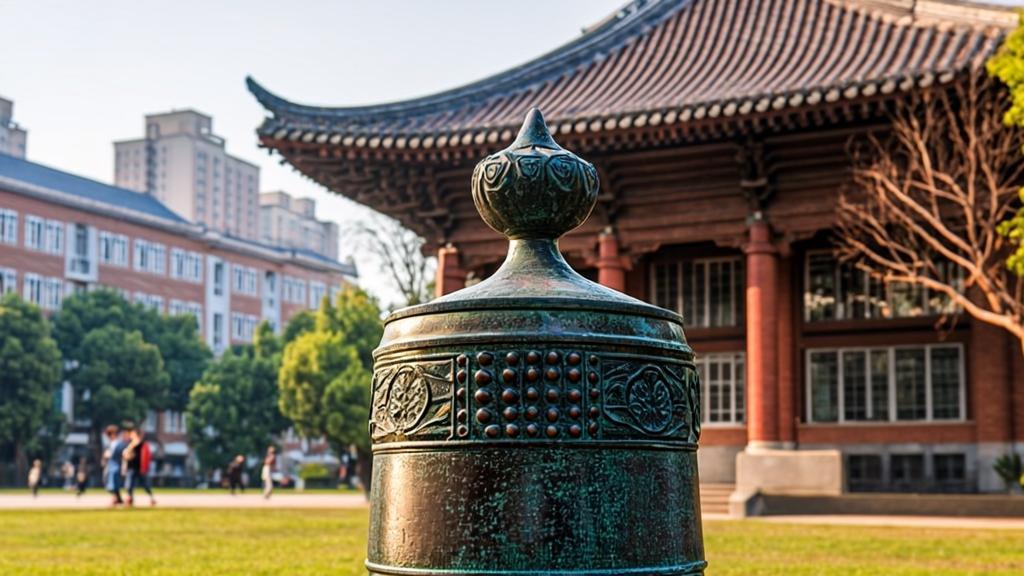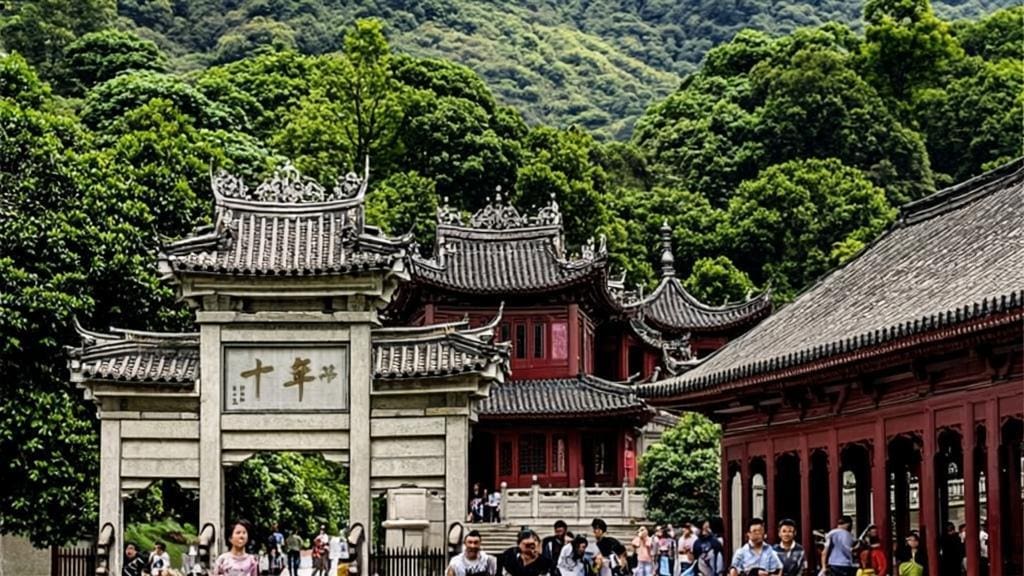
Hunan University sits in Changsha, China, beside the Xiang River and at the foot of Yuelu Mountain. From the outside, it looks like many other modern Chinese campuses — wide paths, research buildings, students on bikes. But walk a few minutes deeper into the grounds, and something shifts. The red-painted walkways narrow. Gray-tiled rooftops appear between ancient trees. A plaque above an arched gate reads: “The Thousand-Year-Old Academy.”
That’s not a metaphor. It’s a statement of fact.
The Place That Predates Oxford — Hunan University’s Ancient Core
Yuelu Academy was founded in 976 AD, during China’s Song Dynasty. That puts it roughly 120 years older than the University of Oxford (est. ~1096) and about 112 years older than the University of Bologna (est. 1088), Europe’s oldest university (Wikipedia, 2024).
Most remarkably, it never stopped operating. It survived the Song, Yuan, Ming, and Qing dynasties. It survived wars, fires, and multiple reconstructions. In 1903, it became a modern higher learning institution. In 1926, it was officially renamed Hunan University (The Conversation, n.d.).
No other ancient Chinese academy made this unbroken transition. As Hunan University itself describes it, the school has been “an institution of higher education run at a permanent location for the longest time in China” (The Conversation, n.d.).
In other words: the classroom is real. Students still walk through the same gates. Lectures still happen in the same hall.
What the Academy Actually Taught — And Why It Still Matters
The Hunan University Lecture Hall Where 1,000 People Showed Up to Watch a Debate
In 1167 AD, two of China’s most influential thinkers arrived at Yuelu Academy. Zhu Xi had traveled from Fujian. Zhang Shi was already teaching here. Their meeting — known as the “Zhu-Zhang Debate” — drew more than a thousand spectators (Sixth Tone, n.d.).
They weren’t arguing about politics. They were debating the nature of the mind, self-cultivation, and how humans relate to the cosmos. The debate lasted days. It shaped Neo-Confucian philosophy for centuries.
Think about that. No microphone. No livestream. Just two philosophers exchanging ideas in an open hall — and a thousand people showing up because the ideas mattered.
This tradition of open intellectual debate is not a relic. It became the Academy’s defining identity. Cross-regional scholarly exchange, lectures open to outsiders, competing schools of thought welcomed into the same space — all of this traces back to that single forum in 1167 (Sixth Tone, n.d.).
How Hunan University Kept the Spirit Alive in a Modern World
The “Seek Truth From Facts” Motto — And a Famous Student Who Took It Seriously
Above the Lecture Hall hangs a plaque with four Chinese characters: 实事求是 — “Seek Truth from Facts.” The phrase was carved there in 1917. A young student named Mao Zedong lived and studied near the Academy between 1917 and 1919. He later made this motto a cornerstone of his political philosophy (The Manila Times, 2025).
The motto itself comes from the Book of Han, an ancient Chinese historical text. But the emphasis on empirical truth, practical knowledge, and the unity of thought and action — zhixing heyi, often translated as “Unity of Knowledge and Action” — runs far deeper than a single phrase. It was Zhang Shi’s core teaching principle back in the 12th century (China Tripedia, 2025).
In Western terms, you might compare this to the Socratic tradition — learning through questioning rather than passive reception. But there’s a meaningful difference. The Socratic method uses dialogue to challenge existing beliefs. The Academy’s tradition uses dialogue to apply them to real-world responsibility. The goal was never just intellectual brilliance. It was cultivating people who could govern, serve, and improve society (Chinese Social Sciences Net, 2015).
That distinction still shapes how students learn at Hunan University today.
Learning at Yuelu Academy Today: Ancient Hall, Modern Curriculum
What Hunan University Students Experience Inside the Academy
Yuelu Academy currently functions as both a cultural research institute and an active academic department within Hunan University. It began recruiting undergraduate students in 2009 and has been implementing a “four-in-one” mentorship system since then — pairing each student with a dedicated faculty mentor (Sixth Tone, n.d.).
Several features set it apart from standard university study:
- Reading circles — Almost every faculty member runs a book discussion group, open to students across different specializations.
- Public lecture series — The “Yuelu Lecture Series” continues the tradition of open academic forums, now streamed online for external audiences (Sixth Tone, n.d.).
- Confucian ritual ceremonies — Students participate in traditional rites at the on-site Confucius Temple — not as performance, but as part of understanding classical ethical culture.
- Interdisciplinary programs — History, philosophy, archaeology, and cultural heritage studies are offered together, reflecting the Academy’s belief that knowledge domains should not be artificially separated.
In December 2024, the Academy hosted a “Yuelu Academy Hackathon” — students using AI tools to reinterpret classical texts and design digital cultural products. Ancient hall, laptop screens, Neo-Confucian philosophy. The combination is stranger and more interesting than it sounds (Yuelu Academy, Hunan University, 2024).
Why This Matters for Foreign Students — And What Hunan University Offers Internationally
Hunan University ranks #151 globally in the 2025 Academic Ranking of World Universities (ARWU) and #109 globally in the 2025 U.S. News Best Global University Ranking (Wikipedia, 2024). It is a Project 985 and Double First-Class university under China’s Ministry of Education.
International students from 38 countries and regions — including the US, Germany, Russia, Japan, and South Korea — currently study at Hunan University across undergraduate, master’s, and doctoral programs (Hunan University Foreign Languages and International Education College, n.d.).
The university also runs a Chinese Government Scholarship International Summer School Program, approved and funded by the China Scholarship Council (CSC). This program invites international scholars for short-term academic exchange, including courses connected to the Yuelu Academy’s research in traditional Chinese culture (Hunan University International Cooperation Office, 2025).
For anyone studying Chinese history, philosophy, East Asian cultural studies, or simply curious about how a 1,000-year-old intellectual tradition intersects with a top-200 research university — this combination is, genuinely, unlike anything else in the world.
East Meets West: Two Ancient Models, One Shared Instinct
Here’s something worth pausing on. The University of Bologna — Europe’s oldest — was founded in 1088. Yuelu Academy was founded in 976. They emerged on opposite sides of the world, within roughly a century of each other.
Bologna focused on law, science, and rational empiricism. Yuelu focused on moral cultivation, classical texts, and the duty to serve society. Two very different philosophies of what education is for.
But both insisted that learning should not happen in isolation. Both believed in debate, intellectual community, and the transmission of knowledge across generations. And both — remarkably — are still operating today, in evolved but recognizable form.
Most universities in the world carry the idea of a founding date. Hunan University carries something rarer: an unbroken lineage. The building where Zhu Xi lectured still stands. The platform where he stood is still there. Students walk past it on the way to class.
That’s not history preserved behind glass. That’s history still in use.
References
The Conversation. (n.d.). Hunan University institution profile. https://theconversation.com/institutions/hunan-university-5996
Wikipedia. (2024). Hunan University. https://en.wikipedia.org/wiki/Hunan_University
Wikipedia. (2024). Yuelu Academy. https://en.wikipedia.org/wiki/Yuelu_Academy
Sixth Tone. (n.d.). A onetime Confucian academy balances past, present, and future. https://www.sixthtone.com/news/1009901
Chinese Social Sciences Net. (2015, March 12). Quality education a hallmark of ancient Chinese academies. http://english.cssn.cn/skw_research/education/201503/t20150312_5654133.shtml
China Tripedia. (2025, March 11). Yuelu Academy: One of the four ancient academies in China. https://chinatripedia.com/yuelu-academy-one-of-the-four-ancient-academies-in-china/
The Manila Times. (2025, October 13). As an academy even older than University of Cambridge, the great wisdom “seeking truth from facts” took root here. https://www.manilatimes.net/2025/10/13/tmt-newswire/pr-newswire/as-an-academy-even-older-than-university-of-cambridge-the-great-wisdom-seeking-truth-from-facts-took-root-here/2199247
Hunan University International Cooperation Office. (2025). 2025 International Summer School Program — Chinese Government Scholarship. https://wsc.hnu.edu.cn/info/1279/4326.htm
Hunan University Foreign Languages and International Education College. (n.d.). College overview. http://school.nseac.com/a/10532/10532011.html
New World Encyclopedia. (n.d.). Academies (Shuyuan). https://www.newworldencyclopedia.org/entry/Academies_(Shuyuan)