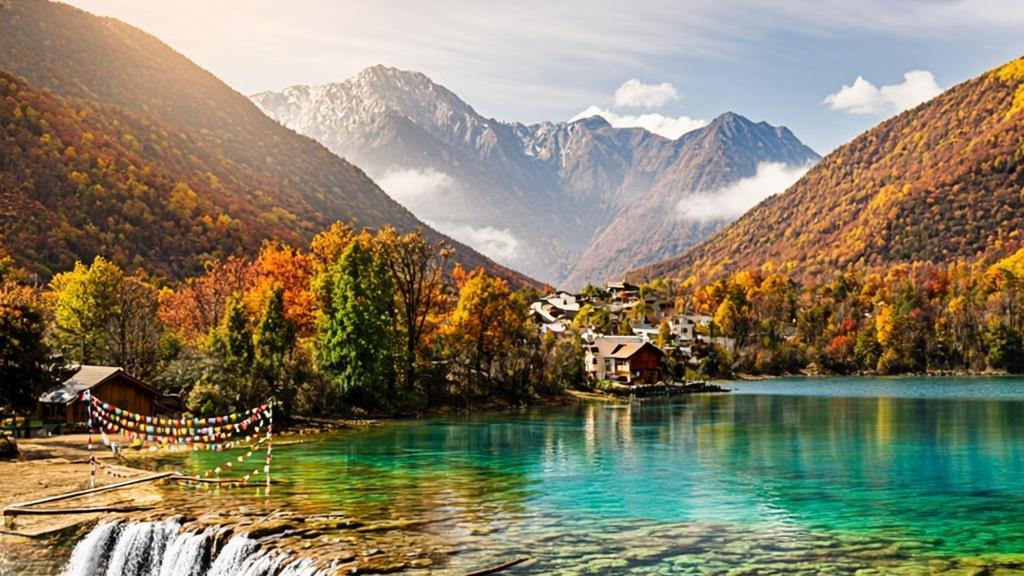
Jiuzhaigou Valley doesn’t look real. That’s the most honest thing you can say about it. Turquoise lakes that shift color from jade to sapphire depending on the hour. Waterfalls laced through autumn forests. Snow peaks reflected on a glassy surface above 3,000 meters. Visitors who’ve been to Plitvice in Croatia or the Canadian Rockies often say Jiuzhaigou feels like both — combined, intensified, and filtered through something older and stranger.
Located in northern Sichuan Province in southwestern China, this UNESCO World Heritage Site spans 72,000 hectares and rises to over 4,800 meters above sea level. It draws over 5 million visitors a year. And yet, somehow, it still surprises people.
Why Jiuzhaigou Valley Looks the Way It Does
The colors aren’t magic. But the explanation is almost as good.
The lakes get their extraordinary hues from dissolved calcium carbonate — the same mineral that forms stalactites. As water flows over limestone terrain, it deposits travertine on the lakebed and along natural dams. These deposits scatter sunlight differently at different depths, creating blues, greens, golds, and sometimes deep purples — sometimes all in the same lake, at the same time.
At Five-Flower Lake (五花海), submerged tree trunks sit beneath crystal-clear water, transformed over centuries into pale, coral-like forms. The water above them shifts from sapphire at the center to gold at the shallows. No filter needed.
In contrast, think of the colored pools at Yellowstone National Park in the US. Those colors come from thermophilic microorganisms in geothermal water. Jiuzhaigou uses entirely different chemistry — cold, glacially-fed mineral water and limestone geology — to create a similar visual wonder. Two completely different processes. Two equally stunning results. It’s worth noticing how nature tends to find different roads to the same kind of beauty.
The Name and the People Behind It
Jiuzhaigou (九寨沟) translates literally as “Nine Settlement Valley.” The name comes from the nine Tibetan villages that have existed along its length for centuries. This wasn’t discovered by the outside world until 1975, when forestry scientist Wu Zhonglun surveyed the region. He later wrote to provincial authorities urging immediate protection, saying he had traveled in Europe and America but never encountered natural beauty like this (Wikipedia – Jiuzhaigou).
That letter arguably saved the valley. Logging was halted. A nature reserve was established by 1980. UNESCO inscribed it as a World Heritage Site in 1992 and a World Biosphere Reserve in 1997.
Today, Tibetan and Qiang communities still live inside the reserve boundaries. Their wooden houses and prayer flags appear between the trees. It’s a different kind of nature park — one where the human presence isn’t edited out, but treated as part of the landscape.
What to See: The Jiuzhaigou Valley’s Three Branches
Jiuzhaigou is shaped like a Y. Three valleys branch out from a central junction, each offering something distinct.
Shuzheng Valley — Where Most Visitors Begin
The main entrance leads into Shuzheng, about 14–15 km long. It’s gentler in terrain and features a long string of lakes connected by boardwalks.
Key highlights:
- Nuorilang Waterfall — 300 meters wide, making it China’s widest high-altitude waterfall. Especially striking in morning light or when a rainbow forms in the mist.
- Rhinoceros Lake — one of the largest in the valley, calm and reflective.
- Shuzheng Lakes — a tiered sequence of pools, best seen from the boardwalk above.
Rize Valley — The Most Photographed
Rize is where most iconic Jiuzhaigou images come from.
- Five-Flower Lake — the crown jewel. Multiple colors visible simultaneously. Best before 10 AM.
- Mirror Lake — arrives early or not at all. By mid-morning, wind breaks the reflection.
- Pearl Shoal Waterfall — broad and shallow, running over a wide travertine terrace. In autumn, the surrounding maple trees make it look like fire poured over stone.
- Panda Lake — named for giant pandas once spotted drinking here. Sightings are rare now, but the lake itself earns the visit.
Zechawa Valley — The High Ground
This left branch climbs to higher elevation.
- Long Lake (长海) — the highest and largest lake in the valley. At 4,000 meters, the air is thin and the silence is heavy.
- Five-Color Pond (五彩池) — small but startlingly vivid. Often called the most colorful single pool in all of Jiuzhaigou.
When to Go to Jiuzhaigou Valley
Each season shows a different face. But not all faces are equal.
Autumn (late September to October) is peak season — and for good reason. Maple and birch forests flame red, orange, and gold. The autumn colors reflect in the lakes, doubling the spectacle. This is Jiuzhaigou at full intensity. Book everything well in advance.
Spring (March to May) is quieter. The snowmelt feeds the waterfalls to full capacity. Crowds are manageable. Some high-altitude areas may still carry ice.
Summer (June to August) brings the heaviest rainfall and lush green canopy. The lakes run deep and dark. It’s beautiful, but wet — and this is also when visitor numbers peak. Expect company.
Winter (December to February) surprises people. Waterfalls freeze into vertical columns of blue ice. Snow covers the forests. The lakes stay vivid. Crowds drop to a fraction of autumn levels. Temperatures are cold, but manageable with the right gear. Perhaps the most underrated time to visit.
Getting Jiuzhaigou Valley: Easier Than It Used to Be
Jiuzhaigou earned a reputation for being remote and difficult to reach. That’s less true now.
By plane: Fly directly to Jiuzhai Huanglong Airport (JZH) from Chengdu — about a 40-minute flight. From the airport, a 90-minute transfer reaches the park entrance. Note: the airport sits at 3,448 meters altitude. Some passengers experience dizziness on arrival.
By high-speed train: The Huanglong-Jiuzhai railway station opened in August 2024, making this a genuinely new option. Chengdu to the station takes roughly 1.5–2 hours by high-speed rail, then a transfer by bus or car to the park (Wikipedia – Jiuzhaigou).
By road: The Chengdu–Jiuzhaigou Expressway opened in late 2025, cutting the drive to around 4 hours. Previously, the mountain road from Chengdu could stretch to 10 hours. This is a significant change.
Practical Tips Before You Go to Jiuzhaigou Valley
Tickets: Must be booked online in advance. The park operates a daily visitor quota. Walk-ins are not always available.
- Peak season (roughly April–October): approximately CNY 169–259 per person
- Eco-shuttle bus inside the park: approximately CNY 90 extra
- Low season pricing is lower — check the official site at www.jiuzhai.com
Altitude: Parts of the valley exceed 3,000 meters. Some areas reach 4,000+. Take it slow on the first day. Stay hydrated. Altitude medication is available in Chengdu and local pharmacies if needed.
Time needed: Two full days is the minimum to see all three valleys without rushing. Three days allows a more relaxed pace and time to visit nearby Huanglong.
Inside the park: An eco-friendly shuttle bus connects major stops throughout all three valleys. The recommended approach is to take the bus to the farthest points first, then walk downhill along the boardwalks. This saves energy and improves views.
Visa: As of December 2024, China’s visa-free transit policy allows travelers from 54 countries to stay up to 10 days without a visa. Citizens of France, Germany, Italy, Spain, and several other countries enjoy 30-day visa-free stays through 2025. Always verify current policies before booking (China Dragon Travel, 2025).
A Place Worth Protecting
Part of Jiuzhaigou’s story is resilience. In August 2017, a 7.0-magnitude earthquake struck the valley, destroying two natural dams — including the famous Nuorilang Waterfall dam — and forcing a full closure. The park reopened with limited access in March 2018 and has since recovered significantly. By 2024, annual visitors reached 5.11 million (Wikipedia – Jiuzhaigou).
That recovery matters. The geology here is fragile. The travertine formations that create the lake colors can take decades to build and seconds to damage. The visitor quota exists for good reason. So do the boardwalk paths that keep foot traffic off the lakebeds.
Jiuzhaigou works best when it’s respected. And when it is, it offers something genuinely rare — a landscape that feels both ancient and alive.
References
China Dragon Travel. (2025). Ultimate travel guide to Jiuzhaigou Valley. https://www.chinadragontravel.com/ultimate-travel-guide-to-jiuzhaigou-valley/
UNESCO World Heritage Centre. (1992). Jiuzhaigou Valley Scenic and Historic Interest Area. https://whc.unesco.org/en/list/637/
Wikipedia contributors. (2025). Jiuzhaigou. Wikipedia, The Free Encyclopedia. https://en.wikipedia.org/wiki/Jiuzhaigou