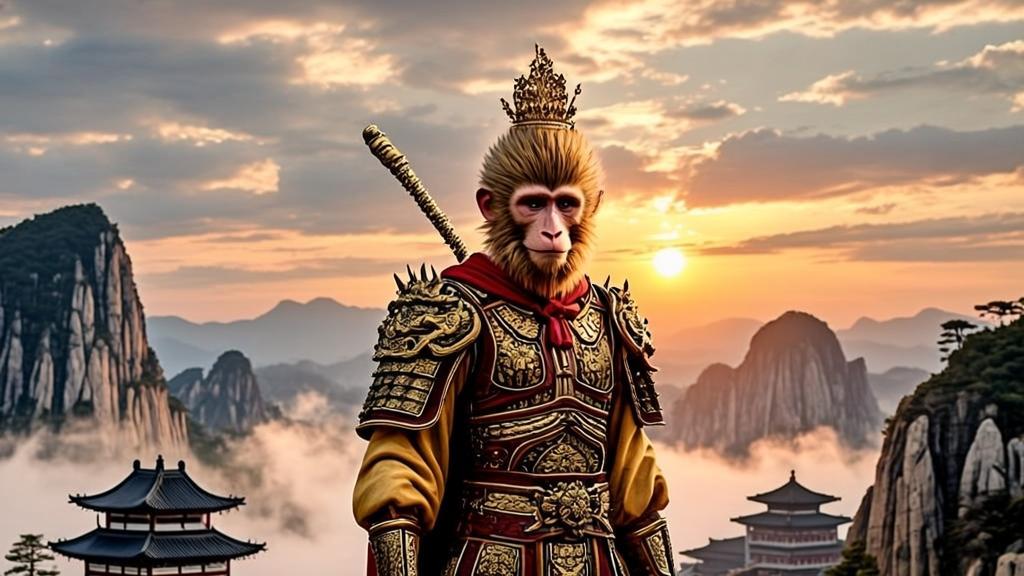
Journey to the West has existed for nearly 500 years. For most of that time, Western readers largely ignored it. Then a video game changed everything.
In August 2024, Game Science released Black Myth: Wukong — China’s first AAA action RPG. It sold 10 million copies in three days. Within a month, that number reached 20 million. By early 2025, total global sales surpassed 25 million units, generating revenues exceeding \$961 million (Meng, 2025). Those numbers are staggering on their own. But something quieter was also happening: Western players started picking up a 16th-century Chinese novel.
This wasn’t planned by a marketing department. It happened organically, driven by curiosity. And it offers a remarkable glimpse into how deeply a well-made game can open a door to an entirely different culture.
How a Video Game Turned Players into Readers of Chinese Mythology
Within 22 days of the game’s launch, eBay data from the UK, US, Canada, and Australia showed a 31% spike in Journey to the West book sales compared to the three prior months combined (TheGamer, 2024). On Reddit, players openly admitted they bought the original text just to understand the lore better.
“Yo, have you read Journey to the West? This game got me to read the book. Now I’m doing my reread before it’s out,” posted Reddit user Gamskining (Global Times, 2024).
That reaction is not accidental. The game was designed precisely to spark that curiosity. Game Science made a deliberate choice not to simplify Chinese mythology for Western audiences. Instead, it leaned in. Taoist talismans, Buddhist relics, demon hierarchies, ancient temple architecture — all rendered without apology or explanation. Players who wanted to understand what they were experiencing had to seek out the source.
Many did.
What Is Journey to the West, Really?
Most Westerners know Sun Wukong, the Monkey King, only vaguely. Maybe from old cartoons. Maybe from a brief pop culture reference. The actual novel goes much further.
Journey to the West is one of China’s Four Great Classical Novels, written in the 16th century by Wu Cheng’en. It follows the Buddhist monk Xuanzang and his three disciples — including the defiant, shape-shifting, fire-wielding Monkey King — as they travel from China to India to retrieve sacred scriptures. The journey spans 14 years and encounters 81 trials.
On the surface, it’s a sweeping adventure. Underneath, it operates on multiple levels simultaneously:
- A Taoist commentary on the corruption of celestial bureaucracy and the absurdity of rigid hierarchy
- A Buddhist allegory about ego, desire, attachment, and the path to enlightenment
- A Confucian meditation on loyalty, duty, and what it means to serve a greater purpose
Sun Wukong begins the story as pure chaos. He rebels against heaven itself. Wukong defeats divine armies. He is imprisoned under a mountain for 500 years as punishment. Eventually, he earns freedom — not through combat, but through spiritual transformation. That arc is the emotional core of the novel, and it’s also the emotional core of the game.
Why Western Players Find This Mythology So Compelling
Western mythology offers rebellious figures too. Prometheus stole fire from the gods and was chained to a rock for eternity. Loki orchestrated divine mischief in Norse mythology. Lucifer fell from heaven in Christian tradition.
But those stories mostly end in permanent punishment or exile. The rebellious figure rarely redeems himself through genuine inner change — he remains defined by his transgression.
Sun Wukong’s arc works differently. His rebellion is real. His punishment is real. But so is his eventual awakening. He doesn’t become good because he’s forced to. He becomes good because, through the journey, he understands why it matters. That distinction is subtle. For many Western players encountering it through Black Myth: Wukong, it feels genuinely novel.
Moreover, the game’s world is saturated with details that reward curiosity. There are dozens of boss characters — each drawn from specific chapters of the novel, each with their own mythology and motivation. Players who recognized only one or two of them reported going back to read the source material just to understand the others. The novel functions, in this sense, as the ultimate lore expansion.
The Sun Wukong No One Told You About
Here’s what most Western readers don’t expect: Sun Wukong is genuinely funny.
He is arrogant, vain, impulsive, and wildly overclaims his abilities — often immediately before pulling them off. Wukong argues with Xuanzang constantly. He complains. He schemes. Wukong shows favoritism and harbors grudges. He is, in short, one of the most human characters in any epic tradition, despite being a supernatural monkey.
This is part of why Journey to the West has sustained a readership in China for nearly 500 years. The Monkey King doesn’t represent an ideal. He represents the particular difficulty of becoming better than you currently are — which is a problem every person understands.
The game captures this characterization with real skill. Players often describe feeling genuine affection for the Destined One, the game’s protagonist. That affection has a direct literary lineage.
The Tourism Effect: From Screen to Sacred Sites
The cultural impact of Journey to the West through this game didn’t stay digital. Black Myth: Wukong features 36 real-world locations in China, 27 of which are concentrated in Shanxi Province. According to data presented at the China Game Industry Annual Conference 2025, ticket revenue from those Shanxi heritage sites rose sharply in the two months after the game’s release — exceeding 160 million yuan (approximately \$22.7 million USD) (Automaton West, 2024).
Several heritage sites even offered free entry to players who could prove they had completed the game. That is a remarkable convergence: a 16th-century Chinese novel, a video game built from its mythology, and ancient temples offering free admission to foreign players who engaged with both.
Additionally, the Black Myth art exhibition at the China Academy of Art’s museum in Hangzhou ran for 108 days — originally planned for 40 — due to overwhelming demand. Around 450,000 visitors attended, with over 80% under the age of 18 (Automaton West, 2024). For many, it was their first visit to an art museum.
What the Novel Gives You That the Game Cannot
The game is magnificent. It is also roughly 40 hours long. The novel is 100 chapters.
Journey to the West contains political satires embedded inside demon-kingdom storylines. It has passages of intricate poetry woven into the prose narrative. Journey to the West has extended philosophical debates between characters about the nature of the mind, reality, and enlightenment. It has jokes — very good ones.
Scholars have spent centuries debating what Wu Cheng’en was really saying about imperial power, religious orthodoxy, and the nature of the self. The reader who comes to the novel after the game arrives with a character already vivid in their mind. Sun Wukong is no longer an unfamiliar name — he is someone the reader has already spent dozens of hours with. That changes how the novel reads entirely.
For those wanting to start: the most complete English translation is by Anthony C. Yu (University of Chicago Press, 2012) — four volumes that preserve the novel’s poetry and philosophical depth. A more accessible single-volume abridged edition by W.J.F. Jenner is also widely available and gives a strong sense of the full narrative.
A Bridge That Took 500 Years to Build
Journey to the West didn’t need a Western audience to be a masterpiece. It already was one, on its own terms, in its own language, within its own tradition.
But Black Myth: Wukong offered something rare: a high-quality, visually stunning, emotionally compelling entry point for readers who had no prior reason to find their way into Chinese literary mythology. The game sold 25 million copies globally. Not every player will read the novel. But the ones who do will find that Sun Wukong — chaotic, brilliant, ultimately striving toward something better — is a character who transcends every cultural boundary he crosses.
That, in a way, is the whole argument of Journey to the West. The destination is only ever a pretext. What matters is who you become on the way there.
References
Automaton West. (2024, December 22). Black Myth: Wukong’s cultural impact responsible for huge boost in tourism of Chinese province used as setting. https://automaton-media.com/en/news/black-myth-wukongs-cultural-impact-responsible-for-huge-boost-in-tourism-of-chinese-province-used-as-setting/
Fan, F. X. (2025). From myth to market: Lessons from Black Myth: Wukong’s success. SSRN Working Paper. https://ssrn.com/abstract=5123353
Global Times. (2024, June). ‘Black Myth’ makes its journey to the west. https://www.globaltimes.cn/page/202406/1314556.shtml
KitGuru. (2025, February 3). Black Myth: Wukong surpasses 25 million copies sold. https://www.kitguru.net/gaming/joao-silva/black-myth-wukong-surpasses-25-million-copies-sold/
Meng, Q. (2025). Black Myth: Wukong: The internationalization of Chinese games. Journal of Media and Social Sciences. https://atripress.org/index.php/jmss/article/download/173/150
TheGamer. (2024, September 10). Black Myth: Wukong has caused a huge spike in Journey to the West book sales. https://www.thegamer.com/black-myth-wukong-spike-in-journey-to-the-west-book-sales/
Wang, Y., & Wang, X. (2025). The global dissemination of Chinese culture through Black Myth: Wukong: A systematic literature review. Research in Communication and Culture, 13, 83–96. https://rcommunicationr.org/index.php/rcr/article/download/170/71/1042