South Korea’s two leading semiconductor companies — Samsung Electronics and SK Hynix — have significantly increased investment in their Chinese manufacturing facilities in 2025. The move signals that Korean chip giants are doubling down on China at a time when global AI memory demand has pushed supply to its tightest point in over a decade.
Investment Numbers: Korean Chip Giants Sharply Boost China Spending
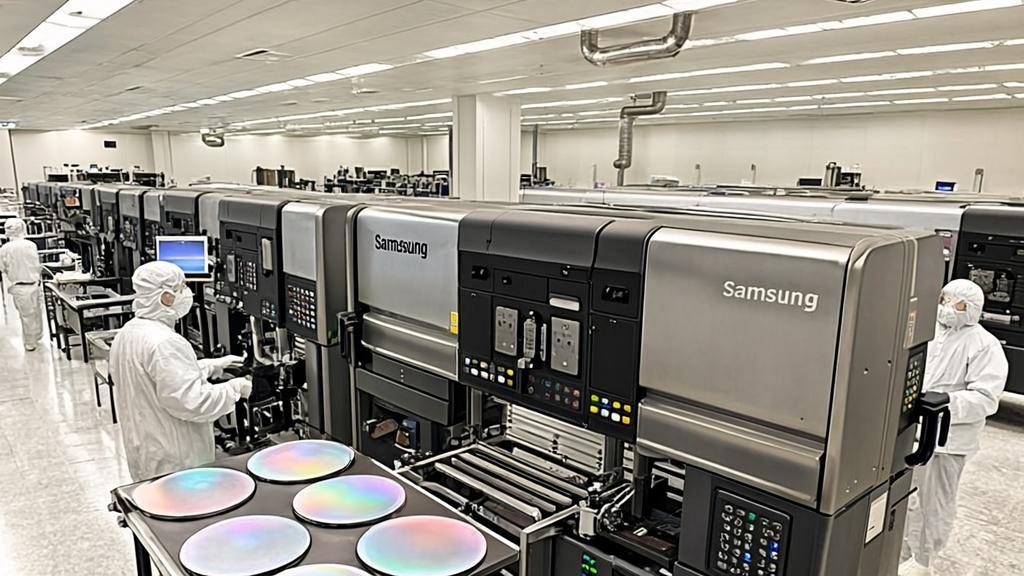
The figures are notable. According to annual reports filed with South Korea’s Financial Supervisory Service, Samsung invested 465.4 billion won (approximately USD \$308.8 million) in its Xi’an chip plant in 2025. That marks a 67.5% increase over the 277.8 billion won invested in 2024 (TechNode, 2026).
SK Hynix went even further. The company poured:
- 581.1 billion won into its Wuxi DRAM plant — up 102% year-on-year
- 440.6 billion won into its Dalian NAND facility — up 52% from 2024
Combined, SK Hynix’s Chinese investment exceeded 1 trillion won for the first time since it acquired Intel’s Dalian NAND plant in 2022 (TrendForce, 2026).
Why China? The Strategic Logic Behind the Investment
These are not new facilities. Samsung has operated its Xi’an plant since 2006. SK Hynix has run the Wuxi DRAM fab since the same year. So why invest heavily now, rather than simply building elsewhere?
The answer is straightforward. New semiconductor fabs typically take three to five years to construct. Speed matters when demand is surging.
Lee Byung-chul, a visiting research fellow at the Sejong Institute and a former Samsung Electronics executive vice president with 15 years of experience at its China subsidiary, put it plainly: “Optimizing operations at existing production bases in China enables a much faster supply response” (The Korea Times, 2026).
The stakes are high. Samsung’s Xi’an facility is its only overseas NAND flash memory plant, accounting for roughly 40% of total NAND output. SK Hynix’s Wuxi plant supplies more than 30% of its global DRAM production (Korea Times, 2026).
The AI Memory Shortage Driving the Push
Context matters here. Korean chip giants are increasing investment in China precisely because global memory demand — especially for AI — has outrun supply dramatically.
Goldman Sachs raised its 2026 DRAM supply shortfall estimate to 4.9% of total demand, up from 3.3%. Its analysts described the situation as potentially “the most severe shortage in 15 years.” The bank also lifted its NAND shortfall forecast to 4.2% (Korea Times, 2026).
The IDC further confirmed the trend. In a February 2026 analysis, the research firm noted that demand from AI data centers is “pulling a disproportionate share of global [memory] capacity,” leaving less DRAM available for consumer devices (IDC, 2026).
Both DRAM and NAND supply are, by most estimates, effectively sold out this year. Against that backdrop, Korean chip giants have every reason to maximize output from facilities already in operation — and China is home to some of their largest ones.
China as Market and Partner: The Broader Picture
China is not just a production base for Samsung and SK Hynix. It is also a crucial end market.
Samsung’s exports to China reached 64.9 trillion won (approximately USD \$44.8 billion) in 2024 — a 53.9% year-on-year increase, slightly exceeding its US exports for the first time (TrendForce, 2025). SK Hynix’s China sales subsidiary reported 13.1 trillion won in revenue and 1.4 trillion won in net profit in 2024, up 64.3% and 65.4% respectively.
China has actively welcomed the trend. During the recent China Development Forum in Beijing, Zheng Shanjie, head of China’s National Development and Reform Commission, met Samsung Executive Chairman Lee Jae-yong. He urged the company to “seize the opportunities arising from China’s continuous opening-up” and “further expand investment and cooperation” in the country (Korea Times, 2026). Both Lee and SK Hynix CEO Kwak Noh-jung attended the forum — notably, for the second consecutive year.
U.S. Export Controls: A Complicating Factor
The investment boom does not come without tension. In August 2025, the U.S. government revoked the “Validated End-User” status previously granted to Samsung and SK Hynix. That status had allowed them to import certain U.S.-made chip equipment to their Chinese plants without individual approvals. Now, both companies must seek annual licenses for such imports.
The U.S. government did grant 2026 approvals to both firms, according to Reuters / Yahoo Finance (2025). However, the annual review system introduces new uncertainty for long-term planning.
Lee Byung-chul of the Sejong Institute offered a candid assessment: “This investment underscores how Korean semiconductor firms are compelled to make the most of their existing production bases in China as U.S. export controls tighten. If the rivalry intensifies, Korean companies are likely to have no choice but to explore long-term adjustments to their production exposure in China” (Korea Times, 2026).
What This Means for China’s Semiconductor Landscape
Korean chip giants increasing investment in China is significant beyond the balance sheets of two companies. It reinforces China’s continued centrality as a global memory production hub — despite years of geopolitical pressure aimed at redirecting semiconductor supply chains.
China accounted for roughly 40–45% of SK Hynix’s total NAND output and 35–40% of its DRAM production in 2025, according to TrendForce estimates (TrendForce, 2026). Those are figures that don’t shift quickly, regardless of policy changes elsewhere.
For China’s semiconductor ecosystem more broadly, the continued presence and expansion of Samsung and SK Hynix brings advanced manufacturing expertise, equipment investment, and supply chain depth. It also signals to other foreign investors that China remains a viable, active partner in high-technology manufacturing — even in a complex global environment.
The situation remains dynamic. But for now, the numbers tell a clear story: Korean chip giants see China as an indispensable part of their near-term production strategy.
References
IDC. (2026, February). Global memory shortage crisis: Market analysis and the potential impact on the smartphone and PC markets in 2026. https://www.idc.com/resource-center/blog/global-memory-shortage-crisis-market-analysis-and-the-potential-impact-on-the-smartphone-and-pc-markets-in-2026/
Jin, H. (2025, December 30). US approves Samsung, SK Hynix chipmaking tool shipments to China for 2026, sources say. Reuters / Yahoo Finance. https://finance.yahoo.com/news/samsung-wins-us-annual-approval-041415683.html
The Korea Times. (2026, March 30). Korean chip giants step up China investments to combat AI memory shortage. https://www.koreatimes.co.kr/business/companies/20260330/korean-chip-giants-step-up-china-investments-to-combat-ai-memory-shortage
TechNode. (2026, March 26). Samsung and SK Hynix accelerate expansion in China. https://technode.com/2026/03/26/samsung-and-sk-hynix-accelerate-expansion-in-china/
TrendForce. (2025, March 13). Samsung & SK Hynix post strong 2024 sales in China, driven by China’s “Old-for-New” policy. https://www.trendforce.com/news/2025/03/13/news-samsung-sk-hynix-post-strong-2024-sales-in-china-driven-by-chinas-old-for-new-policy/
TrendForce. (2026, March 27). Memory giants’ China investments soar in 2025: Samsung Xi’an up 67%, SK Hynix Wuxi, Dalian hit trillion-won. https://www.trendforce.com/news/2026/03/27/news-memory-giants-china-investments-soar-in-2025-samsung-xian-up-67-5-sk-hynix-wuxi-dalian-hit-trillion-won/