The Archaeological Ruins of Liangzhu City sit quietly outside Hangzhou — and most foreign tourists walk right past them on the way to West Lake. That’s a mistake. This is the only place on earth where you can stand inside a 5,000-year-old city that was planned, engineered, and then swallowed by floodwaters. Think Atlantis, but real, verified by UNESCO, and an hour from Shanghai by train.
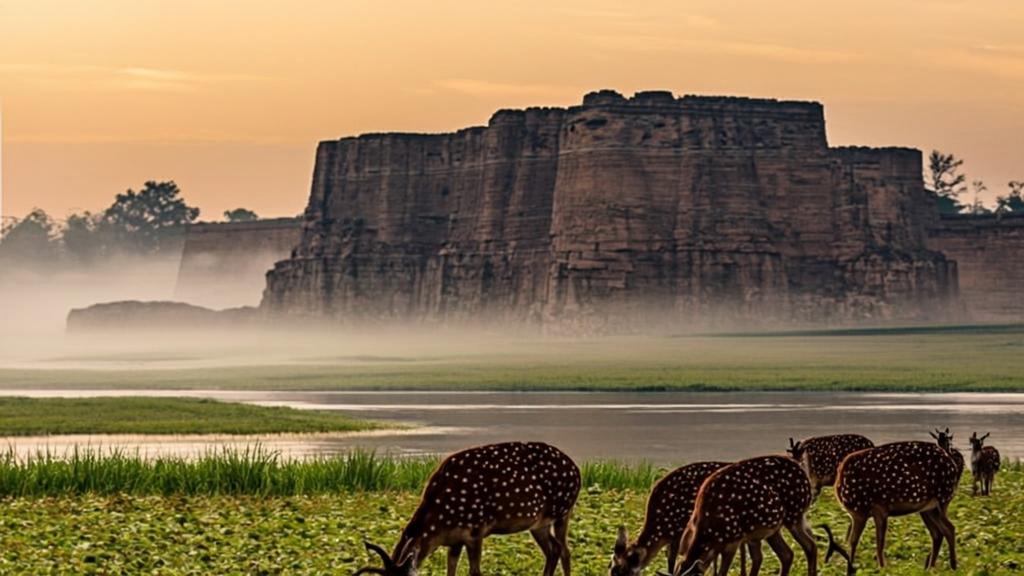
Also: there are deer.
What Is Liangzhu, Exactly?
Most people picture ancient China as bronze vessels and Confucian scholars. Liangzhu breaks that frame entirely.
Around 3,300–2,300 BCE — roughly 3,000 years before the Great Wall was built — a sophisticated urban civilization was already thriving here in the Yangtze River Delta. The Archaeological Ruins of Liangzhu City weren’t a village. They were a planned state, complete with a palace complex, a tiered social hierarchy, dedicated rice granaries, and a hydraulic engineering system that, according to archaeologists, predates comparable Mesopotamian dam-building by around three centuries.
Cambridge archaeologist Colin Renfrew — a Fellow of the British Academy — stated that the ruins provide “profound and compelling evidence that Chinese civilization started 5,000 years ago, 1,000 years earlier than previously thought.” UNESCO agreed. In 2019, the site was inscribed as a World Heritage property, described as an “outstanding example of early urban civilization.”
For context: when Liangzhu’s engineers were designing flood-control dams in the marshlands, ancient Egyptians were just beginning to build the pyramids.
The Water City That Shouldn’t Exist
Here’s the part that tends to stop people cold.
Liangzhu wasn’t built on solid ground. It was built in a swamp — a low-lying wetland plain at the foot of the Tianmu Mountains, laced with rivers and prone to flooding. And yet its inhabitants didn’t just survive there. They thrived for a thousand years, building a city covering over 2.9 million square meters.
How? Engineering.
The peripheral water conservancy system at Liangzhu consists of 11 dams, forming an interlocking network that controlled a watershed of roughly 100 square kilometers. It managed flood risk, supported irrigation, and enabled water transport throughout the city. This is, according to current evidence, the world’s oldest large-scale hydraulic engineering project — and it works on principles that engineers still recognize today.
Meanwhile, Western civilization was building with stone in deserts. Liangzhu was building with earth and water in a delta. Two completely different approaches to the same problem: how do you build something that lasts?
That contrast — water civilization versus desert civilization — is one of the more genuinely mind-expanding things about visiting this site. It offers a different origin story for what “advanced society” can look like.
Jade, Power, and a Symbol That Predates Everything
Beyond the dams, Liangzhu is famous for jade.
Over 4,229 jade artifacts have been recovered from elite cemeteries within the city. The most iconic is the jade cong — a tube-shaped ritual object with a square exterior and circular interior, carved with the recurring “sacred eye” motif known as the shen ren shou mian (divine face). These appear consistently across Liangzhu burial sites, suggesting a unified belief system across the entire regional state.
The jade cutting is extraordinary. These craftsmen, working around 3000 BCE, produced surface engravings so fine that some details are under 0.1mm thick — invisible to the naked eye and only discovered under magnification. No metal tools. All done with abrasive techniques and jade-tipped instruments.
Compare this to European Neolithic cultures of the same period: mostly stone tools, small settlements, no centralized state. Liangzhu had already moved past that phase entirely. Its social complexity, as Renfrew noted, “was on par with that of a country.”
If you want to understand why the jade cong matters: the mascot “Congcong” at the 2023 Hangzhou Asian Games was modeled directly on it. The Asian Games flame was first lit at Liangzhu. That’s how central this symbol remains to Chinese cultural identity.
The City Vanished — And That’s Also Fascinating
Around 2,300 BCE, Liangzhu disappeared.
No invasion. No conquest. Research published in 2021 suggests decades of extreme monsoon rainfall triggered catastrophic flooding that overwhelmed the dam system. The cultural layers at the site are interrupted by muddy, marshy deposits — evidence of the floods that ended a civilization. Liangzhu’s collapse may have occurred during the same global climate event that brought down the Old Kingdom of Egypt and the Akkadian Empire in Mesopotamia.
A civilization brought down by the very water it had mastered. That’s a story worth sitting with.
What to Actually Do There: A One-Day Route
The Archaeological Ruins of Liangzhu City cover nearly 100 square kilometers of protected land. Here’s a practical route that hits the highlights without overwhelming:
Morning — Bike the ruins park. Rent a bicycle at the East Gate. The Mojiaoshan Palace area is the centerpiece — a 300,000-square-meter artificial terrace that served as the royal and ceremonial hub. Seven granaries excavated here could store approximately 100 metric tons of rice. Stand on the mound and try to picture it. It takes a minute.
Midday — The Deer Park at Daguanshan. Yes, really. Next to the main service area, sika deer roam freely against a backdrop of wetland and ancient earthworks. Social media has started calling it “China’s little Nara” — a reference to Nara, Japan’s famous deer park. The comparison holds. It’s genuinely beautiful, and genuinely photogenic.
Afternoon — Liangzhu Museum. This is the intellectual payoff. The museum was designed by British architect David Chipperfield — the 2023 Pritzker Prize laureate — as four travertine stone bars set on a lake, connected by bridges. The building alone is worth the visit. Inside, AR-guided tour technology brings ancient craftsmanship to life. The museum houses over 1,000 excavated objects, including the famous “King of Cong” jade. Allow at least two hours.
Late Afternoon — Sunset on Mojiaoshan. If the timing works, come back to the palace mound for the sunset. This is where the Liangzhu king lived 5,000 years ago. The view hasn’t changed much — wetlands, hills, sky. The same light that fell here then falls here now. It’s one of those quietly affecting travel moments that doesn’t require explanation.
Before or After: West Lake and Dragon Well Tea
One practical note worth making: Liangzhu sits in Hangzhou’s Yuhang District, roughly 30 kilometers from the city center. West Lake — one of China’s most celebrated landscapes and itself a UNESCO World Heritage Site — is an easy addition to the same trip.
More specifically, the Dragon Well (Longjing) tea-growing region lies between Liangzhu and West Lake. In the morning you stand inside a 5,000-year-old hydraulic city. In the afternoon you drink the freshest possible cup of Longjing tea in the hills where it grows. That combination of deep antiquity and living culture is exactly the kind of thing that makes travel in this region different from anywhere else.
Getting There
Liangzhu is accessible from Hangzhou city center by metro (Line 2 to Liangzhu Station) plus a short taxi ride. From Shanghai, high-speed rail to Hangzhou takes about 45 minutes.
Entrance to the archaeological site park: ¥80 per person. The Liangzhu Museum admission is free (passport required for registration). Best visited any time of year, though spring and autumn offer the most comfortable conditions.
For current visa requirements and entry policies, check China’s National Immigration Administration. Citizens of 45 countries, including most EU member states, Australia, Japan, and South Korea, currently enter China visa-free for up to 30 days.
Why This Place Gets Overlooked — And Why That’s Changing
Most foreign visitors to China follow the same circuit: Beijing, Xi’an, Shanghai. Those are all worth it. But Liangzhu offers something different — a prehistory that most Westerners haven’t encountered and that meaningfully changes how you understand the phrase “ancient China.”
The Archaeological Ruins of Liangzhu City are not a reconstruction. Not a theme park version of the past. They are actual earthworks, actual cemeteries, actual dam foundations — a 5,000-year-old city that you can walk through, bicycle around, and watch deer wander across at midday.
UNESCO recognized it. Cambridge archaeologists were astonished by it. The Asian Games lit their flame here.
Most foreign tourists still haven’t heard of it. That gap won’t last much longer.
References
David Chipperfield Architects. (2008). Liangzhu Culture Museum. https://davidchipperfield.com/projects/liangzhu-museum
Hangzhou Liangzhu Archaeological Site Administrative District Management Committee. (2019). Hangzhou’s Liangzhu Archaeological Site joins UNESCO World Heritage Site club. PR Newswire. https://www.prnewswire.com/news-releases/hangzhous-liangzhu-archaeological-site-joins-unesco-world-heritage-site-club-300882407.html
National Immigration Administration of China. (2026). Visa exemption policies for foreign nationals. https://en.nia.gov.cn/n147418/n147463/c183390/content.html
UNESCO World Heritage Centre. (2019). Archaeological Ruins of Liangzhu City. https://whc.unesco.org/en/list/1592/
Wikipedia contributors. (2026). Archaeological ruins of Liangzhu City. Wikipedia. https://en.wikipedia.org/wiki/Archaeological_ruins_of_Liangzhu_City
Wikipedia contributors. (2026). Liangzhu culture. Wikipedia. https://en.wikipedia.org/wiki/Liangzhu_culture
Wikipedia contributors. (2026). Liangzhu Museum. Wikipedia. https://en.wikipedia.org/wiki/Liangzhu_Museum
Xinhua / China Government. (2024, November 26). China’s Liangzhu, window to one of world’s oldest civilizations. https://english.www.gov.cn/news/202411/26/content_WS6745600ec6d0868f4e8ed6d1.html
CGTN. (2019, July 6). China’s Liangzhu Archaeological Site now a UNESCO World Heritage Site. http://news.cgtn.com/news/2019-07-06/China-s-Liangzhu-Archaeological-Site-now-a-UNESCO-World-Heritage-Site-I6mabihpok/index.html