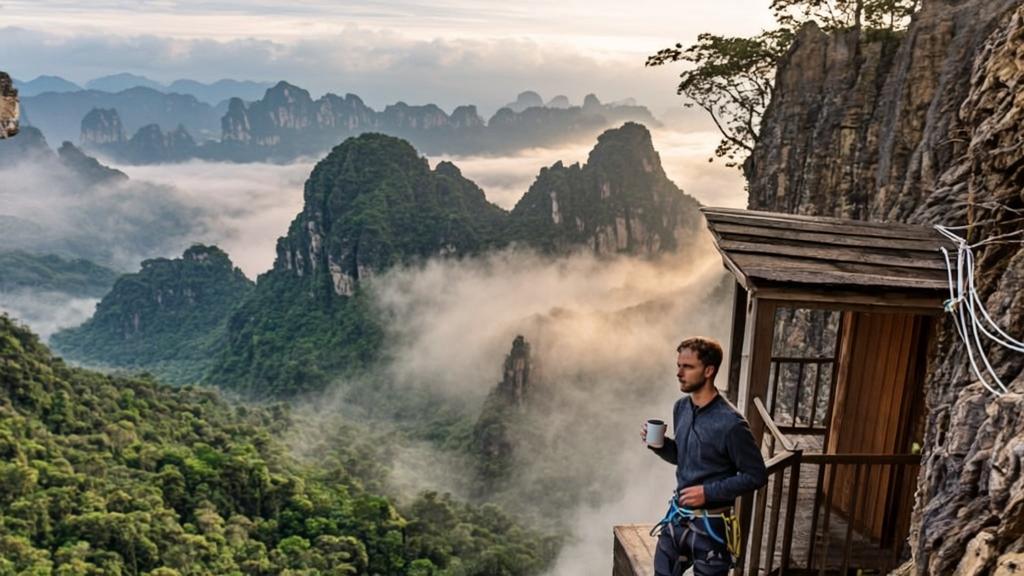
Libo Karst is not just a place to look at. It is a place that does something to you — and a cliffside café perched 200 meters above a UNESCO-listed forest is the best proof of that.
Most travelers have heard of Guilin. Many have seen Zhangjiajie on a screen saver. But Libo? It tends to surprise people. Then it tends to change the way they think about what a destination can actually offer.
The Café That Started With a Carabiner Click
Here is the setup. To reach this café in Libo County’s Cool Play Forest Park, you first hike through dense jungle. Then you clip into a via ferrata — a fixed-rope climbing route — and ascend a 200-meter cliff face. The climb takes roughly 30 minutes. At the top, a wooden platform waits. And on that platform, someone hands you a specialty coffee.
Xinhua reported in February 2026 that the café now seats 25 guests at a time and serves up to 150 visitors daily. During China’s National Day holiday in 2025, visitor numbers surged 40 percent year on year (Xinhua, 2026).
So no, this is not a gimmick. It is a functioning business — and a genuinely unusual one.
For foreign travelers trying to learn something real about modern China, this café is actually a remarkable classroom. It tells you about how a new generation of Chinese entrepreneurs thinks. It tells you about how tourism is evolving here. And, perhaps most strikingly, it tells you something about how the Chinese relationship with nature differs from the one most Westerners grow up with.
What Westerners Tend to Expect — and What Libo Karst Actually Is
In many Western countries, “nature tourism” follows a recognizable script. You drive to a national park. You stay on marked trails. You admire the view from a designated viewpoint. Nature and humans exist at arm’s length from each other.
Libo Karst works differently. The landscape here is part of the South China Karst, inscribed as a UNESCO World Natural Heritage Site in 2007. It covers extraordinary terrain — limestone peaks, turquoise rivers, 68-tier cascading waterfalls, ancient forests growing directly out of rock. But crucially, it is not a place designed for passive observation.
The Chinese concept of shanshui (山水) — literally “mountain-water” — frames nature not as a backdrop but as a living relationship. Mountains and water are active forces. You move through them, not just around them. This explains, in part, why a cliff-climbing café makes perfect cultural sense here. The experience is not “nature interrupted by coffee.” It is the landscape and the person becoming part of the same moment.
Western visitors who understand this shift in perspective tend to find Libo far more rewarding than those who arrive expecting a scenic overlook.
The “Coffee Plus” Trend: China’s New Tourism Language
The Libo café belongs to a wider movement called “Coffee Plus” (咖啡+), which Xinhua described as “turning dramatic landscapes into unique consumption scenarios” (Xinhua, 2026). The trend makes more sense when you consider the numbers: China’s coffee consumption has grown at an average annual rate of over 15 percent since 2010.
Young Chinese consumers want experiences, not just products. Coffee has become the medium — but the setting is the real story. Across Guizhou province, you can now find:
- A cave café in Xiuwen County — built inside a natural karst cave, with stalactites overhead and paddleboarding available inside. It opened in August 2025 and generated over 1 million yuan (approximately USD $143,740) in sales by year’s end.
- A canyon café under the Huajiang Grand Canyon Bridge — the world’s tallest bridge at 625 meters above the Beipan River. Guests arrive by sightseeing elevator and drink lattes shaped with the bridge’s tower art.
- The Libo cliff café — the original, the one that started the conversation.
For foreign travelers, this trend is worth learning from. It reflects a very specific shift in how Chinese tourism now operates: experience-first, story-second, Instagrammable-third.
What You Actually Learn at 200 Meters
There is something worth sitting with here — beyond the altitude and the coffee.
Standing on that platform, looking out over an unbroken sea of karst peaks, you are also looking at one of the world’s rarest ecosystems. The Libo Zhangjiang area contains what UNESCO describes as the most intact karst primeval forest at this latitude in the world (UNESCO / Travel China Guide, 2025). Maolan Karst Forest, adjacent to the scenic area, is a UNESCO Man and Biosphere Reserve Network member precisely because of its ecological completeness.
So the café is, oddly, an environmental education. You earn the view. You understand what it took to preserve it. And you leave with a sense of scale that a tour bus stop simply cannot give you.
This is what Libo Karst offers that most China destinations do not. It is simultaneously a physical challenge, a cultural lesson, and a natural spectacle.
Practical Notes: How to Actually Get There
Getting to Libo requires planning. Here is what to know:
From Guiyang (the provincial capital):
- By long-distance tourist bus: about 3.5–4 hours direct to Libo County
- By high-speed rail to Duyun East Station, then scenic-area shuttle: about 2 hours total from Duyun
- Self-driving from Guiyang along the expressway: scenic and recommended if you want flexibility
Inside Libo:
- Xiaoqikong Scenic Area ticket: ¥130 per person (adult, peak season)
- Daqikong Scenic Area: ¥55 per person
- Shuichun River Rafting: ¥190–200 per person
- Shuttle buses run within the scenic areas; budget an additional fee on top of entry
The Cliff Café specifically is located at Cool Play Forest Park (荔波酷玩森林公园) in Libo County. Trip.com lists it as a bookable experience (Trip.com, 2024). Advance booking is strongly recommended — especially during Chinese national holidays and summer peak season (July–August).
Best seasons to visit Libo Karst overall:
| Season | What to Expect |
|---|---|
| Spring (April–May) | Lush green, high water, fewer crowds |
| Summer (June–August) | Peak waterfalls, more visitors, humid |
| Autumn (September–October) | Clear skies, cool air, fall foliage |
| Winter (December–February) | Off-peak, misty, quiet — and cheaper |
Avoid Chinese public holidays if possible (early October Golden Week, early May). The scenery does not change; the crowd count does.
A Few Things Worth Knowing Before You Go
Beyond the cliff café, Libo rewards explorers who slow down. A few highlights often missed by first-time visitors:
- Mandarin Duck Lake — row a traditional iron boat into what locals call the “water maze,” a flooded ancient forest where trees grow from the riverbed. The silence is genuinely startling.
- Yaoshan Ancient Village — home to the Baiku (White Pants) Yao people. The village is often called a “living eco-museum” and offers direct interaction with a culture almost entirely absent from English-language travel writing.
- Maolan Karst Forest — a UNESCO Biosphere Reserve with guided walking trails through primary subtropical karst forest. Rare plants, rare quiet.
These three spots alone justify an extra day in Libo — and none of them require climbing a cliff.
The Bigger Picture
Libo Karst tends to reframe things. Travelers arrive expecting scenery. They leave with something harder to name — a sense of how a landscape and a culture can coexist without one overwhelming the other, and how adventure can be a form of attention.
The cliffside café is the headline. But the education runs deeper than the altitude.
References
Xinhua News Agency. (2026, February 5). Novel coffee experiences brew new, elevated tourism trends in SW China. Retrieved from https://english.news.cn/20260205/f8b631ab9d3e4a55ae3c99d6bdaeddd6/c.html
Xinhua News Agency. (2026, February 6). Novel coffee experiences brew new, elevated tourism trends in SW China. Retrieved from https://english.news.cn/20260206/f901574f7fe64d9cab5ba9300b352674/c.html
People’s Daily Online. (2026, February 6). Novel coffee experiences brew new, elevated tourism trends in SW China. Retrieved from https://en.people.cn/n3/2026/0206/c90000-20423290.html
Travel China Guide. (2025). South China Karst – UNESCO World Heritage. Retrieved from https://www.travelchinaguide.com/attraction/worldheritages/southkarst.htm
Trip.com. (2024). Libo Cool Park outdoor experience in Guizhou. Retrieved from https://us.trip.com/things-to-do/detail/103416379/
China Survival Kit. (2025, December 15). Xiaoqikong scenic area Guizhou: Complete visitor guide. Retrieved from https://chinasurvivalkit.com/blog/xiaoqikong-guizhou-guide
Travel Ur China. (2025, July 31). Libo County – South China Karst UNESCO World Heritage Site. Retrieved from https://travelurchina.com/libo-county-south-china-karst-unesco-world-heritage-site/