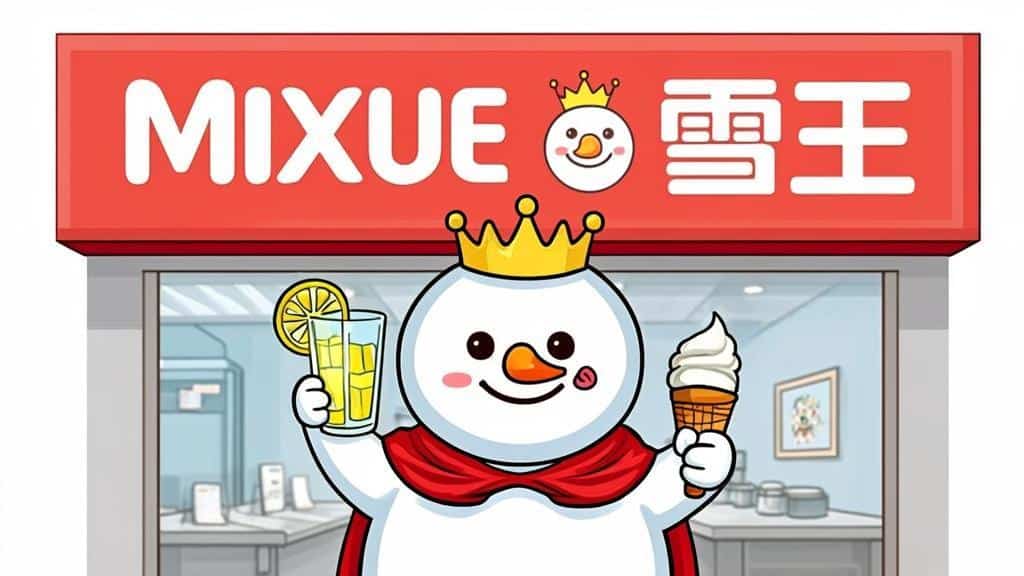
Mixue Bingcheng — you may not have heard of it yet. But chances are, somewhere on your TikTok feed, a cheerful snowman in a red crown has already danced into your life. This Chinese bubble tea and ice cream giant is now the world’s largest fast-food chain by store count, quietly surpassing McDonald’s and Starbucks while most of the world wasn’t paying attention. And honestly? There’s a lot to unpack here — not just about cheap drinks, but about how a college student in Zhengzhou built something that the entire world is still trying to figure out.
If you’re curious about Chinese consumer culture, modern entrepreneurship, or simply want to know where to find the best ¥4 lemonade on earth, Mixue Bingcheng is your classroom.
The Origin Story: Mixue Bingcheng Started With a ¥3,000 Loan
In June 1997, Zhang Hongchao was a college student at Henan University of Economics and Law. He borrowed ¥3,000 from his grandmother and set up a small shaved-ice stall near his campus in Zhengzhou. That was it. No investors. No business plan. Just ice, heat, and determination.
The early years were rough. Zhang closed three stores in quick succession. He tried selling tanghulu (candied fruit skewers) in Hefei — that failed too. But he kept returning to Zhengzhou, kept experimenting, and kept adjusting. By 2003, the first truly successful Mixue Bingcheng store was open (Wikipedia, 2025).
This part of the story matters. Many people visit China expecting to find only ancient temples and vast landscapes. What they often discover instead is a country buzzing with entrepreneurial energy — and Mixue Bingcheng is perhaps the most vivid proof of that.
The Pricing Genius: How Mixue Bingcheng Makes ¥2 Ice Cream Work
Here’s the part that confuses most Western observers. How does a brand sell soft-serve ice cream for roughly \$0.28 and still turn a profit?
The answer isn’t magic. It’s supply chain mastery.
Mixue Bingcheng built the most large-scale and complete end-to-end supply chain system in China’s ready-to-drink beverage industry, covering procurement, production, logistics, R&D, and quality control. More than 60% of the ingredients supplied to franchisees are self-produced. Core ingredients? 100% self-produced.
In 2022 alone, Mixue procured 50,000 tonnes of lemons, 9,000 tonnes of tea leaves, and 5,000 tonnes of coffee beans — volumes that give it enormous bargaining power over suppliers. That scale translates directly into lower costs and lower prices for customers.
As analyst Robert Carter put it to CBC News, “They’ve got a really interesting pricing strategy. They keep things very low, but their product quality is high” (Carter, as cited in Arunasalam, 2025).
This is a masterclass in vertical integration. And you can taste that lesson for under a dollar at any of their tens of thousands of stores across China.
Snow King: How Mixue Bingcheng Turned a Snowman Into a Cultural Icon
The Mascot That Changed Everything
In 2018, Mixue Bingcheng introduced “Snow King” (雪王) — a cheerful, crown-wearing snowman. The timing wasn’t accidental. That same year, the brand opened its first overseas store in Hanoi, Vietnam. They needed a face that could cross cultural lines without translation (Wikipedia, 2025).
Snow King worked beyond anyone’s expectations. Mixue has put Snow King in animated series, microdramas, and variety shows, making it its star IP. When Mixue listed on the Hong Kong Stock Exchange in March 2025, it was Snow King — not the founder — who rang the opening bell. That image went viral globally.
Why did this resonate? Because Snow King isn’t polished. The character is deliberately simple, even slightly silly. That unpretentious quality is exactly what made it relatable to hundreds of millions of Chinese consumers who felt seen by an affordable brand that didn’t pretend to be luxury.
The Song You Cannot Unhear
Then came the theme song. Adapted from the American folk song “Oh! Susanna,” the jingle — “You love me, I love you, Mixue Bingcheng is so sweet” — launched in 2020 and spread like wildfire. The music video was broadcast over 2.5 billion times on the internet in two years. Chinese short video platforms like Douyin and Bilibili flooded with parodies and covers, all effectively advertising the brand for free.
This is what modern marketers call “earned media.” Mixue Bingcheng didn’t pay for most of that promotion. It just made something catchy enough that people couldn’t stop sharing it. The lesson? Authenticity and humor travel further than polished campaigns.
What Travelers to China Can Learn by Visiting a Mixue Bingcheng Store
Walking into a Mixue Bingcheng store in China is a cultural experience in itself. Here’s what you actually learn:
- The rhythm of everyday Chinese life. These stores sit on every street corner, in every tier of city — from Shanghai to remote county towns. They are where students decompress after exams and where workers grab a cold drink on a summer afternoon.
- The power of the “sinking market.” Over 57% of Mixue Bingcheng’s stores are located in third-tier and lower cities. China’s economic story isn’t just in Beijing and Shanghai. Visiting those smaller cities and seeing how Mixue Bingcheng thrives there reshapes how most outsiders understand Chinese consumer culture entirely.
- Franchise culture, Chinese style. Nearly every Mixue store is franchised. The initial investment is around ¥210,000 — far lower than comparable Western brands. This accessibility has created a genuine small-business revolution across rural China.
Actually visiting China to see this firsthand is different from reading about it. The scale is impossible to convey in statistics alone.
Going Global: The Mixue Bingcheng Expansion Story
Mixue Bingcheng’s international journey is worth following closely. It began in Vietnam in September 2018. By 2022, it had entered Singapore, Thailand, Cambodia, Malaysia, South Korea, and Japan. Australia followed in 2023. Then, on December 20, 2025, Mixue opened its first American store in Hollywood, Los Angeles, drawing immediate attention for its strikingly low prices (Wikipedia, 2025).
As of mid-2025, Mixue operated 53,014 stores worldwide, with revenue for the first half of 2025 rising 39.3% year-on-year to RMB 14.87 billion (KR Asia, 2025).
This expansion strategy reveals something important about how Chinese brands now approach the world. They don’t simply copy Western models. Instead, Mixue Bingcheng adapts — earning halal certification in Malaysia, training local staff in Indonesia, building a new Hainan production hub specifically to supply Southeast Asia. Mixue’s globalization follows a steady path of respecting local communities, empowering local business, and growing together with the local market.
That philosophy, arguably, is a Chinese brand philosophy worth studying.
The Bigger Picture: What Mixue Bingcheng Reveals About Modern China
Part of what makes Mixue Bingcheng so fascinating is what it reflects about China more broadly.
China’s consumer market is enormous, price-sensitive in many segments, and increasingly driven by younger generations who value fun and authenticity over prestige. Mixue Bingcheng read that audience perfectly. It didn’t try to compete with Starbucks on image. It carved out entirely different territory — and then dominated it.
As of June 2025, Mixue had over 48,000 stores in China and over 4,700 stores abroad, making it the largest fast-food chain in the world by store count, surpassing McDonald’s, Starbucks, and Subway (Daxue Consulting, 2025).
That fact deserves a pause. A brand selling ¥2 ice cream now operates more locations than McDonald’s. It happened in less than three decades, starting from a borrowed ¥3,000. This isn’t just a business story. It’s a window into how China moves, innovates, and scales.
For anyone serious about understanding China — economically, culturally, socially — following Mixue Bingcheng is genuinely valuable. And sipping a fresh lemonade in a store somewhere in Henan Province, where it all started, is perhaps the best way to begin.
Conclusion: Come to China, Meet the Snow King
Mixue Bingcheng has already come to parts of the world. But the full experience — wandering through Zhengzhou’s streets, spotting the red-crowned Snow King waving from a storefront, hearing that jingle loop from every corner — that only exists in China.
China offers visitors something rare: the chance to witness a business revolution happening in real time, at street level, one ¥4 lemonade at a time. Whether you’re a traveler, a student of business, or simply someone who loves a good origin story, Mixue Bingcheng gives you a reason to look closer.
The Snow King is waiting.
References
Arunasalam, S. (2025, March 4). Never heard of Mixue? The bubble tea chain has more locations than McDonald’s. CBC News. https://www.cbc.ca/news/business/mixue-bubble-tea-boba-chain-1.7473318
Daxue Consulting. (2025, December 17). Chinese beverage brand Mixue disrupts the industry with \$1 drinks. https://daxueconsulting.com/chinese-beverage-brand-mixue/
DAO Insights. (2025, August 19). Key lessons from Snow King’s rise to fame in China. https://daoinsights.com/works/key-lessons-from-snow-kings-rise-to-fame-in-china/
KR Asia. (2025, September 17). Mixue trims abroad, doubles down at home, and brews up Lucky Cup’s rise. https://kr-asia.com/mixue-trims-abroad-doubles-down-at-home-and-brews-up-lucky-cups-rise
MIXUE Group. (2025). Annual results announcement for the year ended December 31, 2024. Hong Kong Exchanges and Clearing. https://www1.hkexnews.hk/listedco/listconews/sehk/2025/0326/2025032601256.pdf
Wikipedia. (2025). Mixue Ice Cream & Tea. https://en.wikipedia.org/wiki/Mixue_Ice_Cream_%26_Tea
World of Chinese. (2025, March). China’s jolly Snow King protects his throne. https://www.theworldofchinese.com/2025/03/chinas-jolly-snow-king-protects-his-throne/
Yuan, J. (2023, April 12). Explaining the viral marketing of social media with the explosion of MIXUE Ice Cream & Tea. https://yjysocialmediamarketing.wordpress.com/2023/04/12/explaining-the-viral-marketing-of-social-media-with-the-explosion-of-mixue-ice-cream-tea/