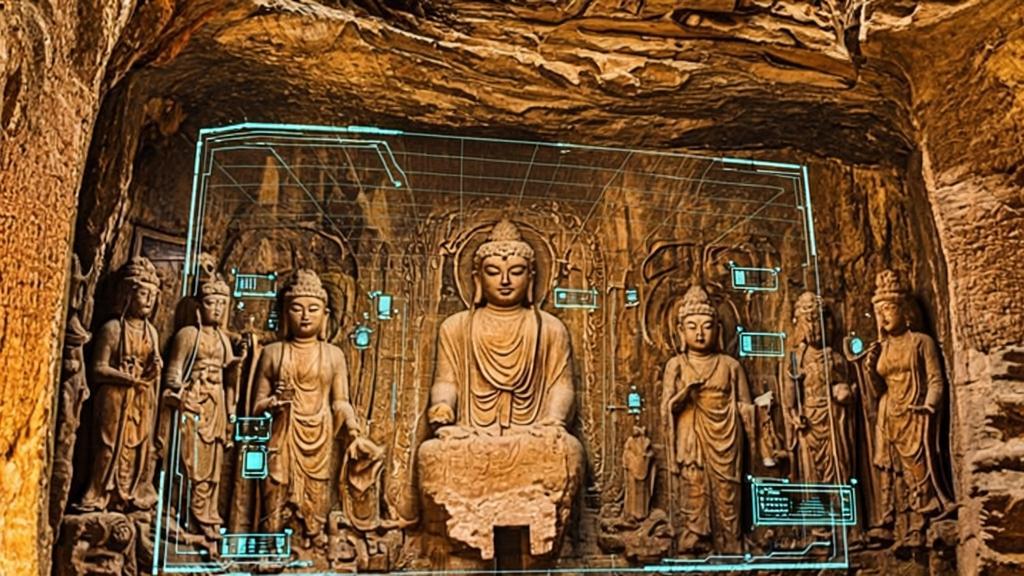
The Mogao Caves sit at the edge of the Gobi Desert in Dunhuang, northwest China — and for most of history, only a lucky few ever stood inside them. Today, you can explore a millennium-old cave from your phone, interact with historical characters through game technology, and zoom into murals that took monks decades to paint. This is not a future concept. It is already happening.
A Place Too Fragile to Share — Until Now
The Dunhuang Mogao Caves are a UNESCO World Heritage Site. These 735 caves, carved into desert cliffs between the fourth and fourteenth centuries, contain 45,000 square meters of vivid murals, intricately crafted sculptures, and manuscripts documenting the cultural exchanges along the ancient Silk Road.
The problem? They are extraordinarily fragile. Every breath a visitor exhales raises humidity. Every flash of light accelerates the fading of pigments that have survived for over a millennium. Visitor numbers had to be strictly capped. Most caves remained permanently closed to the public.
So China went digital. And it went big.
Tencent, Game Engines, and Millimeter Precision
The Digital Library Cave was co-created by the Dunhuang Academy and Tencent as part of a five-year strategic partnership. Tencent and the Dunhuang Academy used the latest in game technology to build a hyperspace participatory museum, vividly re-creating the historical scenes of the Library Cave and over 60,000 precious cultural relics stored inside.
Think about that for a moment. Over 60,000 relics — manuscripts, silk paintings, embroidered texts — recreated in a virtual space using game engine technology.
Laser scanning and photo reconstruction technology restore the details of cultural relics with millimeter-level accuracy. PCG and PBR technologies from the game engine are also used to digitally reproduce the grand occasion before the cultural relics were dispersed, as if you are “talking from a distance” with 10,000 cultural relics.
This is not a slideshow of photographs. It is a reconstruction of an entire historical world at near-perfect physical fidelity.
Cave 17: The “Library Cave” Reborn
Cave 17 — also known as the Sutra Cave or Library Cave — is particularly significant. The Scripture Cave is the 17th cave of the Dunhuang Mogao Grottoes, with an area of less than 7 square meters. It was once filled with more than 60,000 pieces of scriptures, documents, embroidery, and silk paintings from the 4th to the 11th century. Each piece carries rich cultural and academic value, earning the cave the title “key to the medieval history of the world.”
Unfortunately, most of those relics were taken by foreign explorers in the early 20th century. The physical cave today is nearly empty. But the digital version restores it to its former glory — a virtual reunion of scattered cultural memory.
The gaming approach allows viewers to be present inside the virtual Mogao sutra cave. It works like a script-based experience themed on Dunhuang, where viewers choose from six roles and interact with eight non-player characters in the game.
You are not watching history. You are stepping into it.
Cave 285: When You Can Float Up to the Ceiling
The experience goes even further with Cave 285. The Dunhuang Academy, in collaboration with Tencent, used 3D modeling and VR to create a 1:1 high-precision digital replica of Cave 285. Wearing VR equipment allows visitors to closely inspect murals, explore cave details in 360 degrees, and even “ascend” to the cave’s ceiling to immerse themselves in the mural narrative.
Cave 285 is usually closed to the public. This early cave, excavated during the Western Wei dynasty, boasts well-preserved murals that vividly illustrate the exchange and integration of Chinese and Western cultures. It is perhaps one of the clearest visual records of the ancient Silk Road as a meeting point of civilizations. And now, anyone with VR equipment can float to its ceiling and study details that even the original builders could barely see.
The Numbers Behind the Digital Dunhuang Phenomenon
This is not a niche academic project. The reach is genuinely global.
The Dunhuang Academy’s “Digital Dunhuang” resource library has attracted 22 million visitors from more than 78 countries worldwide. More than 30 digital Dunhuang exhibitions have been planned and designed at home and abroad, and more than 60 cultural derivatives have been developed.
Since April 2024, overseas users can access the platform through the “Digital Dunhuang” website, with all information — including introductions to relics — translated into English and French.
The platform is also open for creative use. The co-creation model allows individual and enterprise creators to download materials for their own work. The platform hosts researchers, scholars, teachers, museums, media organizations, and businesses seeking to engage with Dunhuang culture. This is cultural heritage as a living, shareable resource — not a locked archive.
China vs. the West: Different Philosophies of Digital Heritage
Comparison is useful here. Western institutions have also gone digital. The Louvre offers panoramic virtual tours. The British Museum launched crowdsourced digitization efforts as early as 2013. The International Dunhuang Project (IDP), led by the British Library, has provided online access to manuscripts since 1994.
But there is a fundamental difference in approach. IDP emphasises scholarly neutrality; Digital Dunhuang emphasises emotional storytelling. Developed by the Dunhuang Academy and launched in 2016, Digital Dunhuang replaces metadata with narrative, offering not a catalogue, but an experience. Its homepage invites users to “walk into the Dunhuang Grottoes.” Rather than presenting isolated artefacts, Digital Dunhuang allows users to explore entire cave complexes through immersive, zoomable 3D tours.
The Louvre VR is beautiful, but it is essentially a high-end brochure. The Digital Library Cave lets you choose a role, talk to historical characters, and witness the moment the Library Cave was sealed — an act that preserved those manuscripts for 900 years. One approach archives culture; the other animates it.
Why the difference? Part of it is philosophy. Tencent Senior Vice President Leon Guo stated that Tencent has valued cultural diversity and has been committed to the preservation, restoration, and digitization of heritage — including the Palace Museum, Dunhuang Mogao Grottoes, Sanxingdui, and the development of a digital Great Wall of China. The scale of ambition here is notable: this is not one museum’s side project. It is a national strategy.
Part of it is also urgency. The murals at Mogao are fading. The sculptures are cracking. Digital preservation is not optional — it is the only way these artworks survive in high fidelity for future generations.
What Game Technology Adds
This is also where game technology offers something VR museum tours do not. Tencent is bringing its expertise in combining advanced technologies and delivering immersive gameplay to the project — not only to preserve this rich culture but also to explore how it could enable a new model for the digitization of cultural heritage.
Game engines handle dynamic lighting, real-time physics, and interactive character responses. When you “interact” with a historical merchant inside the virtual Sutra Cave, the experience is powered by the same technology behind blockbuster video games. That is a meaningful upgrade from scrolling through a photo gallery.
Still Worth Visiting the Mogao Caves in Person?
Absolutely — perhaps more than ever.
In 2024, Dunhuang received over 20.92 million visitors, a year-on-year increase of 24.3%. The digital version is clearly generating interest, not replacing physical visits. For many travelers, the online experience works like a preview — a reason to book the flight.
At the physical site, the digital presence also enhances the visit. In the Mogao visitor center, immersive VR installations allow tourists to “travel” back over a millennium to witness the murals in their original splendor, vividly illustrating how digital technology serves a dual purpose: protecting irreplaceable relics while sharing them more broadly than ever before.
So the experience now layers: you can explore the caves digitally before you arrive, experience enhanced VR on-site, and then continue exploring the archive at home after you leave. It is a richer visit than any single physical trip could offer.
How to Access the Mogao Caves
You can start right now. The Digital Dunhuang platform at e-dunhuang.com offers panoramic cave tours and high-definition mural archives accessible from anywhere in the world. The Digital Library Cave experience, built in collaboration with Tencent, is available in both English and French.
For a deeper game-based experience, Tencent’s interactive museum uses cloud gaming technology — no downloads required, accessible through a browser.
And if you want to see it in person, Dunhuang is well connected. International and domestic flights land at Dunhuang Mogao International Airport, with rail and road connections to major cities in northwest China.
References
Dunhuang Academy & Tencent. (2024). The Digital Library Cave. Tencent Official. https://www.tencent.com/en-us/articles/2201835.html
Global Times. (2024, May 15). Virtual Mogao Caves show the world strengths of digitizing relics. Global Times. https://www.globaltimes.cn/page/202405/1312380.shtml
Xinhua News Agency. (2024, July 29). Chinese museums embrace technologies to bring exhibits to life. Xinhua. https://english.news.cn/20240729/f542ee0d692c45b4bff2ffdb77558d01/c.html
Silk Road China Tours. (2024, November 28). The “Digital Dunhuang” resource library has attracted 22 million visits from around the world. Silk Road China Tours. https://www.silkroadtourcn.com/blog/474.html
AMT Lab. (2025, March). From Murals to Metadata: Digitizing Cultural Heritage in the Tech Age. Arts Management and Technology Laboratory. https://amt-lab.org/blog/2025/3/digitizing-chinas-cultural-heritage-technology-driven-preservation-and-legacy
Song, Z. (2025). Virtual reality and decolonial practice: a case study of Dunhuang Mogao Caves. Museum Management and Curatorship, 40(6). https://doi.org/10.1080/09647775.2025.2539089
Epoch Magazine. (2025, September). Who Tells the Story of Dunhuang? Digital Heritage, Power, and Possibility. Epoch Magazine. https://www.epoch-magazine.com/post/who-tells-the-story-of-dunhuang
Tencent Games. (n.d.). Digital Dunhuang. Tencent Games Official. https://www.tencentgames.com/technology-2.html