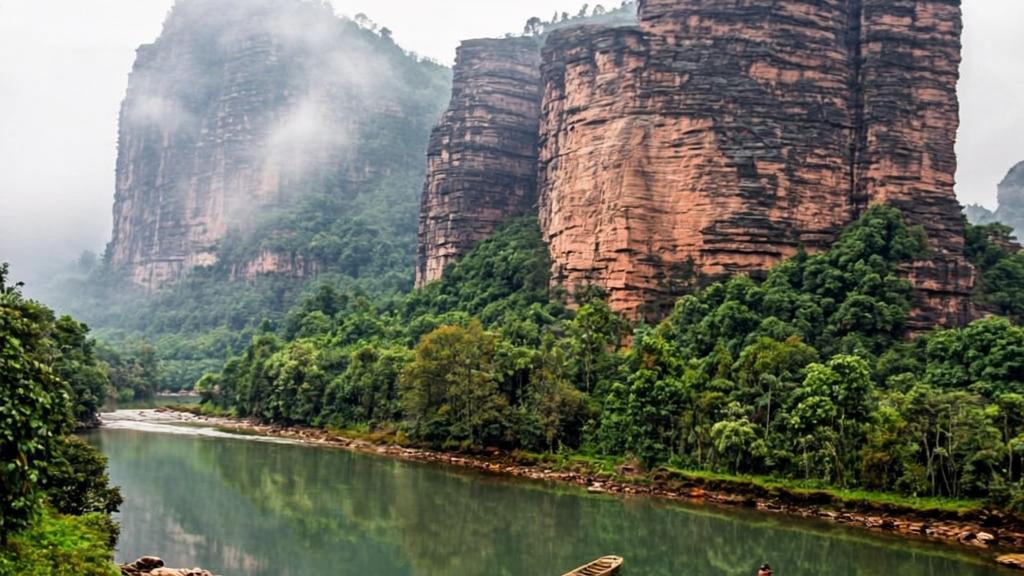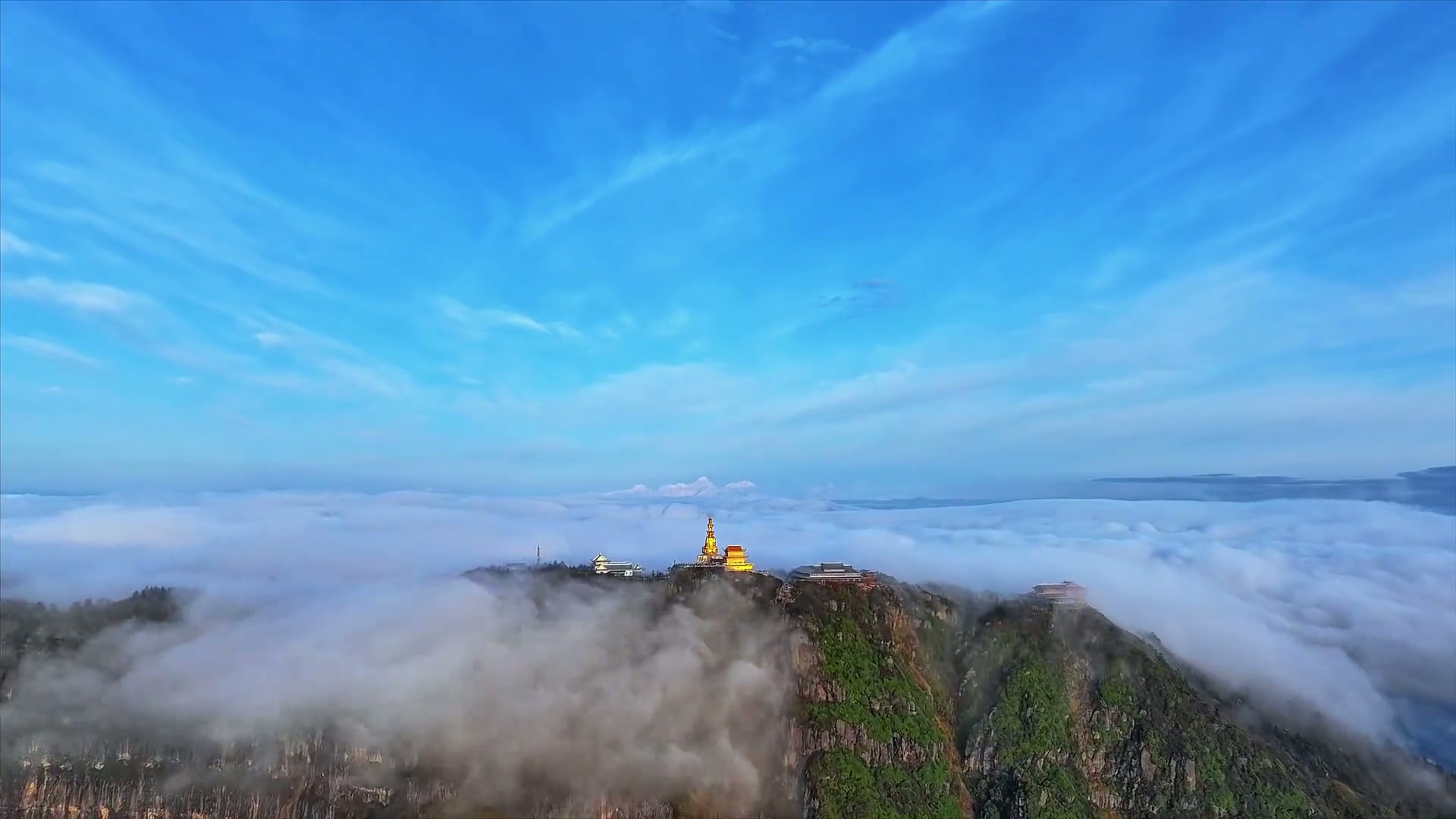
Mount Emei rises like a quiet giant from the misty plains of Sichuan Province. At 3,099 meters above sea level, it is not just a mountain — it is a living piece of Chinese history, spirituality, and wild nature all stacked on top of each other. If you’ve ever wondered what makes China’s sacred mountains so deeply compelling, this is the place to start.
What Makes Mount Emei a UNESCO World Heritage Site?
Mount Emei has been recognized as a UNESCO World Heritage Site for both its cultural and natural significance since 1996. That dual status is rarer than it sounds. Most sites get listed for one or the other — not both.
Mount Emei is not only rich in natural heritage — earning titles like “Plant Kingdom,” “Animal Paradise,” and “Geological Museum” — but also rich in cultural heritage.
So what does that actually mean for a traveler? It means you get two experiences in one trip:
- Ancient Buddhist temples dating back nearly 2,000 years
- Dense subtropical forests packed with rare wildlife
- Dramatic altitude changes from 500m to over 3,000m
- Wild Tibetan macaques wandering freely among tourists
Think of it like combining the spiritual atmosphere of Mount Athos in Greece with the biodiversity of the Scottish Highlands — and then adding golden statues and misty cloud seas on top.
The Four Wonders of Mount Emei — And Why They Matter
Mount Emei is globally renowned for its Golden Summit Buddha Light, sunrises above a sea of clouds, wild monkey colonies, and vast blossoming dove tree forests — known as its “Four Wonders.”
These aren’t tourist gimmicks. They are real natural phenomena.
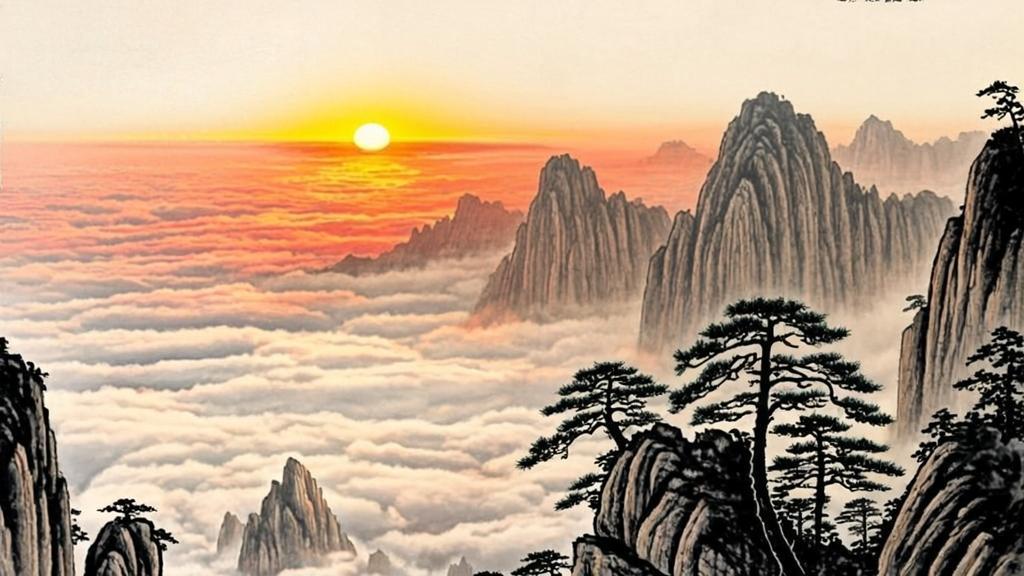
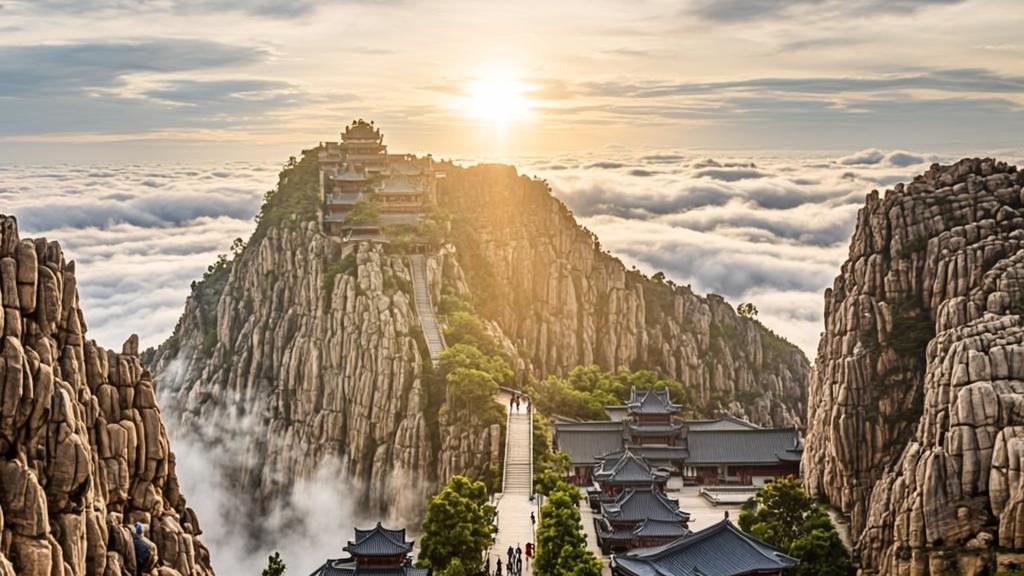
Sunrise above the clouds — Stand at the Golden Summit before dawn. Watch the sky shift from deep blue to crimson. The sun breaks through a sea of clouds below you. It feels less like watching a sunrise and more like floating above the world.
Buddha’s Light (佛光) — When the sun rises from the cloud sea, a rainbow-like halo encircles a nearby statue, creating the illusion of a divine presence. The best time to witness this phenomenon is between 2 PM and 5 PM, and it occurs approximately every five days.
Sacred Lamps — A series of mysterious green lights appear hidden within the mountains, typically on moonless nights. The lights sometimes coalesce into a bright glow that illuminates the forest, and other times disperse into countless individual lights. Scientists still debate the exact cause. Locals have their own explanations.
Sea of Clouds — The sea of cloud forms due to Mount Emei’s location at the edge of the Sichuan Basin. The convergence of warm, moist air from the south and cold air from the north near the Golden Summit results in condensation and upward movement, creating layers of clouds.
Hiking Mount Emei: Routes, Tips, and What to Expect
In addition to its historic temples, Mount Emei is a hiker’s paradise with trails for every skill level and need. You can hike all or part of the summit, or rely on tourist buses or cable cars to take you to places of interest along the way.
Most visitors follow one of two main routes:
Quick Route (1–2 days)
- Take a tourist bus to Leidongping
- Ride the cable car to the Golden Summit
- Visit 2–3 temples along the way
Full Hiking Route (3–4 days)
- Start at Baoguo Temple at the foot of the mountain
- Hike through Wannian Temple and Qingyin Pavilion
- Ascend through forests to the Golden Summit
- Return via a different path
Mount Emei has more than 60 kilometers of stone-paved walking paths from the mountain foot to the top — the Golden Summit — which is an ideal place for a leisure walk while enjoying beautiful mountain views.
A few practical reminders:
- Wear layers. The summit can be near freezing even in summer.
- The summit hike is very steep and requires good physical fitness and appropriate footwear.
- Start early. Morning mist and afternoon rain are common.
The Golden Summit of Mount Emei — The Crowning Glory
There is a saying among Chinese travelers: “You haven’t seen Mount Emei if you haven’t reached the Golden Summit.” That statement is difficult to argue with once you’re standing there.
Towering at an altitude of 3,079 meters, the Golden Summit of Mount Emei is the highest Buddhist site in the world.
At the summit, there is a copper hall completely coated in gold. When sunlight strikes the summit, the golden hall reflects a dazzling golden glow — hence the name Golden Summit.
The Golden Summit is also famous for having the world’s largest and tallest statue of the Bodhisattva Samantabhadra. Constructed in 2006, the statue stands 48 meters tall and weighs 600 tons.
For Western visitors, the sense of scale here is hard to describe. The closest comparison might be arriving at the top of Mont Blanc or the Zugspitze — but instead of a weather station, you find a gleaming golden temple and a 48-meter gilded deity watching over the clouds. The contrast is extraordinary.
Buddhist Culture at Mount Emei: Temples, History, and Spiritual Depth
Mount Emei is one of the Four Sacred Buddhist Mountains of China, and is traditionally regarded as the bodhimaṇḍa — or place of enlightenment — of the Bodhisattva Samantabhadra. This is also the location of the first Buddhist temple built in China, in the 1st century CE.
That is a staggering timeline. Buddhism arrived here around the same time as the fall of the Roman Empire’s predecessors were rising in Europe.
Key temples worth visiting:
- Baoguo Temple — the gateway to the mountain, built during the Ming Dynasty (1615 CE). It covers an area of 100 mu with majestic halls and lush trees, housing four main buildings that rise step by step along the hillside.
- Wannian Temple — One of the oldest ancient temples on Mount Emei, founded in the Eastern Jin Dynasty (401 CE). It contains a unique Indian-style brick hall built without a single beam or column.
- Qingyin Pavilion — Built in 877 CE, known for the sound of wind through pines and two rivers converging at its base.
In Western culture, mountain pilgrimages like the Camino de Santiago or the climb to Montserrat hold deep spiritual significance. Mount Emei carries something similar — but layered over 2,000 years of unbroken Buddhist tradition. The difference is that here, the temples are still active places of worship, not museums.
Wildlife, Hot Springs, and Hidden Surprises
The mountain has a lively non-spiritual side too.
Visitors to Mount Emei will likely see dozens of Tibetan macaques, which can often be viewed taking food from tourists. They are bold, clever, and absolutely unintimidated by humans. Keep your sunglasses secure. Keep your snacks hidden.
There are more than 2,300 kinds of animals and 1,600 kinds of medicinal plants on the mountain. The mountain also lies within the core zone of the Giant Panda Habitat World Heritage area, blending spirituality with ecological richness.
After hiking, the hot springs at the mountain’s base are a genuine reward. Some of the best options include the Hongzhushan Hot Spring, Emeishan Hotel Hot Spring, and Lingxiu Hot Spring. These are natural mineral springs, not hotel spa pools — the minerals actually work.
How to Get to Mount Emei and Plan Your Visit
Getting here is easier than most people assume.
From Chengdu, you can take a high-speed train to Emeishan Railway Station in about 1.5 hours. Mount Emei is approximately 160 kilometers from Chengdu.
Admission fees (2025):
- Peak season (April 1 – November 30): ¥185 per person
- Off-season (December 1 – March 31): ¥110 per person
- Ticket valid for 2 days from validation
Best seasons to visit:
- Spring (March–May): Rhododendrons and azaleas in full bloom along the trails
- Autumn (September–November): Best weather, most vivid colors
- Winter: Far fewer crowds; snow-covered temples; lower prices
2025 visa update: Starting December 2024, transit travelers from 54 countries can stay in China for up to 10 days without a visa. Visitors from France, Germany, Italy, Spain, and several other countries enjoy 30-day visa-free stays through 2025.
Combine Mount Emei with nearby Leshan Giant Buddha — they are only about 30 minutes apart by car and are jointly listed as UNESCO World Heritage Sites. Two world-class destinations, one efficient trip.
Final Thought
Mount Emei is not a destination that fits neatly into any one category. It is part pilgrimage site, part nature reserve, part adventure trail, and part open-air museum. That combination — perhaps more than anything else — is what makes it worth the journey.
Some mountains are impressive. This one is alive.
References
China Dragon Travel. (2025). Mount Emei travel guide: Facts, map, temple, hike. China Dragon Travel. https://www.chinadragontravel.com/mount-emei-travel-guide-facts-map-temple-hike/
China Odyssey Tours. (2025). Mount Emei: A guide to Sichuan’s Buddhist paradise. China Odyssey Tours. https://www.chinaodysseytours.com/chengdu/mt-emei.html
China Xian Tour. (2025). Travel guide of Emei Mountain: What to see & helpful tips. China Xian Tour. https://www.chinaxiantour.com/xian-travel-blog/the-mount-emei.html
Asia Odyssey Travel. (2025). Mount Emei, Sichuan: Emeishan mountain cable car, hiking. Asia Odyssey Travel. https://www.asiaodysseytravel.com/chengdu/mount-emei.html
The China Journey. (2026). 2026 Mount Emei travel guide: Temples, trails & tips. The China Journey. https://www.thechinajourney.com/mount-emei-travel-guide/
Wikipedia contributors. (2025). Mount Emei. Wikipedia, The Free Encyclopedia. https://en.wikipedia.org/wiki/Mount_Emei
China Discovery. (2025). Emeishan trip planner: How to plan a trip to Mount Emei. China Discovery. https://www.chinadiscovery.com/tour-emei-mountain/how-to-plan-an-emeishan-trip.html