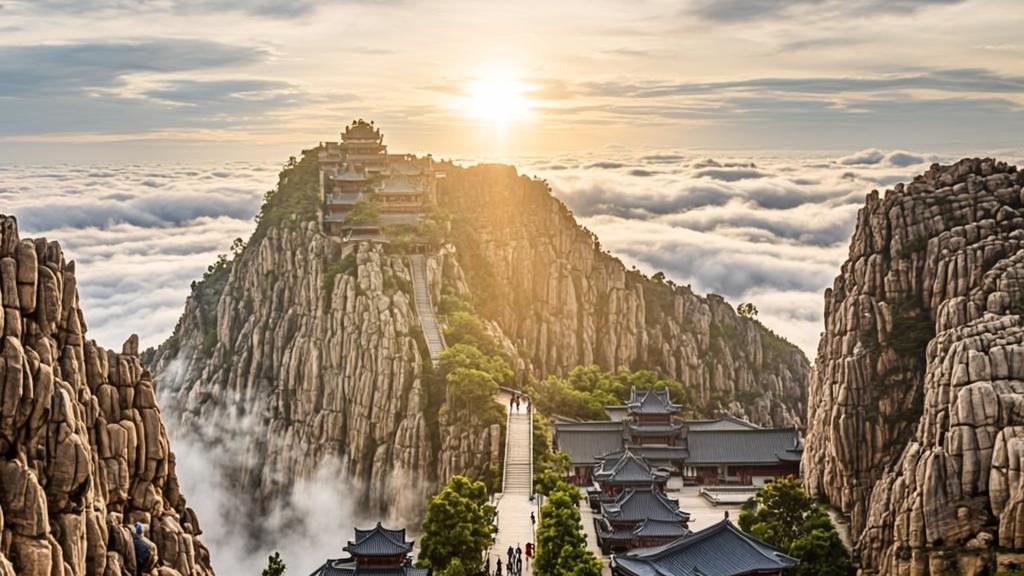
Mount Tai, or Taishan, remains the undisputed crown jewel of China’s five sacred mountains, drawing millions of travelers to Shandong Province every year. As we look toward 2026, this UNESCO World Heritage site continues to blend ancient imperial history with modern hiking infrastructure. Whether you seek a spiritual pilgrimage or a grueling physical challenge, understanding the nuances of this “First Under Heaven” mountain is essential for a smooth trip.
Key Trip Planning Quick-Links
- Official Booking: “Taishan Scenic Area” WeChat Mini-program.
- Main Entrance: Red Gate (24/7 for night climbers).
- Peak Elevation: 1,545 meters (Jade Emperor Summit).
- Best Season: September to November (High visibility).
Why Mount Tai Defines the Chinese Spirit
If you want to understand the Chinese concept of “stability,” look no further than the granite ridges of Mount Tai. For millennia, emperors came here to perform the Fengshan sacrifices, signaling to Heaven that their reign was legitimate. My point is, this isn’t just a pile of rocks; it is a political and cultural monument. The saying “If Mount Tai is stable, the whole world is at peace” still resonates in the local psyche (mounttaitravel.com).
The geological formation is equally impressive. The mountain consists of a complex tilting block structure, with the oldest rocks dating back to the Archean Era. You are essentially walking on nearly 3 billion years of Earth’s history. This blend of deep time and human ego makes the climb feel uniquely heavy—in a good way.
Choosing Your Mount Tai Hiking Route
Selecting the right path is probably the most important decision you will make. Not all trails are created equal. Some focus on stairs, while others offer bus shortcuts.
The Imperial Red Gate Route (Classic)
This is the “standard” experience. It follows the exact path ancient emperors took.
- Starting Point: Red Gate (Hongmen).
- Duration: 4 to 6 hours.
- Highlight: The “Eighteen Bends” (Shiba Pan), a vertical staircase of 1,633 steps.
- Vibe: Cultural, crowded, and physically demanding.
The Tianwaicun Bus Route (Energy Saver)
If your knees aren’t what they used to be, this is the way to go.
- Process: Take a scenic bus from Tianwaicun to Zhongtianmen (Halfway Gate).
- Next Step: Hike the rest or take a cable car to the top.
- Time: 2 to 3 hours total (mounttaitravel.com).
The Taohuayu Scenic Route
This path is often called the “Romantic Route.” It is less about history and more about water features and peach blossoms (in spring). It is generally quieter, which might be a relief during Chinese public holidays.
Mastering the Logistics for 2026
Traveling in China has become incredibly tech-heavy. You can no longer just show up at the gate and buy a paper ticket. Everything—and I mean everything—is digitized.
- Ticket Booking: Use the “Taishan Scenic Area” official WeChat mini-program. You must register with your passport.
- Cost: Expect to pay around 115 RMB during peak season. Students usually get a 50% discount with a valid ID.
- Transport: Tai’an has two main stations. Tai’an Station (High Speed) is further away, while Taishan Station (Regular) is right in the city center.
- Opening Hours: The Red Gate trail is open 24 hours to accommodate night climbers.
Key point: Don’t forget that 2026 might see higher domestic tourism. My advice? Book your mountain-top hotel at least two weeks in advance if you plan to stay for the sunrise.
The Night Climb: Chasing the Sunrise
Night climbing Mount Tai is a rite of passage for many young locals. They start around 11:00 PM to reach the summit by 5:00 AM.
The temperature at the top is significantly lower than at the base. We are talking about a difference of 10^\circ C to 15^\circ C. You can rent heavy “Army Coats” (Jun Da Yi) at the South Gate to Heaven for about 30–50 RMB. It might look silly in photos, but you will be grateful for the insulation while waiting for the sun.
But actually, the sunrise isn’t guaranteed. Clouds often roll in. Even if you miss the “Golden Ball,” being above the sea of clouds is a spiritual experience in its own right. Some people argue it’s better to hike during the day to see the calligraphy; perhaps they have a point, but the night climb has a unique energy.
Significant Landmarks and Calligraphy
As you ascend, you will notice hundreds of inscriptions carved directly into the cliffs. These aren’t graffiti; they are masterpieces.
- The Diamond Sutra Valley: A massive rock shelf where a monk carved 2,500 Chinese characters, each about 50 cm wide.
- The “Five Sacred Mountains Unique” Stone: This is the image on the back of the 5 RMB note. It’s a mandatory photo spot.
- South Gate to Heaven (Nantianmen): This marks the end of the steepest climb (1,460m). Crossing this threshold feels like entering another realm.
Essential Gear and Preparation
You don’t need professional mountaineering gear for Mount Tai, but you do need common sense. The entire path is paved with stone steps. This is hard on the joints.
- Shoes: Bring broken-in sneakers with a good grip.
- Energy: Grab some “Taishan Pancakes” (Jianbing) at the base. They are thin, crispy, and filled with scallions.
- Hydration: Water prices triple as you go higher. Carry two bottles, but buy more as needed to keep your pack light.
- Sun Protection: The sun at 1,545 meters is brutal, even if it feels cool.
Managing Expectations in the Peak Season
Wait times for cable cars can exceed 2 hours during the “Golden Week” (October) or May Day holidays. If you value your sanity, I suggest avoiding these dates entirely. Mid-week in September or late March offers the best balance of weather and crowd control.
Furthermore, please be mindful of your physical limits. The descent can actually be harder on your knees than the ascent. Many people take the cable car down even if they hiked up. There is no shame in it; the goal is to enjoy the scenery, not to end up in a clinic.
Final Thoughts on the Sacred Peak
The allure of Mount Tai lies in its permanence. In an ever-changing world, this mountain stands as a symbol of the “Taishan Spirit”—resilience and duty. 2026 is a fantastic year to visit, especially as Shandong expands its high-speed rail links, making it easier than ever to reach from Beijing or Shanghai.
Whether you are there for the history, the workout, or the Instagram shot, Taishan rarely disappoints. Just remember to pace yourself. As the stone tablet says: “The ascent must begin from the low ground.” Everything worth doing takes time.
References
- Mount Tai Travel. (2026a, February 12). 2026 Mount Tai Travel Guide: Lazy People’s Route & Avoiding Pitfalls. Mount Tai Travel Network. https://mounttaitravel.com/taishan-lvyou-gonglue-2026/
- Mount Tai Travel. (2026b, February 4). Full Guide to Mount Tai Scenic Area: Transportation, Tickets, and Must-See Spots. Mount Tai Travel Network. https://mounttaitravel.com/taishan-you-wan-gong-lue/
- Mount Tai Travel. (2025a, October 5). Climbing Mount Tai: Four Classic Hiking Routes. Mount Tai Travel Network. https://mounttaitravel.com/mount-tai-deng-shan-lu-xian/
- Mount Tai Travel. (2025b, December 17). How Long Does It Take to Climb Mount Tai? Complete Time Guide. Mount Tai Travel Network. https://mounttaitravel.com/taishan-yao-pa-duo-jiu/
More of China’s scenic