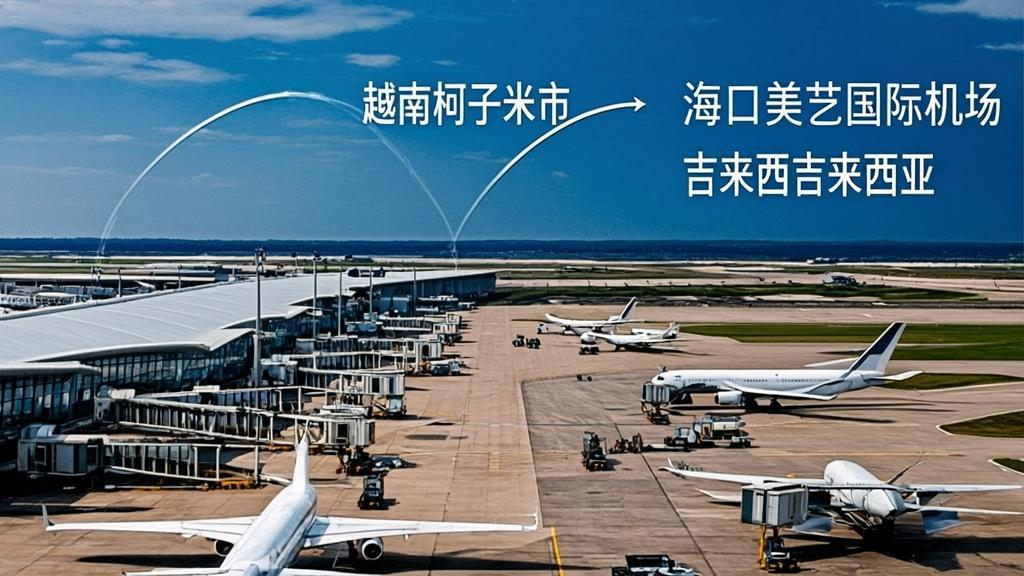
New Southeast Asia routes are reshaping the air freight landscape for Hainan. On March 16 and 17, 2026, Haikou Meilan International Airport officially launched two new international cargo routes — one connecting Ho Chi Minh City to Haikou, and the other linking Haikou with Kuala Lumpur. The move immediately increased Southeast Asia-bound cargo flights from 4 to 13 per week. For businesses eyeing China’s most ambitious free trade experiment, this development carries real significance.
What Changed: Two New Southeast Asia Routes in Two Days
The timeline was swift. On March 16, the Ho Chi Minh City–Haikou route launched. Just one day later, March 17, the Haikou–Kuala Lumpur round-trip service followed. Together, these two routes more than tripled weekly international cargo flight frequency on the Southeast Asia corridor — from 4 flights per week to 13 (Huxiu, 2026).
That kind of acceleration reflects something deliberate. Hainan is not gradually expanding its logistics network. It is building fast, and the Southeast Asia direction is clearly the priority right now.
Why Southeast Asia? Hainan’s Strategic Location Explains It
Hainan sits at a geographic crossroads. The island province faces Southeast Asia directly, positioned between the South China Sea and major ASEAN shipping lanes. This geography, combined with policy momentum, makes the region a natural first target for cargo route expansion.
Hainan is positioned as a gateway for China’s major national strategies — including the Belt and Road Initiative and deepening trade connectivity with Southeast Asia. The new Southeast Asia routes are a direct extension of this broader ambition.
Furthermore, Hainan’s strategic location — connecting mainland China, Southeast Asia, and the Pacific — gives it a unique role as a bridge across the region. New cargo capacity now turns that geographic advantage into operational reality.
The Hainan Free Trade Port: Context Behind the New Southeast Asia Routes
These route launches did not happen in a vacuum. In December 2025, Hainan completed a major policy milestone. On December 18, marking the anniversary of China’s pivotal “reform and opening-up” policy, Hainan province officially launched independent customs operations across the island — a significant milestone in its ongoing transformation into a free trade port.
The policy changes are substantial. Duty-free categories have surged from 1,900 to 6,600 product categories, covering 74% of all taxable items. Goods processed in Hainan with 30% or more local value added can now enter the Chinese mainland tariff-free. This is a compelling structure for ASEAN-based manufacturers and traders.
As a result, demand for reliable air freight connections between Hainan and Southeast Asia has grown sharply. The new Southeast Asia routes directly serve that demand.
Meilan Airport: A Hub Built for This Moment
Haikou Meilan International Airport (IATA: HAK) has been expanding steadily. In 2025, the airport operated a total of 296 routes, including 241 domestic routes, 47 international and regional passenger routes, and 8 international and regional cargo routes. Its passenger throughput reached over 26.85 million, ranking it 20th among Chinese civil airports.
The airport’s infrastructure matches its ambitions. Haikou Meilan International Airport, as the core aviation hub of the Hainan Free Trade Port, continues to expand its international cargo route network, covering multiple key nodes in Asia, Europe, and the Middle East, forming a global logistics corridor.
Beyond routes, Meilan Airport has invested in logistics technology. On February 12, 2026, Haikou Meilan International Airport officially launched the first airport aviation logistics autonomous driving demonstration project in Hainan Free Trade Port. Autonomous cargo tractors now operate around the clock, processing freight continuously without manual shift limitations. The airport plans to expand this system further.
Additionally, Meilan Airport will continue to expand and optimize its route network, accelerate the expansion of the international aviation market, and fully leverage the benefits of open-air traffic rights to improve the structure of the international route network.
What This Means for Businesses Shipping Between China and Southeast Asia
The expansion of new Southeast Asia routes is particularly relevant for businesses involved in cross-border trade. Air freight rates from Meilan Airport are competitive. Leveraging the policy benefits of the Hainan Free Trade Port and the hub airport’s route network, Haikou Meilan International Cargo Airport offers a highly competitive air freight pricing system for global customers.
The practical advantages are clear:
- Faster transit times between Hainan and ASEAN markets
- More frequent departures — 13 flights per week instead of 4
- Lower cargo rates backed by Free Trade Port policy incentives
- Streamlined customs clearance through the FTP’s “First Line” open-entry framework
- 24-hour operations supported by the airport’s autonomous logistics system
For companies moving goods such as electronics, tropical produce, pharmaceuticals, or consumer goods, these new Southeast Asia routes reduce both cost and transit risk.
Ho Chi Minh City and Kuala Lumpur: Two Key Nodes
The choice of destinations is strategic. Both Ho Chi Minh City and Kuala Lumpur are major ASEAN trade and business hubs.
Vietnam has been one of China’s fastest-growing trade partners in recent years. Ho Chi Minh City, in particular, handles a large share of Vietnam’s manufacturing exports. A direct cargo link with Haikou shortens the supply chain considerably for businesses operating across both markets.
Malaysia, meanwhile, is a central node in the broader ASEAN logistics network. Kuala Lumpur International Airport connects to dozens of Southeast Asian destinations. The Hainan provincial government views connectivity to Kuala Lumpur as strengthening trade and tourism between southern China and Malaysia. A cargo route, rather than just a passenger one, takes that relationship to a more operational level.
Together, these two new Southeast Asia routes cover both the Indochinese Peninsula and the Malay Archipelago. That is a meaningful geographic spread for two routes launched in consecutive days.
A Broader Picture: Hainan as China’s Open-Economy Gateway
The new Southeast Asia routes fit into a much larger story. Hainan has the potential to attract higher value-added activities, regional distribution centers, final-stage assembly, supply chain management, services trade, and even regional headquarters.
Analysts at the United Nations have noted a similar point. Free trade ports can anchor predictable, rules-based environments that attract global investment, support diversified value chains, and build trust among trading partners. Hainan increasingly fits that description.
For foreign businesses considering China as a trade destination or operational base, Hainan presents a distinct entry point — lower tariffs, simplified customs, and now, improved air connectivity to Southeast Asia.
What to Watch Next
The current expansion may not stop at two routes. Meilan Airport has consistently signaled plans to broaden its international cargo network. To meet the growing demand for air cargo guarantee in Hainan Free Trade Port, Meilan Airport plans to add more cargo and baggage transportation routes.
Meanwhile, Hainan’s 2026–2030 Masterplan aims to develop an international cooperation highland focused on Southeast Asia and Belt and Road partners. Air freight connectivity is a key enabler of that plan — not an afterthought.
In short, the new Southeast Asia routes launched this week are a marker of a larger trend. Hainan is moving from policy framework to operational infrastructure. The gap between ambition and execution is closing. For businesses, that makes Hainan’s air cargo network worth watching closely.
References
Huxiu. (2026, March 17). 海口美兰国际机场连开两条东南亚国际货运航线 [Haikou Meilan International Airport opens two Southeast Asia international cargo routes]. Huxiu. https://www.huxiu.com/moment/1228051.html
Haikou Meilan International Airport. (2025). About Meilan. mlairport.com. https://www.mlairport.com/mljcen/wap/AboutMeilan/
UISEE. (2026, February). UISEE achieves new milestone in airport autonomous driving. uisee.com. https://www.uisee.com/en/article227-cases1.html
Goodhope Freight. (2025). From Hainan to the world: A comprehensive guide to cross-border logistics at Haikou Meilan International Cargo Airport in 2025. goodhopefreight.com. https://goodhopefreight.com/cargo-airports/hak.html
Sasmita, R. P. (2026, February 20). Hainan Free Trade Port is the future of globalization. Asia Times. https://asiatimes.com/2026/02/hainan-free-trade-port-is-the-future-of-globalization/
TropicalHainan.com. (2025, December). Hainan releases 2026–2030 Masterplan. tropicalhainan.com. https://www.tropicalhainan.com/hainan-releases-2026-2030-masterplan-what-the-next-five-years-mean-for-the-free-trade-port/
United Nations in China. (n.d.). Hainan Free Trade Port Development Exchange Conference. china.un.org. https://china.un.org/en/306817-hainan-free-trade-port-port-development-exchange-conference
PRNewswire. (2026, February 25). Sanya Yazhou Bay Science and Technology City appoints Intrinsic SEA as Southeast Asia strategic partner. prnewswire.com. https://www.prnewswire.com/apac/news-releases/sanya-yazhou-bay-science-and-technology-city-appoints-intrinsic-sea-as-southeast-asia-strategic-partner-following-landmark-hainan-ftp-special-customs-operations-302696990.html
Travel and Tour World. (2025, December 24). Haikou to unite London, Brussels, Jeddah, Nha Trang, Ho Chi Minh City, Kuala Lumpur with new routes effectuated by Hainan Airlines. travelandtourworld.com. https://www.travelandtourworld.com/news/article/haikou-to-unite-london-brussels-jeddah-nha-trang-ho-chi-minh-city-kuala-lumpur-with-new-routes-effectuated-by-hainan-airlines-what-you-need-to-know/
ORCA Asia. (n.d.). Hainan Free Trade Port. orcasia.org. https://orcasia.org/article/1497/hainan-free-trade-port