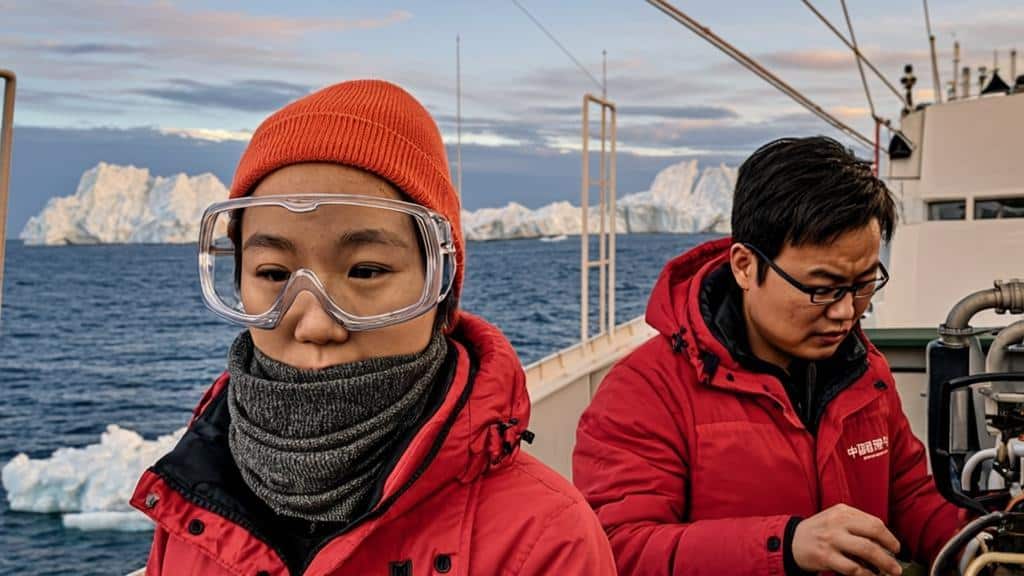
Ocean University of China sends graduate students to the bottom of the world — literally. While most universities keep their marine biology labs indoors, this one puts students on icebreakers headed for the Southern Ocean. And yes, they catch fish there. Strange, glowing fish that live 1,000 meters deep. It sounds like science fiction. But for doctoral students in Qingdao, it’s just another semester.
Why Ocean University of China Runs Antarctic Expeditions
Here’s something most people don’t know. Over half of the 75 scientists on China’s very first Antarctic expedition graduated from this coastal university (China Daily, 2024). That was back in 1984. Four decades later, the institution still dominates China’s polar research pipeline.
The Pelagic and Polar Fisheries Research Team has joined China’s 36th through 40th Antarctic expeditions. Altogether, team members have spent over 1,070 days in polar regions (OUC News, 2024). These aren’t seasoned explorers. Many are PhD candidates and young faculty members — students, essentially, learning science in the harshest classroom on Earth.
So what drives a university to build such a program? Partly national strategy. Partly scientific curiosity. But also — and this is key — a belief that real ocean scientists need real ocean experience. Textbooks can only go so far when the subject is 1,000 meters below the surface.
Catching Lanternfish at the Bottom of the World
The fish they’re after aren’t exactly dinner-table material. Lanternfish — tiny creatures covered in light-emitting organs — live in the mesopelagic zone, roughly 200 to 1,000 meters below the surface. They glow in the dark. They rarely exceed 8 centimeters in length. Yet they play a massive role in Antarctic food webs.
Liu Chunlin, a doctoral student at the College of Aquatic Sciences, joined China’s 40th Antarctic expedition in early 2024. He explained to CGTN why the Myctophidae family matters so much: the species Electrona antarctica is widespread around the continent and supports the broader ecosystem (CGTN, 2024).
During that expedition, the team used multiple collection methods:
- Mid-water trawl nets
- Bongo plankton nets
- Deep-sea longlines and fish traps
- Environmental DNA sampling
They completed 43 survey stations. They collected over 800 specimens covering nearly 20 species. These were among the first mesopelagic fish samples ever gathered by Chinese researchers in the Southern Ocean (OUC News, 2024). For a graduate student, that’s not just data — that’s a career-defining moment.
Why Mesopelagic Fish Matter More Than You’d Think
Here’s the thing about lanternfish. They’re tiny. Nobody eats them. But they transfer enormous amounts of carbon from the surface to the deep ocean every day. Scientists call this the “biological pump.” Understanding it helps predict climate change patterns.
Western researchers at institutions like the British Antarctic Survey have studied these species for decades. Chinese researchers entered the field more recently. However, their rapid progress — going from zero mesopelagic samples to 800+ in just five expeditions — shows serious commitment. It also reflects a broader trend: China investing heavily in understanding Southern Ocean ecosystems before global fishing pressures change them forever.
Learning by Doing: The Ocean University of China Approach
Most Western marine science programs emphasize lab-based training first. Fieldwork comes later — often much later. Ocean University of China flips that model somewhat.
The university owns three research vessels. The flagship Dongfanghong 3 displaces 5,000 tonnes. It holds a Silent-R certification from Norway’s DNV classification society — only the fourth ship in the world to earn that distinction at the time (OUC Ship Center). In plain terms, the ship runs so quietly that fish 20 meters away can’t detect it.
This matters for teaching. Students don’t just read about acoustic monitoring or water sampling techniques. They operate these systems on actual expeditions. Compare this to the Woods Hole Oceanographic Institution in the U.S. or the British Antarctic Survey. Both run excellent graduate programs. However, few universities anywhere integrate polar fieldwork into PhD training this routinely.
Think of it this way. At many schools, an Antarctic expedition is a career highlight. At this Qingdao campus, it can be part of your coursework. That’s a fundamentally different educational philosophy.
What Makes Ocean University of China’s Antarctic Program Unique
A few numbers help frame the bigger picture.
- The university ranks No. 1 globally in oceanography (ShanghaiRanking, 2023)
- It ranks No. 1 globally in marine and freshwater biology (US News, 2024)
- 16 alumni have become academicians of the Chinese Academy of Sciences or Engineering
- Over one-third of China’s PhD holders in marine and aquaculture fields studied here
- It has partnerships with 300+ institutions across 50+ countries
(China Daily / Manila Times, 2024)
For international students, this creates an unusual opportunity. English-taught programs are available. The main Laoshan campus sits at the foot of Mount Lao, right on the Yellow Sea coast. Meanwhile, the older Yushan campus features German colonial architecture from the early 1900s — a fascinating legacy of Qingdao’s history as a German concession territory.
This isn’t some remote research outpost. It’s a vibrant coastal university with deep roots and genuine global credentials.
How Ocean University of China Shapes Antarctic Research Policy
China launched its 42nd Antarctic expedition in November 2025. The mission involved over 500 researchers from 80+ institutions. Participants came from Thailand, Chile, Portugal, and other countries (Gov.cn, 2025). The Qingdao university continues to supply key personnel for these missions.
Beyond individual expeditions, the institution shapes polar policy too. Professor Tang Jianye published a 550,000-word monograph on Antarctic marine conservation law in 2024. The book covers CCAMLR conventions, krill fisheries regulation, and marine protected area disputes (SHOU, 2024). This dual role — field science plus policy research — is relatively uncommon for a single academic institution.
The 41st expedition in 2024–2025 also made headlines. Researchers discovered an active “dark ecosystem” in Antarctic waters during autumn and winter months. They observed surprising surges of planktonic organisms in deep ocean layers (China Daily, 2025). These findings reshape understanding of polar marine biology. And yes, Qingdao-trained scientists contributed to those results.
Practical Guide: Studying Marine Science at Ocean University of China
If polar marine science sounds appealing, here’s what prospective students should know.
Available programs include:
- Marine Science (Bachelor’s, Master’s, PhD)
- Fisheries Science and Aquaculture
- Ocean Engineering and Technology
- Marine Pharmacology
- Environmental Science with a marine focus
Unique resources:
- Three research vessels, including one of Asia’s most advanced
- Annual Antarctic and Arctic expedition slots for qualified students
- National research initiatives like “Blue Granary” and “Blue Drug Storage”
- A mobile lab system covering nearshore waters to polar regions
Location perks:
- Qingdao offers beaches, world-famous seafood, and Tsingtao Beer
- Direct flights connect to Seoul, Tokyo, and Hong Kong
- Mild summers rarely exceed 30°C, with distinct four seasons
The university celebrated its centenary in October 2024. It has set a goal to become a world-class comprehensive ocean university by 2030 (China Daily, 2024).
Final Thoughts: Why the Antarctic Classroom Matters
Antarctic research often feels distant. Abstract. Something governments and big agencies handle. But at this university, it’s deeply personal. Graduate students haul fish traps in subzero temperatures. They share cramped ship quarters with penguins waddling nearby on the ice. They process specimens in rolling labs during Southern Ocean storms.
There’s a Chinese concept worth mentioning here — 知行合一 (zhī xíng hé yī), meaning “unity of knowledge and action.” It comes from the Ming dynasty philosopher Wang Yangming. The idea is simple: true understanding requires practice. You can’t separate knowing from doing. Western education sometimes leans toward theory first, practice second. This program does both simultaneously, 10,000 kilometers from the nearest lecture hall.
That’s not just education. That’s transformation. The kind you can’t replicate on a screen.
For anyone curious about marine science — or simply about what Chinese universities actually offer at the highest level — this institution deserves a serious look. The Southern Ocean is waiting. And apparently, so are the lanternfish.
References
CGTN. (2024, January 8). China’s fish survey in Antarctica to focus on lanternfish. CGTN. https://news.cgtn.com/news/2024-01-08/China-s-fish-survey-in-Antarctica-to-focus-on-lanternfish-1qc8Zf0OqjK/p.html
China Daily. (2024, November 1). OUC celebrates 100 years of excellence. The Manila Times. https://www.manilatimes.net/2024/11/01/tmt-newswire/pr-newswire/ouc-celebrates-100-years-of-excellence/1995873
China Daily. (2025, June 9). Findings of first autumn Antarctic expedition released. China Daily. https://www.chinadaily.com.cn/a/202506/09/WS6846322ba310a04af22c3d8c.html
Gov.cn. (2025, November 1). China kicks off 42nd Antarctic expedition with new polar research, equipment. English.gov.cn. https://english.www.gov.cn/news/202511/01/content_WS6905b666c6d00ca5f9a073d4.html
OUC News Center. (2024, April 11). Breaking ice and chasing fish — OUC polar fisheries team Antarctic expedition report. Ocean University of China News. http://news.ouc.edu.cn/2024/0411/c90a115641/page.htm
OUC Ship Center. (n.d.). Dongfanghong 3 vessel overview. Ocean University of China Ship Center. http://cbzx.ouc.edu.cn/wdfh3wh/list.htm
Shanghai Ocean University. (2024, November 13). Pelagic Fisheries Sci-Tech Innovation Team achieves new results in Antarctic ocean governance research. SHOU News. https://www.shou.edu.cn/eng/2024/1113/c6941a335721/page.htm