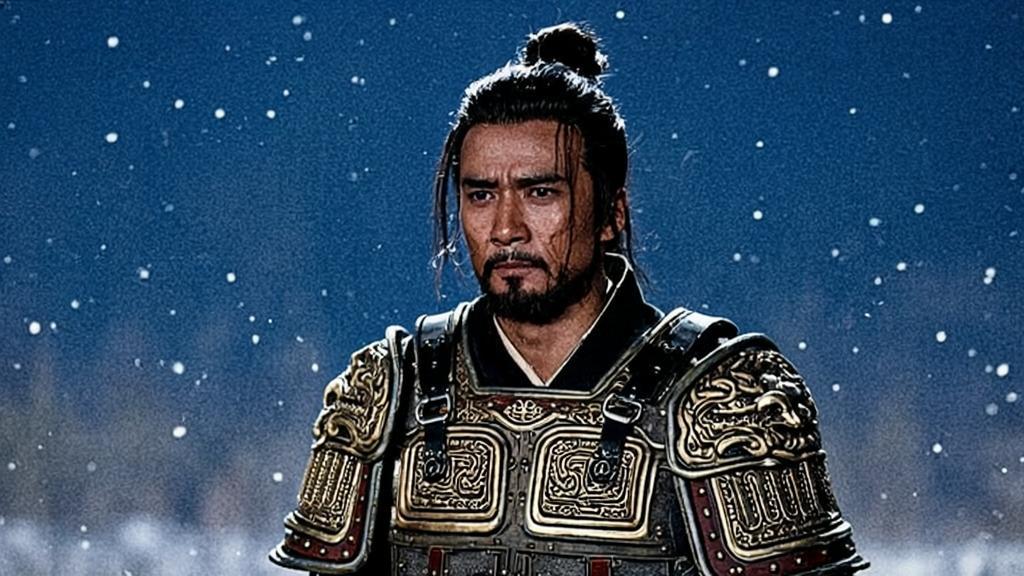
Peter Ho — known in Chinese as 何润东 — is a 50-year-old actor born in Los Angeles, raised in Canada, and now one of the most talked-about names in Chinese entertainment in 2026. But here’s the odd part: the role of making people talk isn’t new. It’s from 2012. And the reason it matters now says more about Chinese culture than it does about celebrity gossip.
Why a 14-Year-Old Role Went Viral in 2026
In early 2026, a viral comparison video swept Chinese social media. On one side: a modern historical drama featuring a general with flawless skin, glowing armor, and wind-machine hair. On the other: 何润东’s Xiang Yu from Legend of Chu and Han (楚汉传奇) — dust-covered face, 95-kilogram physique, and heavy hand-forged armor.
The contrast hit hard. Viewers started calling the new-style general the “foundation-cream general” (粉底液将军). Within days, Peter Ho gained nearly 1 million new followers on Douyin, jumping from 3 million to over 4 million.
So what exactly did he do differently — and why does it matter to anyone outside China?
The Role That Changed How People See Him
Peter Ho Prepared for Seven Months Straight
For the role of Xiang Yu, Peter Ho didn’t just memorize lines. He trained intensively for seven to eight months, increasing his body weight to over 80 kilograms to carry authentic armor. He also studied Shiji (史记), China’s foundational historical text written by Sima Qian around 100 BC, and reportedly wrote tens of thousands of words of character notes.
Filming conditions were extreme. Temperatures dropped to -17°C during outdoor battle sequences. Despite this, Peter Ho performed shirtless. No body double. Director Gao Xixi later called his performance “irreplaceable,” noting that the portrayal focused on Xiang Yu’s genuine emotions rather than a mythologized version.
He Trained Like a Western Method Actor — But the Goal Was Different
Western audiences may recognize this dedication. It resembles method acting traditions: Daniel Day-Lewis famously refused to break character for months during shoots. The physical transformation echoes actors like Christian Bale or Tom Hardy preparing for The Dark Knight Rises.
But the goal wasn’t the same. In Western method acting, the actor often disappears into the character. Here, Peter Ho was trying to understand and embody a 2,200-year-old idea of heroism specific to Chinese culture — one that doesn’t require the hero to win.
The Chinese Hero: Why Losing Can Make You Immortal
What Westerners Usually Miss About Xiang Yu
Xiang Yu (项羽, 232–202 BC) was the most powerful military leader of his era. He overthrew the Qin dynasty, the first unified empire in Chinese history. Xiang Yu was physically legendary: ancient historian Sima Qian described him as capable of lifting a bronze cauldron with his bare hands, standing over 1.8 meters tall.
He lost anyway. His rival Liu Bang outmaneuvered him politically, and Xiang Yu was surrounded at the Battle of Gaixia. He broke through the encirclement, killing over a hundred soldiers alone. Then, refusing to flee across the Wu River and face his home province in defeat, he killed himself.
Liu Bang went on to found the Han dynasty. In Western terms, Liu Bang is the clear winner — the successful founder, the pragmatist who survived. Yet in Chinese culture, Xiang Yu is remembered as a hero, while Liu Bang is viewed as clever but morally compromised.
Why? Because Chinese heroism often centers on integrity under pressure, not outcome.
The Achilles Comparison — and Where It Breaks Down
Scholars at Vocal Media have compared Xiang Yu directly to Achilles: both were physically extraordinary, both were proud to the point of self-destruction, and both died before their enemies.
But there’s a key difference. Achilles was the son of a goddess. His strength had divine origin. Xiang Yu had no divine backing — his greatness was entirely human. According to the Shiji, when things went wrong, Xiang Yu blamed heaven. Traditional Chinese commentators found this laughable. A true hero owns his failures.
As a cultural analysis on Medium put it: “The American hero is a winner. A survivor. The Chinese hero is often a tragic figure — someone who stands firm, sacrifices, and sometimes falls gloriously.”
This isn’t pessimism. It’s a different philosophy of what makes a life worth living.
What Peter Ho Learned — And What You Can Too
A Canadian-Raised Actor Decoding Chinese Identity
Peter Ho was born in Los Angeles and grew up in Canada. He’s not someone who absorbed Chinese culture passively. He had to learn it deliberately — somewhat like a foreign student approaching China today.
His father was strict in a specific way: he trained Peter to hold chopsticks correctly, placing beans in a bucket and using an ivory chopstick to strike his son’s hand if he failed. He cut off his allowance at 15, expecting his son to earn his own way. The lesson wasn’t just discipline — it was the transmission of values through behavior, not explanation.
That approach mirrors how classical Chinese heroism is taught. You don’t read about it. You embody it through practice, through pressure, through doing something hard with no guarantee of reward.
For foreigners interested in understanding China more deeply, this is actually a useful entry point. Chinese cultural values — loyalty (忠), integrity (义), endurance (韧) — aren’t best understood from a textbook. They show up in stories. In performances. In the physical choices an actor makes under -17°C conditions.
Three Things Foreigners Can Learn From This Story
- Physical commitment communicates cultural values. The fact that Peter Ho wore real armor, gained real weight, and stood in real cold wasn’t vanity. It expressed something Chinese audiences recognized as authentic.
- Losing with dignity is not failure. In Chinese history and storytelling, how you face defeat often matters more than whether you win. This appears across Chinese opera, wuxia novels, and historical drama.
- Preparation is a form of respect. Peter Ho studying Shiji before playing Xiang Yu reflects a Confucian respect for accumulated knowledge. Engaging seriously with the source material wasn’t optional — it was the point.
Why the Viral Moment in 2026 Actually Matters
The “Foundation Cream General” Debate Is Cultural, Not Just Aesthetic
The viral contrast between Peter Ho’s gritty portrayal and the polished modern version sparked real debate in China. Critics pointed out that modern historical dramas increasingly prioritize idol-style aesthetics over historical authenticity. Reviews noted that battle scenes had become a backdrop for romance rather than historically grounded conflict.
Peter Ho himself was humble about the resurgence. In a recent interview, he said he “does not dare to claim any titles” and described the renewed attention as feeling like “reliving a dream” (KBizoom, 2026).
But the debate is larger than one actor’s moment. It’s about what Chinese audiences want to see reflected back at them — and what kind of heroism they find meaningful.
How to Experience This Culture Yourself
If this story makes you curious about Chinese historical drama, the series Legend of Chu and Han (楚汉传奇, also known internationally as King’s War) is available on Netflix. It’s a good starting point for understanding the Chu-Han rivalry and the cultural weight of Xiang Yu as a figure.
Beyond streaming, the historical sites connected to this story are real and visitable. Wujiang County in Jiangsu Province, where Xiang Yu made his final stand, remains a place of cultural significance. The Chu-Han period shaped the Chinese language itself — the phrase 四面楚歌 (surrounded on all sides, like Chu soldiers hearing home songs) is still used in everyday Chinese speech today.
The Lesson That Outlasts the Trend
Peter Ho didn’t plan to go viral in 2026. He prepared seriously for a role in 2011, worked in -17°C temperatures, and moved on. Fourteen years later, that preparation became evidence.
That’s possibly the most Chinese thing about the whole story. Not the spectacle. The quiet accumulation of work — and the patience to let it be recognized on its own terms.
For anyone looking to understand China beyond headlines, this is where to start: not with politics or economics, but with what a culture calls a hero, and why a man who lost everything 2,200 years ago still matters today.
References
Gao, X. (Director). (2012). King’s War (楚汉传奇 / Legend of Chu and Han). Bona Film Group. Available on Netflix: https://en.wikipedia.org/wiki/King‘s_War
KBizoom. (2026, April). Peter Ho feels grateful for his resurgence in popularity. KBizoom Entertainment. https://kbizoom.com/peter-ho-xiang-yu-resurgence-interview/
Teo, S. (2009). Chinese martial arts cinema: The wuxia tradition. Edinburgh University Press. https://www.researchgate.net/publication/287071481_Chinese_Martial_Arts_Cinema_The_Wuxia_Tradition
Vocal Media. (n.d.). Classical heroes: Achilles and Xiang Yu. https://vocal.media/futurism/classical-heroes-achilles-and-xiang-yu
Wang, C. H. (1975). Towards defining a Chinese heroism. Journal of the American Society, 95(1), 25–35. https://www.jstor.org/stable/599175
Zhou, Y. (2025, May). Heroes: A tale of two cultures. Medium. https://medium.com/@yanzhoukai/heroes-a-tale-of-two-cultures-041f66cd33dc
Baidu Baike. (2024). Xiang Yu character entry — Legend of Chu and Han. https://baike.baidu.com/en/item/Xiang%20Yu/60910
The China Project. (2018, September). Film Friday: Xiang Yu, the tragic Chinese hero. https://thechinaproject.com/2018/09/07/film-friday-xiang-yu-the-tragic-chinese-hero/