


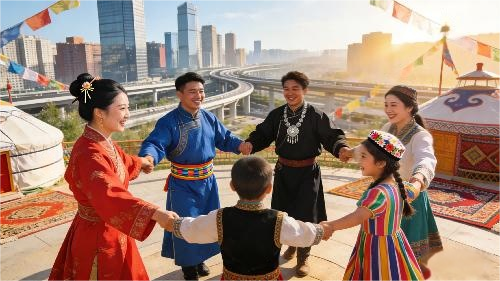
The ethnic groups in China are never a cold number in textbooks. In the vegetable market, the Uyghur stall owners will warmly deliver the hot Nang. At the Miao village festival, Han tourists can join hands with local people to dance the Lusheng dance. On the snowy plateau, the Tibetan grandmother patiently teaches the Han volunteer teacher Zhiyu. These tiny moments, like pomegranate seeds, tightly bind 56 ethnic groups.
Ethnic groups in China: a community growing up in the fireworks
In Sandu Shui Autonomous County, Qiannan Prefecture, Guizhou, the lively scene of the Shui “duanjie” is full of appeal. The open space at the entrance of the village was full of people of all ethnic groups, and the aquatic uncles were catching fish in the pond, and the spray was splashing and cheering. On the other hand, Miao girls were teaching Han girls to wear silver jewelry, and the sound of Lusheng was covered by the laughter like a silver bell.
The village party secretary said that the current Festival is no longer a single ethnic “internal party.” On the “Xiaonian Festival” of the Buyi Ethnic Group, the Dong Pipa song and the Han Yangge were performed on the same stage; During the Miao ethnic group’s “guzang Festival”, the Zhuang ethnic group’s five-color glutinous rice and the Yi ethnic group’s Tuotuo meat were placed on the same long table.
This fusion grows naturally in the fireworks. In a small area, the dried fruit shop of Uygur Ay Guli is next to the Hot Pot shop of the Han boss in Sichuan. Mr. Fei Xiaotong once said: “The beauty of each country, the beauty of beauty, the beauty of the United States and the world.” Each nation has cultural treasures, but it does not hinder mutual appreciation and acceptance. Hunan pepper seedlings can grow under the grape frame in Xinjiang, and the Northeast Kang table can be placed in the bamboo building in Yunnan. This inclusiveness is the solid foundation of the Chinese national community. Relevant cases can refer to the special reports of the National People’s Committee.
Ethnic groups in China: a new life from the historical fold
It is said that China’s national story is a long history of “harmony but difference”. This is very reasonable, and this long volume is never static, and it has been continuing to write a new chapter.
The elders recalled that in the past, the northwest ethnic areas were very backward, the tents of Tibetan herdsmen were windy in winter, and the stands of Hui merchants were windy and sunny on the side of the road. Now go again, the scene is totally different. Tibetan people in Linzhi, Tibet, set up homestays to promote plateau peach blossom with short videos; Hui entrepreneurs in Wu Zhong, Ningxia, built a modern chemical plant and made Tanyang into an export product. These changes are inseparable from the support of the state and the common struggle of the people of all ethnic groups.
Brilliant development data
There is a group of data in the national development blue book: China’s national development report (2,024) that is very persuasive: from 2021 to 2,023, the per capita disposable income of rural residents in ethnic areas increased by 8.2% per year, 1.1 percentage points higher than the national average.
Qinghai barley wine, Inner Mongolia dairy products, and Yunnan Pu’er tea, once “local specialties”, have now become “hot cakes” in the market (Wang Yanzhong et al., 2,024). This report has a more detailed analysis of the development of ethnic areas. You can refer to it if you are interested.
Cultural heritage is also rejuvenated. In the past, when people mentioned national culture, they always thought of “old antiques”. Now young people are using new ways to make it live. The girls of the Nakhi ethnic group in Yunnan made the Dongba language into a tidal brand sweater, the Dong ethnic group in Guizhou adapted the Dong ethnic group song with an electronic piano, and the blogger of the Mongol ethnic group in Inner Mongolia taught the Andai dance in a short video. Although these innovations are controversial, they let the national culture out of the museum.
An interesting phenomenon is that the more national it is, the easier it is to go to the world. At the Shanghai international cultural and cultural fair last year, the Silk Pavilion of Xinjiang edelese was filled with foreign businessmen; Shui Horse Tail Embroidery handicrafts are favored by French designers to make high-end fashion. The charm of culture lies in that it is rooted in the national soil, but it can open flowers across national boundaries.
Ethnic groups in China: common growth under the policy temperature
The development of ethnic areas cannot be separated from the policy escort, but the policy is not “one size fits all” assistance, but “precise drip irrigation”. The system of regional ethnic autonomy gives full autonomy to all ethnic groups: the Tibetan New Year in Tibet is off, the Xinjiang Meat Festival is off, and the ethnic group’s language is widely used locally.
A Tibetan teacher in Lhasa said that the school teaches both Chinese and Tibetan, and the students can skillfully switch between the two languages. This kind of respect for culture enables each nation to hold its own roots and not lose its essence in development.
The pairing-assistance policy also benefited the ethnic areas. Beijing pairing-assistance Xinjiang Hotan, Jiangsu pairing-assistance Tibet Lhasa. Developed regions come with capital, technology, and talent to help local industries. Hetian’s Beijing-aided construction of the textile factory has enabled many Uyghur women to achieve employment at home. They can not only take care of the older people and children, but also earn money with their hands. One elder sister said with a smile, “Before, they relied on the sky to eat; now they rely on crafts to eat, and life is more and more ambitious.”
National Friendship in Education
Education is an important link in national integration. In many “bilingual schools” in ethnic areas, Han and ethnic minority students study and live together. Qinghai Sanjiang source ethnic middle school has students from Han, Tibetan, Hui, Mongol, and other ethnic groups. The school often runs an “ethnic cultural corner”, and students from all ethnic groups come to show their own culture.
This kind of friendship cultivated from childhood is the most precious national feeling. Some scholars believe that the biggest feature of China’s ethnic policy is that it not only emphasizes the “sense of the Chinese national community” but also respects the differences of various ethnic groups. In other words, it includes “pluralism” in “one” and condenses “one” in “pluralism”. This kind of balance keeps the national relations harmonious and stable.
After learning so many stories, you will find that China’s national stories are very simple, just the stories of ordinary people. It’s not a grand narrative, but the temperature of the hot Nang, the luster of the silver jewelry, the joy in the song, and the sincerity in the smile. These fragmented moments are the most vivid picture of national relations.
Maybe in the future, we will no longer deliberately emphasize the “national” label. It has been integrated into life, as usual as air, but indispensable. The beauty of each, the beauty of the United States, and the common grow together in the pluralistic symbiosis, which is probably the most ideal state of ethnic relations.
Wang Yanzhong, Zhao Tianxiao, Xu Wenhua, etc (2024). National development blue book: China National Development Report (2,024) – Rural Revitalization and economic modernization in ethnic areas, Social Sciences Literature Press