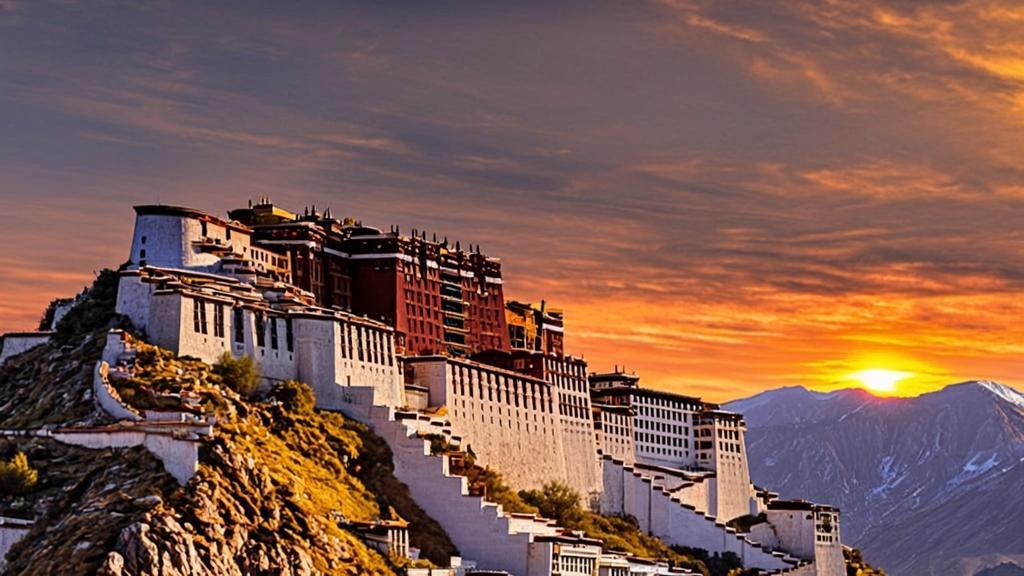
The Potala Palace stops people mid-step. Not metaphorically — literally. Travelers who have spent years staring at photos of it still describe the same moment: they turn a corner in Lhasa, and there it is, and nothing prepared them for it.
But here’s something most travel guides don’t tell you: the Potala Palace you see at 7 AM is a completely different building from the one you see at 9 PM. Same stone. Same red and white walls. Totally different experience.
This guide breaks down exactly what changes — and when to go if you want the best version of it.
Why the Potala Palace Is Built for Every Hour of the Day
Most palaces were designed to impress at a single moment. The Potala Palace, perched at 3,700 meters on Red Hill in Lhasa, Tibet, works differently.
Its architects — working across the 7th and 17th centuries — built a structure that changes with the sky. The inward-sloping white walls catch morning gold. The red section absorbs dusk orange. At night, floodlights push it into something almost theatrical.
That’s not an accident. UNESCO describes the Potala Palace as rising from Red Mountain in the centre of Lhasa Valley, with a beauty and originality that harmoniously integrates with its striking landscape (UNESCO World Heritage Centre, n.d.). In other words: the building was designed to exist within the light, not apart from it.
Compare this to, say, the Palace of Versailles. Versailles faces south, catches one type of midday light, and that’s more or less it. The Potala faces you from every angle — and rewards every angle differently.
Morning: The Golden Window (9:00–11:00 AM)
Dawn at the Potala Palace is, honestly, the version most people should prioritize.
The morning light is soft, enhancing the contrast between the red and white walls without harsh glare — ideal for photography. Tour crowds are thinner before noon, offering a quieter experience inside the halls (The China Journey, 2026).
What that means practically:
- Fewer tour groups jostling at the entrance
- Softer shadows across the palace face
- Cleaner air, cooler temperatures
- The Deyangshar Square midpoint offers a sweeping view over Lhasa below
The palace opens at 9:00 AM in summer (May–October) and 9:30 AM in winter (November–April) (TibetTour.org, 2025). Aim to enter in the first time slot. You’ll have the halls at their quietest, and the light at its kindest.
One insider tip: after your interior visit, head directly to Chakpori Hill Viewing Platform across the road. Morning light falls perfectly on the palace’s eastern face from there. It’s also the exact angle featured on the back of China’s 50-yuan banknote — bring one along for comparison.
Midday: Architecture Study Mode
Midday is not the most photogenic window. The sun sits high, shadows flatten, and tour groups peak.
That said, full daylight reveals something valuable: the architectural detail. The Potala Palace’s walls are massive — granite walls from 6 to 15 feet thick, supported through rammed-earth construction methods reinforced with copper (EBSCO Research, n.d.). That scale only registers fully in direct light.
The golden roof ornaments also pop at midday. They blend Han Chinese zoomorphic symbols with Tibetan Buddhist imagery — a visual record of two civilizations meeting in one building. Worth studying, even if it’s not your best photo hour.
If visiting in this window, use the time inside the Red Palace’s chapel halls. The Jokhang Temple Monastery nearby houses over 3,000 images of Buddha and historical figures, with mural paintings covering the walls — a good pairing for the midday stretch.
Afternoon: The Shift Begins (3:00–5:00 PM)
Something changes in late afternoon. The sky over Lhasa deepens. The white walls shift from bright to warm cream. The red walls start to glow.
Autumn offers the best visibility, with clear, crisp skies and cooler temperatures. The landscapes around the palace are beautifully vibrant during this time, making it perfect for photography (TibetTour.org, 2025).
Note: the last entry is at 3:40 PM in summer, 3:20 PM in winter, and the palace is closed on Mondays. So late afternoon is exterior-only — but the exterior is worth it.
Head to Zongjiao Lukang Park, directly behind the palace. A willow-lined lake reflects the rear facade in almost perfect symmetry. This is the view that gets shared on photography forums, and almost nobody tells first-time visitors about it. Arrive around 4:30–5:00 PM for optimal light.
Sunset: When the Palace Earns Its Drama
Sunset in Lhasa hits differently at high altitude. The air is thinner, the colors more saturated.
From Chakpori Hill at sunset, the palace shifts through orange, amber, and deep gold before the sky darkens. At sunset, the sky turns into a palette of oranges, reds, and purples, and the palace stands out against this colorful backdrop (Tibet Travel, 2025).
The Ping Cuo Kang Sang Restaurant, about 15 minutes east of the palace on the 6th floor, gives you panoramic sunset views over the entire complex — paired with Tibetan food. That combination is genuinely hard to beat.
Sunset in Lhasa typically falls around 8:00–9:00 PM in summer, later than most visitors expect.
Night: The Version Most Tourists Never See
This is the Potala Palace’s best-kept secret, and it isn’t really secret — most visitors just leave too early.
Shortly after sunset, during the blue hour, the entire facade of the palace lights up beautifully, glowing in white, red, and yellow hues (Tibet Travel, 2025). The effect is dramatic. The palace floats above the city, lit from below, the surrounding darkness sharpening every edge.
Then, from 20:30 to 22:00 nightly, the Potala Palace Square hosts a music fountain and light show. Water jets, colored lights, and the illuminated palace behind — it’s one of Lhasa’s most genuinely spectacular evening experiences, and almost no English-language travel content covers it properly.
The lighting schedule runs approximately:
- Winter: lights on from 19:00, off between 23:00–24:00
- Summer: lights on from 20:15, off around 23:30
Zongjiao Lukang Park at night offers the mirror reflection of the lit palace in the lake. On calm nights, the image is almost perfect. Bring a tripod if you care about the photo — or just sit and absorb it if you don’t.
Locals gather in the square for evening walks and prayers. Pilgrims circle the palace’s perimeter in the same clockwise kora they’ve walked for centuries. The night version of the Potala Palace includes all of that. It’s a fuller picture.
Practical Notes Before You Go
The Potala Palace requires advance booking. Same-day tickets are not available. Tickets for peak season (May–October) cost 200 RMB per person for Route 1, and 100 RMB for Route 2. Off-season (November–April) tickets are 100 RMB for both routes (Tibet Travel, 2025).
Key logistics to know:
- Daily visitor limit: 2,300 per day — book early
- Interior visit time: strictly 1 hour per slot
- Closed: every Monday (except national holidays)
- Photography: allowed outside; prohibited inside chapel halls
- Altitude: 3,700 meters — acclimatize for 1–2 days before visiting
- Foreign visitors: must be accompanied by a licensed guide; Tibet Travel Permit required
Potala Palace is a timed, regulated visit — plan it as part of your Lhasa itinerary, not as an afterthought (Experience Tibet, 2026).
One Building, Four Completely Different Experiences
Most buildings give you one face. The Potala Palace gives you four, at minimum — and a fifth if it snows.
Winter at the Potala Palace offers crystal-clear blue skies, with Lhasa enjoying an 80–90% clear sky rate even in the coldest months. A snow-dusted Potala under a deep blue Tibetan sky is arguably the most striking version of all — and the least crowded.
The Eiffel Tower is famous for its nighttime sparkle. Machu Picchu is famous for its dawn mist. The Potala Palace earns something different: it rewards you no matter when you arrive — as long as you know what to look for.
Come in the morning. Stay for sunset. Return for the lights.
References
UNESCO World Heritage Centre. (n.d.). Historic ensemble of the Potala Palace, Lhasa. https://whc.unesco.org/en/list/707/
The China Journey. (2026). 2026 Potala Palace travel guide, iconic landmark in Tibet. https://www.thechinajourney.com/potala-palace/
TibetTour.org. (2025). Potala Palace travel guide: Tickets, best time, highlights & travel tips. https://www.tibettour.org/lhasa-tours/potala-palace.html
Tibet Travel. (2025, August 13). Potala Palace tickets: How to book and tips for visiting. https://www.tibettravel.org/tibet-travel-guide/book-potala-ticket-in-advnce.html
Tibet Travel. (2025). Potala Palace at night: How to plan your evening visit in Lhasa. https://www.tibettravel.org/tibet-travel-guide/potala-palace-at-night.html
Tibet Travel. (2025). Potala Palace in winter: More majestic, religious and highly recommended to visit. https://www.tibettravel.org/tibet-travel-guide/potala-palace-in-winter.html
Experience Tibet. (2026, February 13). How to visit Potala Palace in Lhasa: Permits, tickets, rules, and what to expect. https://experiencetibet.org/blog/how-to-visit-potala-palace-in-lhasa-permits-tickets-rules-and-what-to-expect/
EBSCO Research. (n.d.). Potala Palace. Research Starters: Architecture. https://www.ebsco.com/research-starters/architecture/potala-palace