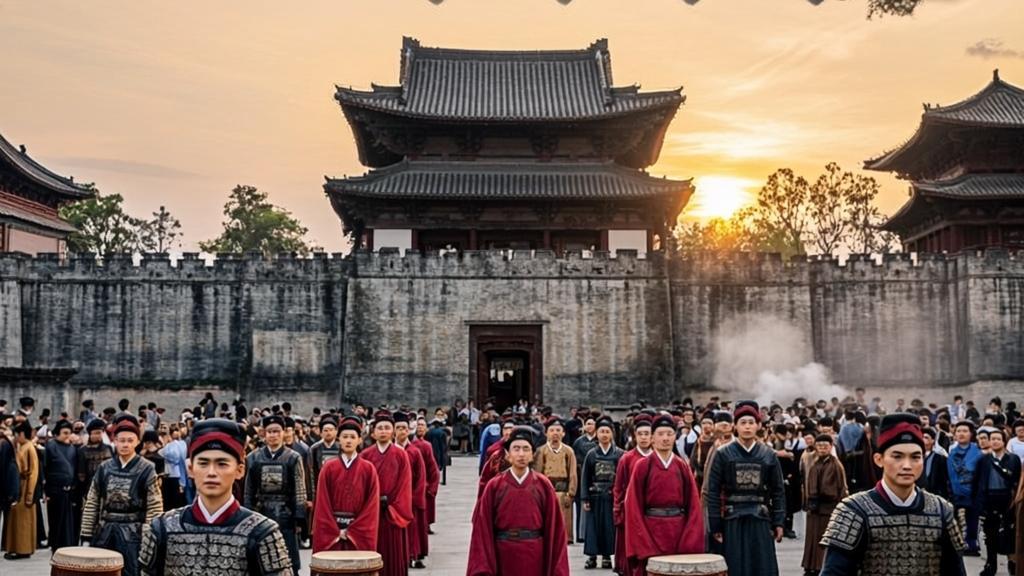
San Kong of Qufu — the UNESCO-listed trio of the Confucius Temple, Kong Family Mansion, and Confucius Cemetery — draws millions of visitors each year. Most people arrive mid-morning, map in hand, ready to tick off the highlights. That’s a fine plan. But it misses something. Something that happens every single day at 8 AM sharp, right outside the South Gate, and lasts about fifteen minutes. Those fifteen minutes, honestly, might be the most cinematic thing you’ll see in all of China.
What Happens When the Gate Opens
By 7:30 AM, the crowd has already gathered. Hundreds of people press against the ancient city wall — many dressed in flowing Hanfu robes, with wide sleeves and layered silk in ink blue, crimson, and gold. Others wear modern clothes and hold cameras above their heads. Vendors call out in Mandarin. Someone offers you a steamed bun. The smell of incense drifts in from somewhere nearby.
Then the drums begin.
At 8:00 AM exactly, actors in Tang and Han dynasty court costumes perform the opening ceremony outside the South Gate of the Confucius Temple (Trip.com, 2025). Ceremonial guards take their positions. The music rises — it’s not the kind of ambient background noise you’d expect at a tourist site. It’s deliberate. Ancient. The kind of sound that makes your body do something involuntary, like hold its breath.
Then the gate swings open. And the crowd moves forward.
Why This Feels Different From Any Other “Cultural Show”
Here’s the thing: this isn’t a ticketed performance. There’s no stage. No roped-off VIP section. The ceremony simply happens, and you’re simply there. That’s what makes it strange and wonderful.
Think about how Western heritage sites typically work. You book a slot. A guide explains things. You look at objects behind glass. It’s educational, often moving, but fundamentally passive.
This is different. The gate opening at San Kong of Qufu pulls you into the rhythm of something that has been happening — in some form — for over 2,500 years. The Confucius Memorial Ceremony was inscribed as a national intangible cultural heritage in 2006 (UNESCO Multimedia Archives, 2009). The ceremony dates to the Han dynasty. It has survived wars, dynasties, a Cultural Revolution, and the relentless march of modernity. And now, here it is. On a Tuesday morning. With you watching.
The Crowd Itself Is Part of the Experience
Pay attention to who’s standing beside you. That’s where the real story is.
You’ll see students in school groups, some wearing Hanfu for the first time, see older visitors — grandparents, perhaps — who may have studied the Analects in school decades ago and are here on a kind of quiet pilgrimage. You’ll probably spot a few people like yourself: foreign travelers who showed up early on a vague instinct that something important was about to happen.
The World of Chinese reported that by 7:30 AM, vendors are already calling out to the gathered crowd as laoshi — 老师, meaning “teacher” (The World of Chinese, 2025). That word originally meant “old master.” Today, it’s used as a general respectful address — the linguistic equivalent of calling everyone around you a potential mentor. It’s a small thing. But it tells you everything about what Qufu believes a stranger might be.
The Hanfu Phenomenon: More Than a Costume
You’ll notice the Hanfu immediately. It’s everywhere. And if you want to wear it too, rental shops near the temple gate charge roughly 50–80 RMB for a full outfit.
But why is everyone in traditional dress? This isn’t just cosplay or Instagram content (though it’s certainly both of those things too). The resurgence of Hanfu is tied to a broader cultural movement across China — a reclamation of pre-modern Chinese aesthetics and identity. At San Kong of Qufu specifically, wearing Hanfu also gives visitors discounts or sometimes free entry to certain experiences, as Global Times reported in its coverage of the Spring Festival period (Global Times, 2024).
More importantly, it changes how you move through the space. It’s surprisingly hard to check your phone while managing sleeves that wide.
After the Gate: What the Next Few Hours Look Like
Once you’re through the South Gate, the morning is yours. Here’s a rough shape for how to spend it well:
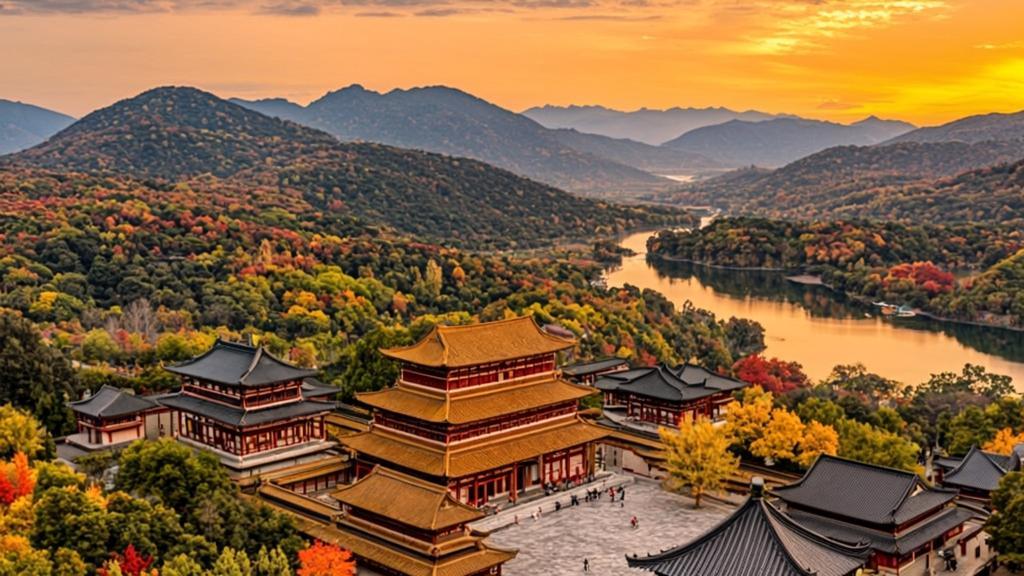
- Confucius Temple (孔庙): The oldest and largest temple complex dedicated to Confucius in the world — 460 rooms across 16,000 square meters, second only to the Forbidden City in scale (China Discovery, 2025). Allow 90 minutes minimum. Don’t rush Dacheng Hall.
- Kong Family Mansion (孔府): Directly east of the temple. This was the actual home of Confucius’ direct descendants — 152 buildings, 480 rooms — used as both a private residence and official government compound for nearly 600 years. Allow an hour.
- Confucius Cemetery (孔林): About 2 km north. Take a tuk-tuk or walk the tree-lined boulevard. This is where Confucius is actually buried — a quiet, forest-like space with over 100,000 graves spanning 2,300 years. Give yourself at least an hour, ideally more.
The combined ticket (San Kong) costs approximately 140–150 RMB and is valid for two days.
September 28: The Day the Ceremony Becomes a Grand Ritual
The daily gate ceremony is remarkable. But if you can arrange your trip around September 28 — Confucius’ birthday — you’ll witness something on a different scale entirely.
The 2025 Grand Ceremony of Worship of Confucius marked the 2,576th anniversary of his birth (CGTN, 2025). The event includes the formal opening of the city gate, ceremonial processions, the recitation of passages from the Analects, ancient music performed on instruments that most people have never seen before, and a flower basket offering. Guests attend from dozens of countries. Scholars come. Diplomats come. Confucius’ own descendants come.
The 2024 ceremony saw guests from 36 countries and regions, including representatives from Confucian temples and academies across Japan, South Korea, Vietnam, Indonesia, Malaysia, France, and Germany (CGTN, 2024).
There is nothing quite like it anywhere else on earth.
A Different Kind of Pilgrimage
The Vatican draws pilgrims. Mecca draws pilgrims. Varanasi draws pilgrims. And Qufu draws pilgrims — except what they’re coming to venerate is not a god, not a prophet, but a teacher.
That distinction matters. Confucius never claimed divine authority. He was a scholar, a civil servant, an exile, a man who spent most of his life failing to convince rulers to govern with benevolence. His ideas outlasted every empire that ignored him. And now, every single morning, people in ancient robes stand in the dark outside a wall and wait for a gate to open in his honor.
Twelve Chinese emperors made formal visits to Qufu. Emperor Qianlong came eight times — more than any other ruler (The World of Chinese, 2025). If that precedent means anything, showing up early on a weekday morning seems like the very least a traveler can do.
Set your alarm. Arrive by 7:30. Bring your camera, or don’t. Either way, you won’t forget it.
Practical Information
| Detail | Info |
|---|---|
| Location | South Gate, Confucius Temple, Qufu, Shandong Province |
| Daily ceremony time | 8:00 AM (arrive by 7:30 AM) |
| Closing ceremony | 5:00 PM (5:30 PM in peak season) |
| Combined ticket (San Kong) | ~140–150 RMB |
| Best months to visit | March–June, September–October |
| Annual highlight | September 28, Confucius Birthday Ceremony |
| High-speed rail | ~2.5 hours from Beijing, ~3.5 hours from Shanghai (Qufu East Station) |
| English guides | Available at the Visitor Service Hall and Confucius Temple Square |
References
China Discovery. (2025). Confucius Temple, Qufu: Visitor guide. https://www.chinadiscovery.com/shandong/qufu/confucius-temple.html
CGTN. (2024, September 26). Global guests to gather in Qufu for Confucius Cultural Festival. https://news.cgtn.com/news/2024-09-26/Global-guests-to-gather-in-Qufu-for-Confucius-Cultural-Festival-1xcYETTRXd6/p.html
CGTN. (2025, September 28). Grand ceremony in Qufu marks Confucius’ 2,576th birthday. https://news.cgtn.com/news/2025-09-28/Grand-ceremony-in-Qufu-marks-Confucius-2-576th-birthday-1H2ogk0NmZG/p.html
Global Times. (2024, February 15). Hometown witness: Tourists across nation enjoy authentic Chinese flavor in Confucius’ birthplace. https://www.globaltimes.cn/page/202402/1307367.shtml
The World of Chinese. (2025, September 11). Qufu: The “Holy City of the East” that continues to inspire students today. https://www.theworldofchinese.com/2025/09/qufu-the-holy-city-of-the-east-that-continues-to-inspire-students-today/
Trip.com. (2025). Confucius Temple tickets, opening hours & visitor guide. https://www.trip.com/travel-guide/attraction/qufu/confucius-temple-76546/
UNESCO Multimedia Archives. (2009). Sacrificial rite in the Confucian Temple. https://www.unesco.org/archives/multimedia/document-2232