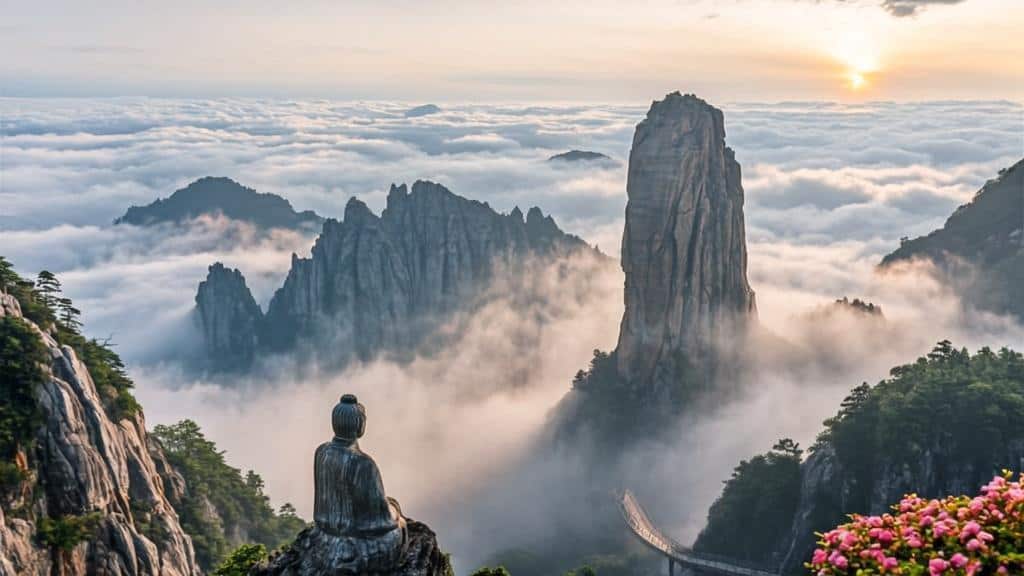
Sanqing Mountain doesn’t look real at first glance. Granite pillars pierce through thick morning fog. Clouds pour between peaks like slow-moving water. And somewhere above the treeline, an 86-meter rock formation stands silently — shaped, unmistakably, like a seated woman gazing across the valley. This is not a scene from a fantasy film. This is Jiangxi Province, northeastern China, and this mountain has been inspiring artists, pilgrims, and poets for over 1,400 years.
Why Sanqing Mountain Looks Like a Chinese Painting
There’s a reason traditional Chinese landscape painting (shān shuǐ, 山水画) has looked a certain way for centuries. Impossible vertical peaks. Swirling mist between stone columns. Mountains that seem to hover rather than stand.
Sanqing Mountain is where that aesthetic wasn’t invented — but confirmed.
According to the UNESCO World Heritage listing, the park concentrates 48 granite peaks and 89 granite pillars in a relatively small area, many resembling human or animal silhouettes (UNESCO World Heritage Centre, 2008). Moreover, UNESCO specifically cited the mountain’s meteorological conditions — including “bright halos on clouds and white rainbows” — as part of its outstanding universal value.
Western Romantic painters, like Caspar David Friedrich, also placed solitary figures against vast, untamed nature. But the emotional logic differed sharply. Western Romantic art whispered: look how small we are. Classical Chinese shān shuǐ painting replied: look how we belong.
Sanqing Mountain embodies that second philosophy completely. Standing on its ridgelines, you don’t feel conquered. Instead, you feel absorbed.
What Sanqing Mountain’s Two Iconic Formations Tell Us About Nature
Two formations define the visual identity of the mountain above all others.
The first is the Eastern Goddess (东方女神). This 86-meter granite silhouette rises from the ridge in the unmistakable shape of a seated woman, hair draped over her shoulders. She has watched over the valley for millennia. No sculptor carved her — erosion and time did.
The second is the Giant Python Out of the Mountain (巨蟒出山). It stands 128 meters tall — a single granite pillar, wind-carved across millions of years. Its resemblance to a rearing serpent is not subtle. It’s immediate, visceral, and slightly unsettling in the best possible way.
Both formations sit within the Nanqingyuan Scenic Area. Both are, frankly, impossible to photograph badly.
For centuries, Chinese poets referenced formations like these as proof that nature itself was the greatest artist. Interestingly, Western Romantics held a parallel belief — that wild landscapes carried divine intention. However, where European artists saw God’s hand in a thunderstorm, Chinese scholars perceived the Dao: an impersonal force that simply creates, endlessly, without agenda or preference.
The Spiritual History Hidden Inside Sanqing Mountain
Most visitors come for the scenery. Fewer realize they’re simultaneously walking through one of China’s oldest continuously active Taoist sites.
The story begins in the Eastern Jin Dynasty, around 357–361 AD. A scholar named Ge Hong — physician, alchemist, Taoist thinker — climbed this mountain to practice his craft. He left behind a stone well that reportedly has never run dry across more than 1,600 years (China Today, 2019).
After Ge Hong, successive dynasties added temples, pagodas, and stone inscriptions to the mountain’s northern slopes. Today, the Sanqing Palace complex holds over 230 ancient structures and carvings. The entire layout follows the Bagua (八卦) — the eight trigrams of Taoist cosmology. Each building placement corresponds to a cosmic principle.
Importantly, this is not a dead heritage site. Incense burns here. Pilgrims still visit. The mountain has not been museumified — it remains alive.
For Western visitors, a useful comparison is the Camino de Santiago in Spain. Both are pilgrimage routes layered over centuries of spiritual use. Both carry a palpable accumulated meaning. But where the Camino terminates at a cathedral built by human hands, Sanqing Mountain’s sacred focal point is the mountain itself. The landscape is the temple.
How to Actually Hike Sanqing Mountain
Here’s where things get practical.
The park covers 22,950 hectares in total (UNESCO World Heritage Centre, 2008). It contains multiple scenic zones, but two matter most for first-time visitors:
- Nanqingyuan (南清园) — The central area. Home to the Eastern Goddess, Giant Python, azalea valleys, and the greatest concentration of dramatic formations.
- West Coast (西海岸) — A suspended plank road running 4 kilometers along sheer cliff faces. Of that distance, 3.6 kilometers are entirely flat and step-free — at over 1,600 meters above sea level.
The West Coast trail, in particular, is unlike most hiking experiences elsewhere. You walk along the edge of a mountain, on a path bolted into vertical rock. Cloud banks drift below. On clear days, the horizon stretches for dozens of kilometers in every direction.
Two cable car stations serve the mountain:
- Jinsha (金沙) — East entrance. Cable car access only.
- Waishuangxi (外双溪) — South entrance. Both cable cars and hiking trails available.
Practical info for foreign visitors:
| Detail | Info |
|---|---|
| Best seasons | April–June (azaleas, mild temperatures); September–October (clear skies, autumn color) |
| Tickets | Entrance + round-trip cable car ≈ 250 CNY |
| Getting there | High-speed train to Shangrao or Yushan South Station, then local transport |
| From Shanghai | Approximately 2.5 hours by high-speed rail |
| Accommodation | On-mountain guesthouses and base hotels both available |
Arriving early matters. The morning fog is not an obstacle — it is, arguably, the entire point.
The Cloud Phenomenon That Defines the Sanqing Mountain Experience
Perhaps the single most visually defining feature here isn’t the rock formations at all. It’s the clouds.
The mountain sits at an elevation where subtropical and temperate air masses regularly collide. This produces weather that shifts within minutes. Fog pours between peaks like slow liquid. Then it lifts abruptly — and suddenly, you’re standing above a white sea.
As Wikipedia’s entry on Sanqingshan notes, the abundant yearly rainfall creates numerous waterfalls throughout the park, some exceeding 60 meters in height, alongside pools and springs across the landscape (Wikipedia contributors, 2024).
UNESCO additionally described “bright halos on clouds and white rainbows” as distinguishing meteorological features. In European alpine tradition, similar optical phenomena are called Brocken spectres — where sunlight projects a viewer’s enlarged shadow onto nearby cloud banks, surrounded by a luminous halo. Sanqing Mountain sees this effect with some regularity.
Classical Chinese poetry spent considerable energy describing these atmospheric phenomena. The clouds were never merely weather. They marked the boundary between the everyday world and something the poets struggled to name directly. Modern visitors don’t need to name it either. They just need to slow down enough to notice it.
Why Foreign Travelers Are Rediscovering Sanqing Mountain Right Now
International interest has grown noticeably in recent years. According to CGTN’s February 2025 report, foreign visitor numbers to Sanqing Mountain rose 23% in early 2025, partly driven by the global success of the animated film Ne Zha 2, which brought renewed international attention to Chinese mythological aesthetics (CGTN, 2025).
That statistic points to something broader. Global audiences are increasingly drawn to the visual language of Chinese culture — the aesthetic logic behind Ne Zha, Journey to the West, and a millennium of landscape painting. Sanqing Mountain is precisely where that language comes from.
Furthermore, the site offers something rare in Chinese travel: simultaneous spectacle, relative quiet, deep cultural layering, and solid practical infrastructure. English signage appears at major waypoints. The trails are well-maintained. The mountain rewards both the casual visitor and the serious trekker equally.
There’s a quiet observation made by photographers who have visited multiple famous Chinese mountains: Huangshan is for the portfolio. Sanqing Mountain is for the experience.
That distinction might be the most honest summary of what this place actually offers.
References
China Today. (2019, February 22). Mount Sanqing National Park: An open-air museum of ancient granite and natural phenomena. China Today. http://english.chinatoday.com.cn/2018/tourism/201902/t20190222_800157544.html
CGTN. (2025, February 25). ‘Ne Zha 2’ boosts tourism in east China’s Jiangxi Province. CGTN. https://news.cgtn.com/news/2025-02-25/-Ne-Zha-2-boosts-tourism-in-east-China-s-Jiangxi-Province-1Bh8XRnbHTa/p.html
UNESCO World Heritage Centre. (2008). Mount Sanqingshan National Park [World Heritage List, No. 1292]. https://whc.unesco.org/en/list/1292/
Wikipedia contributors. (2024). Mount Sanqing. In Wikipedia, The Free Encyclopedia. https://en.wikipedia.org/wiki/Sanqingshan