SF Same-City and Yunji Technology have officially signed a strategic cooperation agreement, marking a significant step forward in China’s smart logistics industry. The two companies formalized the deal at SF Same-City’s headquarters in Shenzhen on March 18, 2026. Together, they are rolling out a “Courier + Robot” relay model — targeting the stubborn “last 100 meters” bottleneck in high-rise building deliveries across China.
What the SF Same-City and Yunji Technology Deal Actually Does
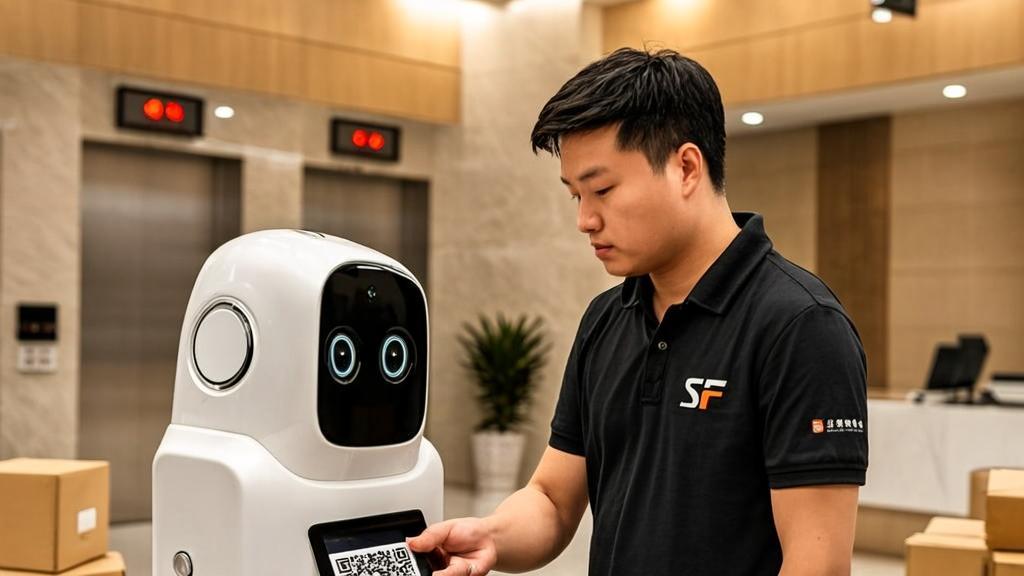
The core of this partnership is straightforward. When a courier arrives at a building lobby, they open the SF Same-City Courier App and scan a QR code on the robot. The app automatically links the order. One tap, and the parcel is loaded. After that, the robot takes over — navigating elevators, traveling to the right floor, and completing the delivery without any human assistance.
No waiting. No extra trips upstairs, and no manual intervention.
This system-level integration between the SF Same-City Courier App and Yunji’s robot terminals is what makes the model genuinely scalable. It is not a one-off pilot. As of now, the “Courier + Robot” relay system is already live across more than 300 cities in China. It is deployed in:
- Over 15,000 hotels
- Multiple commercial office buildings
- High-frequency scenarios including business express parcels, food delivery, and instant retail
Both companies say they plan to extend the model into high-rise residential complexes, hospitals, and university campuses next.
Why This Partnership Makes Sense for Both Companies
SF Same-City: China’s Largest Third-Party Instant Delivery Platform
SF Same-City has been building momentum for years. In 2024, the company posted full-year revenue of approximately RMB 15.75 billion — a 27.1% year-on-year increase — while net profit surged 161.8% to around RMB 133 million. That growth reflects a platform that is maturing fast.
Its scale is equally striking:
- 650,000+ active merchant partners
- 23.41 million active consumers
- Nearly 970,000 active couriers
SF Same-City has also been pushing aggressively into unmanned delivery. As of mid-2025, its autonomous vehicle fleet reached 200 units operating across 38 major cities, with over 10,000 active routes in a single month. The Yunji partnership is a logical complement — adding vertical (upstairs) delivery capacity to a network that already covers ground-level urban logistics.
Yunji Technology: China’s No.1 Hotel Service Robot Company
Yunji Technology is not a newcomer. Founded in Beijing in 2014, the company has spent over a decade building robots specifically for indoor, high-traffic environments. By the end of 2024, Yunji’s robots were performing tasks at more than 34,000 hotels and 150 hospitals worldwide, completing over 500 million service operations in 2024 alone.
Backed by a high-profile investor roster including Alibaba Group, Lenovo Group, Tencent, and Trip.com, Yunji completed its Hong Kong Stock Exchange debut in October 2025, raising approximately HK$660 million (~$85 million) under the exchange’s Chapter 18C specialist technology listing rules. It was the first company to list under that rule in 2025.
According to its prospectus, Yunji holds around 6.3% of China’s robot service agent market — placing it at No.1 nationally. Hotels currently account for the largest share of its revenue, but the company is actively expanding into healthcare, factories, and commercial buildings — exactly the sectors this SF Same-City partnership targets.
The “Last 100 Meters” Problem in China’s Delivery Industry
China’s instant delivery market is booming. Yet one bottleneck keeps recurring: getting parcels from a building’s ground-floor lobby to the door of an individual unit in a high-rise. Elevators, security gates, floor mazes — for a courier on a tight schedule, every minute counts.
Traditional solutions rely entirely on couriers completing the full route. That works at scale until it doesn’t — during peak periods, in dense urban towers, or when a building prohibits couriers beyond the lobby.
The SF Same-City and Yunji Technology model reframes this. Rather than pushing couriers further into buildings, it inserts an autonomous robot at the handoff point. The courier handles outdoor mobility. The robot handles indoor vertical delivery. Both do what they are optimized to do.
This relay logic is simple. But its implications are significant for the broader instant delivery ecosystem in China.
What This Means for Travelers and Residents in China
For anyone staying at a hotel in China — or living in a modern urban residential complex — the practical impact is direct. Food deliveries, online retail orders, and business parcels can now arrive at your door without requiring the courier to navigate the building at all.
Yunji’s robots are already familiar fixtures in Chinese hotel corridors. They navigate autonomously, call elevators independently, and notify guests upon arrival. According to company materials, Yunji robots report 99% operational reliability in certain deployments, with hundreds of millions of tasks executed annually.
As SF Same-City and Yunji Technology expand the relay model into more cities and scenarios, contactless, door-to-door delivery is set to become a routine expectation rather than a novelty — particularly in China’s dense, high-rise urban environments.
Looking Ahead
The partnership between SF Same-City and Yunji Technology represents more than a technology integration. It reflects a broader shift happening in China’s logistics industry: human couriers and autonomous robots working together rather than competing, each covering the leg of the journey suited to their capabilities.
Both companies have signaled plans to explore hospitals, campuses, and high-rise residential communities next. Given SF Same-City’s national coverage and Yunji’s established hotel network, further scale looks feasible in the near term.
China’s service robot market is growing quickly. According to Frost & Sullivan data cited in Yunji’s prospectus, China’s robot service agent market reached RMB 3.7 billion in 2024, and is projected to grow to RMB 13.5 billion by 2029 — a compound annual growth rate of 29.3%.
The SF Same-City and Yunji Technology partnership positions both companies well inside that trajectory.
References
Caixin Global. (2025, October 17). Hotel robotics firm Yunji jumps 26% in Hong Kong debut. Caixin Global. https://www.caixinglobal.com/2025-10-17/hotel-robotics-firm-yunji-jumps-26-in-hong-kong-debut-102372416.html
Frost & Sullivan. (2024). China robot service agent market report. Cited in Beijing Yunji Technology Co., Ltd. prospectus (HKEX, 2025).
HeadSCM / 物流指闻. (2026, March 18). 顺丰同城携手云迹科技,”骑士+机器人”协同智能配送落地全国超300城 [SF Same-City and Yunji Technology partner; “Courier + Robot” relay model live in 300+ cities]. Logistics Insight. https://www.headscm.com/Fingertip/detail/id/53441.html
Sahm Capital. (2025, October 16). Alibaba-backed robot maker Yunji raises $76M in Hong Kong IPO. https://www.sahmcapital.com/news/content/alibaba-backed-robot-maker-yunji-raises-76m-in-hong-kong-ipo-2025-10-16
Sina Finance. (2025, June 3). 顺丰同城:2025年5月顺丰同城无人车运营规模达200台 [SF Same-City autonomous vehicle fleet reaches 200 units in May 2025]. Sina Finance. https://finance.sina.com.cn/tech/roll/2025-06-03/doc-ineyvent6361089.shtml
STCN / Securities Times. (2025, March 28). 顺丰同城2024年净利润增长162% 单量增逾三成 [SF Same-City 2024 net profit up 162%, order volume up over 30%]. Securities Times. https://www.stcn.com/article/detail/1620782.html
The Bamboo Works. (2025, October 16). Yunji rolls out red carpet for investors with Hong Kong IPO. https://thebambooworks.com/yunji-rolls-out-red-carpet-for-investors-with-hong-kong-ipo/