Soochow University offers something that almost no university in the world can match. Students here can take a dedicated course on silk — its history, science, aesthetics, and cultural meaning — in the same city that has produced the world’s finest silk fabric for over two millennia.
That’s not a marketing line. It’s a quirk of institutional history that is genuinely hard to find anywhere else on earth.
The Silk Backstory Nobody Tells Foreign Students
Most international guides to Soochow University mention its QS ranking, its proximity to Shanghai, and its modern campuses. Fewer explain why the university even has a textile school in the first place.
Here’s the short version. In 1997, Suzhou Institute of Silk Technology merged into the University (Wikipedia, 2025). Two years earlier, Suzhou College of Sericulture — which studied silkworm cultivation and raw silk production — also merged in. The result: today’s School of Textile and Clothing Engineering, home to the National Engineering Laboratory for Modern Silk (现代丝绸国家工程实验室). That lab is one of only a handful of state-level silk research institutions in China (Soochow University School of Textile, 2025).
So when students at the University take a silk culture course, they’re not just attending a general humanities elective. They’re sitting inside the same institutional lineage that has studied silk as a scientific, commercial, and cultural subject for decades.
What the Course Actually Covers
The “Silk Culture and Products” course — available on China’s national MOOC platform — runs across nine chapters and covers (China University MOOC, Soochow University, 2024):
- The 5,000-year history of silk and its spread along the Silk Road
- How silkworms are cultivated and how raw fiber becomes woven fabric
- Dyeing and finishing processes
- China’s “Four Great Embroideries” and “Four Great Brocades” (四大绣、四大锦)
- How to identify genuine silk versus synthetic imitations
- Modern applications beyond fashion — including medical and aerospace uses
That last item tends to surprise people. Silk fiber, it turns out, has properties that researchers are actively exploring for surgical sutures, drug delivery, and even structural materials. The University’s National Engineering Laboratory for Modern Silk works on exactly this frontier.
Su Embroidery: The Craft That Lives Next Door
Beyond the classroom, studying in Suzhou gives students direct access to one of China’s most refined art traditions: Su embroidery (苏绣, Sū xiù), recognized as a UNESCO-level intangible cultural heritage.
Su embroidery uses silk threads finer than human hair. Skilled artisans split a single thread into 48 strands. The resulting work can depict photographic-quality images — cats, landscapes, historical figures — using pure needlework. For comparison, the Western tradition of needlepoint typically uses a single thread without splitting, aiming for decorative pattern rather than representational precision.
Soochow University’s School of Art actively collaborates with the Suzhou Silk Museum, the Suzhou Arts and Crafts Museum, and several embroidery studios including Suzhou Yunfan Embroidery Crafts Co. (Cumulus Association, 2025). That means students in art and design programs work alongside actual craft practitioners — not just academics who study craft from a distance.
Why This Is Rare (Even in China)
There are fashion universities in France, textile design schools in England, and fiber arts programs scattered across North America. Most of them teach craft as design. A few teach craft as history. Almost none teach craft as living industrial and cultural ecosystem.
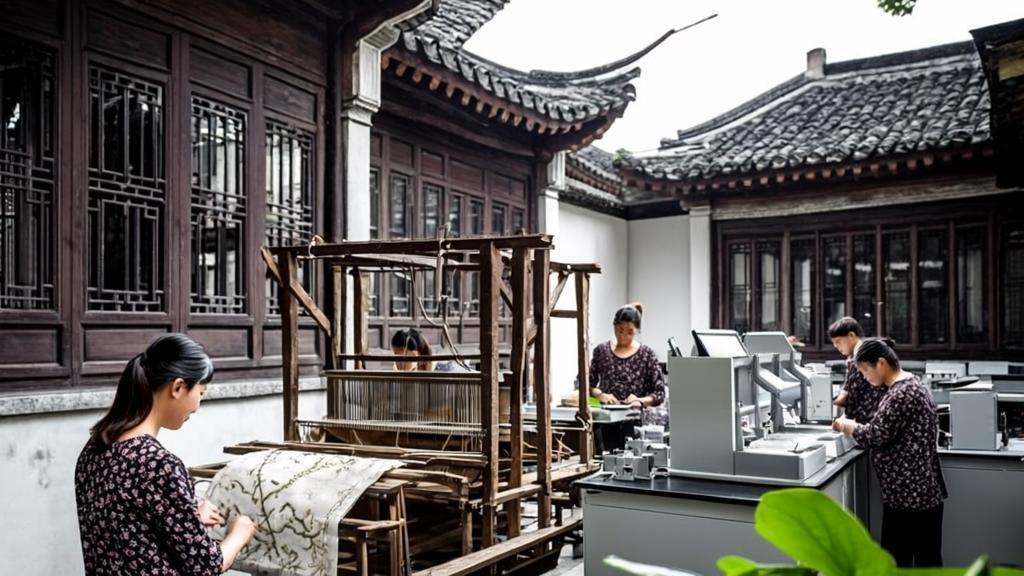
Suzhou is different. The city still has functioning silk mills. The Suzhou Silk Museum holds original looms that still operate. Local artisans practice Su embroidery as a current profession, not a heritage performance. This creates a learning environment that is genuinely difficult to replicate.
The Chinese MOOC course is available to anyone online. However, studying at Soochow University in person adds layers that a screen cannot provide:
- Weekend cultural tours of silk production workshops
- The weekend “Chinese Language and Culture Program” includes visits to Suzhou cultural sites, specifically local crafts (China Job / Soochow University Overseas Education, 2025)
- Access to the National Engineering Laboratory for thesis-level research
The Guochao Connection: Why This Matters Right Now
This is probably not the moment to downplay the cultural timing. The global “Guochao” (国潮) trend — Chinese youth reclaiming traditional aesthetics as modern identity — has pushed silk and embroidery back into mainstream fashion consciousness. Chinese designers are incorporating Su embroidery techniques into contemporary collections. International fashion brands are paying attention.
For foreign students interested in fashion, material science, or cultural studies, Soochow University sits at the intersection of heritage craft and active innovation. That combination is increasingly rare.
Practical Information for International Students
Soochow University is a Double First-Class national university, ranked 28th in China nationally and placed in the 101–150 bracket in the Academic Ranking of World Universities in 2025 (Bright Scholarship, 2026).
For the 2026–2027 academic year, the university offers international students:
- 27 undergraduate programs open to international students
- Chinese Government Scholarship (CSC Type B) for master’s and doctoral students — fully funded, covering tuition, accommodation, monthly stipend (~RMB 3,000–3,500), and medical insurance (Soochow University Agency Code: 10285)
- Soochow University International Student Scholarship — for students not selected under CSC
Self-sponsored students pay roughly RMB 800–900/month for on-campus accommodation (shared room, East Campus). Living costs in Suzhou are significantly lower than Shanghai, about 30–40 minutes away by high-speed rail.
The weekend Chinese Language and Culture Program at the School of Overseas Education runs every semester, accepting students with HSK Level 2 or basic equivalent. Classes include Suzhou local culture sessions and visits to places of interest (China Job / Soochow University, 2025).
A Note on the MOOC Option
Not ready to move to Suzhou? The “Silk Culture and Products” course on the China University MOOC platform is free to audit. It carries official certification from Soochow University (China University MOOC, Soochow University, 2024). It covers silk history, fabric identification, and cultural context across nine chapters. Completion earns a certificate — paid, but the learning itself is accessible.
It functions, essentially, as a preview. Whether it leads to a visit, a semester, or a full degree is another question. But as an introduction to a subject that most Western universities simply do not offer, it’s worth the time.
References
China University MOOC / Soochow University. (2024). 丝绸文化与产品 [Silk Culture and Products]. iCourse163. https://www.icourse163.org/course/SUDA-1001754250
Soochow University School of Textile and Clothing Engineering. (2025). 现代丝绸国家工程实验室 [National Engineering Laboratory for Modern Silk]. https://textile.suda.edu.cn/
Soochow University. (2026). 2026–2027 Application Notice for Undergraduate Students Program. http://apply.international.suda.edu.cn/apply_en/28005/list.htm
Soochow University. (2025). 2025–2026 Application Notice for Graduate Students. http://apply.international.suda.edu.cn/apply_en/2024w2025SoochowUniversityApplicationNoticeforGraduateStudents/list.htm
Wikipedia. (2025). Soochow University (Suzhou). https://en.wikipedia.org/wiki/Soochow_University_(Suzhou)
Cumulus Association. (2025). Member Institution Profile: Soochow University. https://cumulusassociation.org/our-community/our-member-institutions/soochow-university/
China Job / Soochow University Overseas Education. (2025). Study Chinese at Soochow University. https://www.chinajob.com/city_content/detail.php?id=vJf9BaInyDqmqtIyd5
Bright Scholarship. (2026). Soochow University CSC Scholarships 2026 in China (Fully Funded). https://brightscholarship.com/soochow-university-csc-scholarships-2026/