Southeast University is not an aerospace company. Yet what its researchers have demonstrated puts it in genuinely competitive territory alongside commercial players that have spent years chasing the same goal.
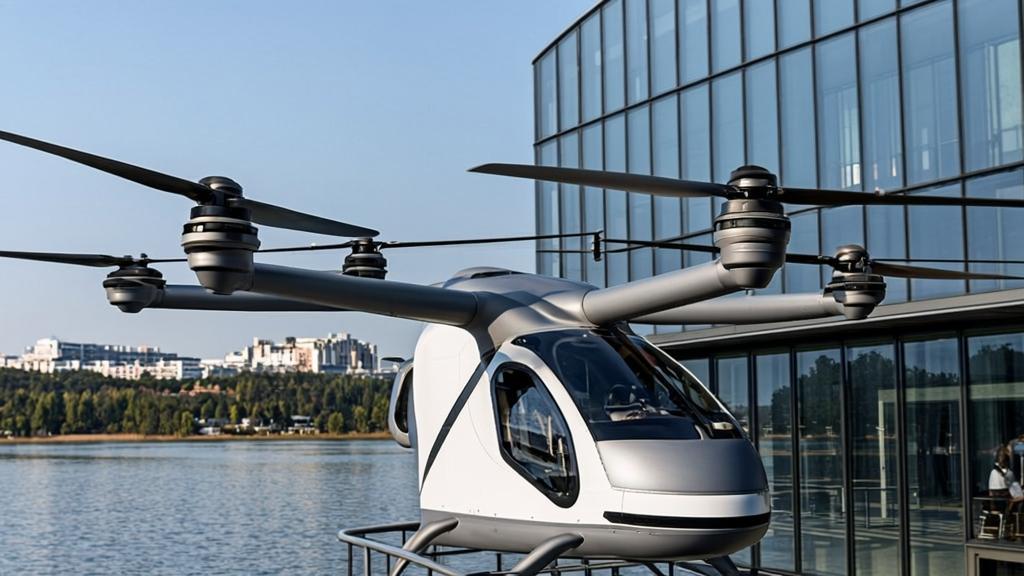
On January 23, 2026, a vehicle lifted off from a platform at Southeast University’s Jiulonghu Campus in Nanjing, China. It crossed a lake. It landed on the fifth-floor outdoor terrace of the Sanjiang Building on the opposite bank. The entire flight took under two minutes.
The vehicle was “Dongda Kunpeng 2” — a land-air integrated flying car developed entirely by a university research team at Southeast University (SEU). This was not a product launch by a technology giant with billions in funding. It was the second public demonstration of an academic research project that, just over a year earlier, had already produced the world’s first distributed electric-driven flying car.
What Makes the Kunpeng Series Different from Every Other Flying Car
Flying cars — loosely speaking — are not new as a concept. Joby Aviation, Archer, Germany’s Lilium, and Volocopter (which filed for bankruptcy in December 2024) have pursued electric vertical take-off and landing (eVTOL) aircraft for years. These are, fundamentally, aircraft. They take off vertically. They fly, land. But they don’t drive on roads in any practical sense.
The Dongda Kunpeng series takes a structurally different approach. As Professor Yin Guodong, the project leader from SEU’s School of Mechanical Engineering, explained directly: “This is China’s first flying car based on distributed electric drive technology, using a car as its primary carrier, rather than relying on drone technology” (Global Times, 2025).
That distinction is meaningful. The Kunpeng vehicles are designed to drive and fly — not to do one while tolerating the other. Switching between modes is a deliberate design requirement, not an afterthought. Engineering a single platform to perform both functions at acceptable levels is significantly harder than optimizing for either one alone.
The Kunpeng 1: Where It Started
The story begins on January 1, 2025, when Southeast University unveiled “Dongda Kunpeng 1” — China’s first distributed electric-driven flying car. Its technical specifications:
- Dimensions: 2.1 × 1.2 × 1.5 meters
- Maximum take-off weight: 500 kg
- Flight endurance: At least 20 minutes
- Maximum flight altitude: Over 300 meters
- Top ground speed: 60 km/h
- Propulsion: Four-axis, eight-rotor distributed electric drive system
The Kunpeng 1 broke real ground. It was China’s first flying car with both all-wheel steering and all-wheel drive in a land-air integrated configuration. It was also the first vehicle of its type in Jiangsu Province (Gasgoo, 2025).
Behind those specs are substantial engineering problems. The vehicle required simultaneous solutions to Ackermann steering geometry, electro-hydraulic composite braking, body structure topology optimization for both driving and flying loads, full-range redundancy in the power system, and a multi-modal digital cockpit — all in a platform small enough to park in a standard space. Combining those requirements in a single coherent design, from scratch, is a serious technical achievement.
Professor Yin described it plainly: Kunpeng 1 proved the principle. It demonstrated, for the first time in China, that a car-based architecture could successfully integrate distributed electric drive with air mobility.
The Kunpeng 2: From Proof to Practice
The Kunpeng 2, debuted in January 2026, is where the research shifts from demonstration toward practical deployment. The most significant design change is the foldable arm structure.
On Kunpeng 1, the four fixed arms holding the rotors were a problem. They made road driving awkward and ordinary parking impractical. Kunpeng 2 solves this directly. The arms fold, enabling rapid transitions between flight-ready and road-ready configurations. According to SEU’s official communications, the team worked through a series of engineering challenges to achieve what they describe as “reliable folding, instantaneous locking” — meaning the arms can be deployed or stowed quickly and safely in operational conditions (SEU News Network, 2026).
The result is a platform that is lighter, more compact, and meaningfully more practical than its predecessor. Professor Yin described the design philosophy directly: Kunpeng 2 is not a simple upgrade. It is “a redefinition for large-scale commercial scenarios.”
The target applications are concrete and near-term:
- Logistics delivery in areas with limited ground infrastructure or difficult terrain
- Infrastructure inspection of power lines, pipelines, remote towers, and bridges
- Emergency response in disaster zones or regions where roads are damaged or inaccessible
These are not vague future possibilities. They are specific operational needs that the Kunpeng 2’s design explicitly addresses.
Southeast University: Why This Institution for This Breakthrough
Southeast University is one of China’s oldest engineering institutions. Founded in 1902 — originally as Sanjiang Normal College — it became National Southeast University in 1921 and was the second national university established in modern China. Today, it holds membership in both the “985 Project” and “Double First-Class” university programs, placing it among the top tier of Chinese research institutions (Wikipedia, Southeast University, 2025).
The university’s School of Mechanical Engineering has particular depth in vehicle systems, control engineering, and intelligent transportation. The Jiangsu Research Center for Intelligent Electric Transport Equipment — the institutional partner for the Kunpeng project — brings manufacturing and systems integration expertise directly into the research process.
The Jiulonghu Campus, where Kunpeng 2 made its lake crossing, is a modern research campus in Nanjing covering more than 375 hectares. The lake crossing itself was not chosen arbitrarily. It demonstrated precision navigation, stable take-off and landing, reliable control in open-air conditions, and — not insignificantly — clean visual documentation of the flight for public and research audiences.
It also happened to look extraordinary.
The Broader Race: China’s Low-Altitude Economy
SEU’s work exists within a rapidly developing national industrial context. China has been actively promoting what it calls the “low-altitude economy” — a new sector centered on commercial operations in airspace below 1,000 meters. The policy direction is explicit and well-funded.
On the commercial side, XPeng’s AeroHT subsidiary has announced plans for its Land Aircraft Carrier modular flying car, with deliveries targeted for 2026. That system uses a different architecture — a large ground carrier that transports a separate air vehicle — and is priced at approximately 2 million yuan (\$280,000 USD). Chery, another Chinese automaker, has tested autonomous flying vehicles over 50-mile ranges.
What makes Southeast University’s Kunpeng project distinctive within this landscape is its approach. Corporate flying car projects typically start from an aircraft and work backward toward ground capability. SEU started from a car and worked forward toward flight. That produces a different architecture — one optimized equally for both modes from the ground up, rather than treating one as the primary function and the other as an add-on.
There is also the research dimension. The Kunpeng project functions simultaneously as engineering R&D and as talent development. The students and researchers building this platform are gaining cross-disciplinary expertise spanning mechanical engineering, vehicle dynamics, aerodynamics, control systems, and electrical engineering. They are, in effect, being trained for careers in an industry that barely existed when they enrolled.
What Comes Next
According to Professor Yin’s team, the next generation of Kunpeng vehicles aims to extend flight endurance beyond two hours. This will require transitioning from the current battery-only power system to an extended-range electric propulsion system currently under development — combining battery power with an additional range-extending aviation-grade electric system (Gasgoo, 2025).
Two hours of flight endurance changes the operational calculus significantly. At 20 minutes, the Kunpeng is a demonstrator and a short-range tool. At two hours, it begins to address real logistics routes, inspection corridors, and emergency response scenarios at meaningful scale.
That development is ongoing. The Kunpeng 1 proved the concept. The Kunpeng 2 is proving it can be made commercially practical. The generation after that is already in planning.
Flying Cars Have Always Been “Ten Years Away” — Until Now?
The joke about flying cars has been consistent for a century: they are always a decade from becoming real. The joke persists because the engineering problems are genuinely hard. Integrating the requirements of road vehicles and aircraft into a single platform requires solving problems in structures, propulsion, control, safety systems, and regulatory frameworks simultaneously.
But the 2025–2026 landscape is materially different from any prior period. Battery energy density has crossed practical thresholds. Sensor and navigation technology has matured. China’s regulatory environment for low-altitude operations is actively liberalizing. And a university research team in Nanjing just flew a land-air vehicle across a campus lake on a January morning — recorded, verified, and published by the university’s own news network.
Southeast University is not selling a product yet. What it is doing is demonstrating, with increasing rigor and increasing ambition, that the engineering problems have real solutions. The Kunpeng 2’s lake crossing is not a stunt. It is evidence.
References
Gasgoo. (2025, January 6). China unveils first distributed electric-driven flying car. https://autonews.gasgoo.com/china_news/70035625.html
Global Times. (2025, January 2). China’s first distributed electric-driven flying car unveiled by Southeast University. https://www.globaltimes.cn/page/202501/1326149.shtml
SEU News Network / Southeast University. (2026, January). Big breakthrough for China’s flying car: Dongda Kunpeng 2 makes debut. https://www.seu.edu.cn/english/
United Daily News. (2025, January 2). China’s first distributed electric-driven flying car ‘Dongda Kunpeng No.1’. https://uniteddaily.my/index.php/en/bea86de8-5dbf-4a69-8999-bfb4657e17c6
Wikipedia. (2025). Southeast University. https://en.wikipedia.org/wiki/Southeast_University
Euro Weekly News. (2025, January 5). China unleashes Kunpeng No. 1: first flying car with distributed electric driving. https://euroweeklynews.com/2025/01/05/china-unleashes-kunpeng-no-1-first-flying-car-with-distributed-electric-driving/
eVTOL News. (2025). Southeast University Dongda Kunpeng 1 (technology demonstrator). https://www.evtol.news/southeast-university-dongda-kunpeng-1