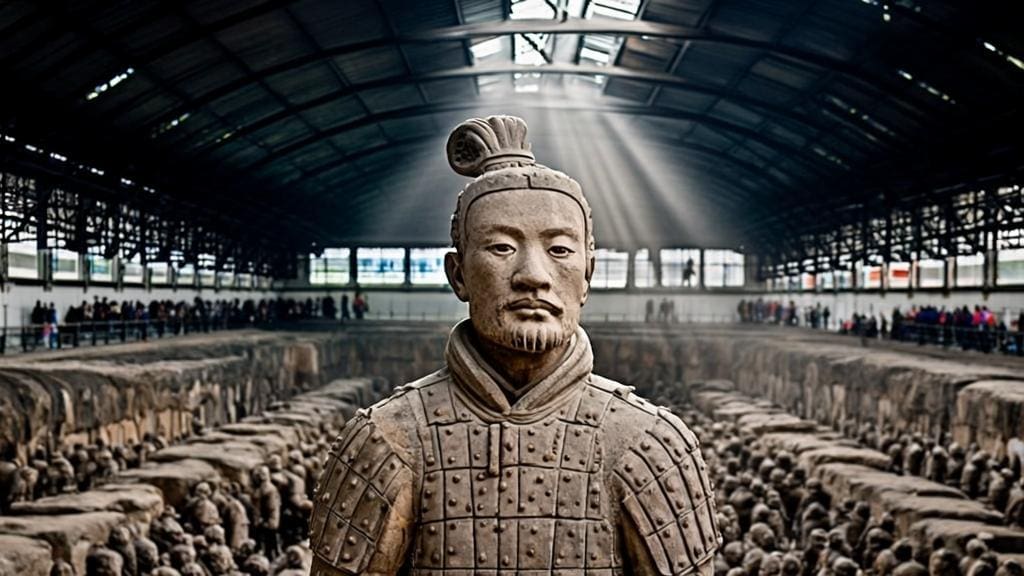
The Terracotta Army doesn’t greet you quietly. You descend into Pit 1 and suddenly face 2,000-year-old soldiers standing in tight formation, eyes forward, waiting. Most visitors gasp. Some go silent. A few reach instinctively for their phones.
But here’s what almost no one asks: What would that soldier tell you, if he could?
That question leads somewhere unexpected. It leads to a teenager’s fingerprint pressed into clay. To colors that vanished in seconds. To a workforce drawn from across a freshly unified empire. The Terracotta Army holds more than soldiers. It holds the full texture of a civilization — and most of it stays hidden in plain sight.
Born in Fire — How the Terracotta Army Came to Life
Imagine being summoned from your village, possibly hundreds of miles away, and handed a task no one had ever attempted before.
That’s roughly what happened around 246 BCE, when Emperor Qin Shi Huang began construction of his burial complex. The Terracotta Army was one part of a sprawling underground world. Archaeologists now estimate the total mausoleum complex covers approximately 98 square kilometers (Wikipedia, 2024).
The warriors were built using a layered coiling method. Craftsmen shaped the legs and torso first, let them air-dry, then applied a second coat of fine clay for carving detail. Arms and heads were made separately and attached later (Global Times, 2023). Think of it as ancient assembly-line production — sophisticated, systematic, and relentlessly precise.
Each figure weighs between 110 and 300 kilograms. The result? An army of roughly 8,000 soldiers, horses, and chariots arranged in strict military formation (Wikipedia, 2024). No two faces are identical. Ancient craftsmen achieved this individuality through a modular system — mixing and matching sculpted ears, noses, brows, and hairstyles to create unique combinations (Passionate Pursuits Travel, 2025).
In the West, ancient Greek and Roman statues aimed for ideal beauty — every face a perfected archetype. The Terracotta Army went the other direction. It insisted on the individual. That is a quietly radical artistic choice.
The Terracotta Army Was Never Grey (And That Changes Everything)
Here is the detail that genuinely stops people cold: every soldier in the Terracotta Army was originally painted in vivid, clashing colors.
Crimson red. Bright green. Purple-blue. Bold, unapologetic combinations that look nothing like the stone-grey figures visitors see today (History Skills, 2024). Archaeologists found traces of red, green, purple, and blue paint across multiple figures.
So what happened? When warriors are first unearthed, the color survives for a matter of seconds. Then oxygen hits. The pigment oxidizes and vanishes almost immediately. Conservators now rush newly excavated pieces into climate-controlled labs and use specialized adhesives — including a type used in eye surgery — to stabilize fragile paint before it’s lost forever (Global Times, 2023).
One particularly striking discovery: researchers identified a pigment called Han Purple, or Chinese Purple, on several figures. This compound — made from quartz, copper minerals, and barium sulfate, fired at approximately 1,000°C — was produced exclusively in ancient China. No other civilization in the ancient world made it (Global Times, 2023). It exists nowhere else in the archaeological record.
This raises a quiet point worth sitting with. When Western visitors stand before what appears to be a grey army, they are actually looking at ghosts of something far more vivid. The original Terracotta Army was almost certainly more colorful than most modern visitors ever imagine.
The Teenager Who Shaped the Terracotta Army — And Left a Mark
In 2025, archaeologists announced a discovery that reframed everything.
Using ultra-depth-of-field microscopy, researchers examined more than 40 restored warriors and extracted over 100 individual fingerprints. Most belonged to adult men, which matched expectations. But a significant number did not.
Some fingerprints belonged to teenagers (Global Times, 2025).
The most striking case involved Warrior No. 28 — an unusual reclining figure discovered in Pit K9901. Three fingerprints on its abdomen measured approximately 3.8 centimeters wide. Experts concluded the ridge density and size matched adolescent hands, likely someone in their mid-teens (Global Times, 2022).
Specialists now believe the craftsmen worked in a master-apprentice system. Senior artisans handled the fine detail: faces, eye sockets, armor joints. Young apprentices shaped rough clay, packed coils, prepared surfaces. Hundreds of workshops, possibly thousands of workers, contributed across the entire project (Global Times, 2025).
This discovery matters beyond archaeology. It makes the Terracotta Army feel human in a new way. A 16-year-old pressed his fingers into clay sometime around 210 BCE. That clay hardened in a kiln. It survived fire, looting, and two millennia underground. And now scientists can read the ridges of his hand.
Compare this to a parallel finding in Egypt: in 2024, Oxford researchers used Reflectance Transformation Imaging on terracotta figurines from the submerged city of Thonis-Heracleion and also found fingerprints revealing collaborative labor involving men, women, and children (Ancient Origins, 2024). Different civilizations, same impulse — leaving a mark on something built to last.
Standing Before the Terracotta Army Today: What Most Visitors Never Notice
When you visit the Emperor Qinshihuang’s Mausoleum Site Museum near Xi’an, you’re entering one of the most significant archaeological sites on Earth. It was inscribed as a UNESCO World Heritage Site in 1987.
Most visitors focus on Pit 1, which is fair — it’s enormous. The pit measures 230 meters long and 62 meters wide. Around 2,000 warriors have been excavated from it so far (Global Times, 2023). But here’s the thing: only about one-third of the total Terracotta Army has been unearthed. Roughly 6,000 more figures and horses remain underground (Global Times, 2022).
That means when you walk across the viewing platforms, you’re standing above thousands of warriors still buried beneath your feet.
The warriors all face east — toward the direction from which enemies might come, positioned to defend the emperor’s tomb in the afterlife (Science News Today, 2025). That directional choice was deliberate and military. It was not symbolic decoration.
There are also things most tourists miss entirely. The Bronze Chariot Museum at the adjacent Lishan Garden (丽山园) houses two extraordinary bronze chariots unearthed in 1980. Each consists of over 6,500 individual parts, connected using 17 different joining techniques. Some welding methods remain unexplained by modern metallurgists (Global Times, 2024). The crowds at the chariots are far thinner than at the main pits.
Practical Tips for a Deeper Terracotta Army Visit
- Book tickets in advance. Since 2023, the museum has required real-name online reservation. Purchase only through the official website (bmy.com.cn) or the official WeChat account “兵马俑票务在线” to avoid scalpers (Emperor Qinshihuang’s Mausoleum Site Museum, 2025).
- Visit Pit 2 for variety. It contains cavalry, archers, and mixed infantry — more troop types than Pit 1.
- Go to the Bronze Chariot Museum. It’s quieter and, arguably, just as remarkable.
- Allow at least half a day. The Lishan Garden section requires a separate trip by shuttle bus and is often overlooked.
- Check the conservation lab, if open. Some visitors can observe restoration work in progress inside the pits — a rare chance to see archaeology happening in real time.
Why the Terracotta Army Still Unsettles People
There’s a reason visitors go quiet. It isn’t just scale.
The warriors look back at you. Their proportions are human. Their expressions are specific. Some look young; others look tired. At close range, you can see individual hair strands, knuckle detail, the folds of cloth armor.
Western ancient art — Greek, Roman — often idealized the human body into something superhuman. The Terracotta Army did the opposite. It tried to capture people as they actually were. That choice, made over two millennia ago, feels strangely modern.
And somewhere among those thousands of faces, a teenager pressed his fingers into wet clay on an ordinary working day. He probably had no idea what he was making would outlast everything — his dynasty, his language, his name.
You can see his fingerprints if you look closely enough.
That is what the Terracotta Army is really about.
References
Global Times. (2023, March 13). New findings unveil production process of Terracotta Warriors. https://www.globaltimes.cn/page/202303/1287637.shtml
Global Times. (2022, June 12). 2,000-year-old fingerprints found among Terracotta Warriors may have belonged to teen craftsman. https://www.globaltimes.cn/page/202206/1269258.shtml
Global Times. (2024, December). New discoveries made at Terracotta Warriors site. https://www.globaltimes.cn/page/202412/1325378.shtml
Global Times. (2025, July). Teenagers found among craftsmen who made Terracotta Warriors: study of 2,000-year-old fingerprints finds. https://www.globaltimes.cn/page/202507/1339032.shtml
Wikipedia. (2024). Terracotta Army. https://en.wikipedia.org/wiki/Terracotta_Army
History Skills. (2024). The enduring mystery of the Terracotta Warriors and the tomb of the first emperor. https://www.historyskills.com/classroom/year-7/terracotta-warriors/
Science News Today. (2025, September 30). The Terracotta Army: Guardians of the First Emperor. https://www.sciencenewstoday.org/the-terracotta-army-guardians-of-the-first-emperor
Passionate Pursuits Travel. (2025). Astonishing facts about China’s Terracotta Warriors. https://www.passionatepursuitstravel.com/blog/astonishing-facts-about-chinas-terracotta-warriors
Ancient Origins. (2024). Fingerprints on Egyptian terracotta figurines show organization of labor. https://www.ancient-origins.net/artifacts-other-artifacts-news-history-archaeology/terracotta-0021657
Emperor Qinshihuang’s Mausoleum Site Museum. (2025). Official ticket reservation notice. https://news.qq.com/rain/a/20251116A0290Z00