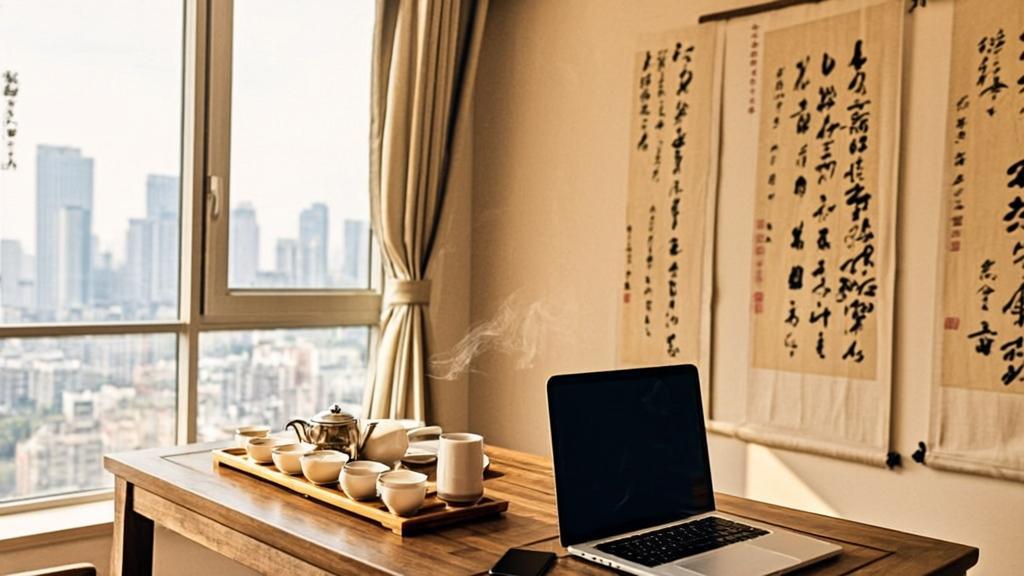
The daily habits of Chinese people are never simply repetitive behaviors. These habits are deeply rooted in the cultural soil and constantly reshaped in the tide of the times. From a cup of hot tea in the morning to studying at the desk late at night, from courtesy at the dining table to careful budgeting during consumption, these seemingly ordinary actions carry thousands of years of cultural codes. Nowadays, with the acceleration of globalization, traditional habits and modern lifestyles are undergoing subtle chemical reactions. Understanding these habits is not only about understanding the behavioral patterns of a group, but also about understanding the cultural logic and social changes behind them.
Introspective Thinking: Self Reflection in the Daily Habits of Chinese People
Introspection occupies a central position in the daily habits of Chinese people. This habit is not self analysis in the sense of modern psychology, but a training of thinking that extends to oneself and others. Professor Qiu Zeqi from Peking University pointed out that Chinese people have a thinking habit of “looking at others and looking at themselves”, which uses others’ evaluations of themselves as a mirror and constantly adjusts their own behavior (Qiu Zeqi, 2022). In other words, people understand themselves by observing feedback from others.
This introspective mechanism is reflected in daily trivialities. For example, controlling the volume in public places and avoiding disturbing others while they are resting. The key is that these behaviors are not simply constrained by rules, but stem from the recognition of “do not do to others what you do not want done to yourself”. The golden rule proposed by Confucius shapes a reflective mode of action. Before making a decision, people tend to deduce the feelings their actions may bring to others. This habit has created a high sensitivity among Chinese people towards others and society.
It is worth noting that introspection does not equate to self repression. It is more like a dynamic adaptation mechanism. In the rapidly changing modern society, this habit manifests as a continuous pursuit of self-cultivation. Whether it’s self-improvement in the workplace or maintaining family relationships, introspection provides a basic behavioral framework.
Harmony in Diversity: Inclusive Wisdom in Social Habits
The daily habits of Chinese people exhibit unique elasticity in the social sphere. On the surface, human relationships are complex and subtle, even including the criticized dining culture. But in reality, deep logic is the inclusive wisdom of “harmony in diversity”. In his later years, Fei Xiaotong proposed the modern interpretation of this tradition by saying “each beauty has its own beauty, the beauty of beautiful women” (Qiu Zeqi, 2022).
In social settings, this habit manifests as a willingness to face differences with equanimity. Despite different backgrounds and perspectives, people still pursue harmonious coexistence. For example, in business banquets, the details of courtesy between hosts and guests are essentially to maintain harmonious relationships. Some people think this is too cumbersome, but in reality, these ritualistic interactions construct a social buffering mechanism.
However, this habit is undergoing a test of modernity. The younger generation may be more inclined to express themselves directly rather than subtly and indirectly. The key is that no matter how the form changes, the pursuit of “harmony” remains deeply rooted. Even in a fiercely competitive business environment, Chinese people tend to establish trust relationships first before discussing specific matters. This habit is in stark contrast to the Western contract first model.
in Household Management: Pragmatism in Consumer Concepts
The daily habits of Chinese people exhibit a strong pragmatic tendency in the field of consumption. Although face culture still has an impact, the pragmatic spirit is more fundamental. Research by Liu Neng from the Department of Sociology at Peking University shows that contemporary Chinese people often consider actual utility rather than brand when making purchasing decisions (Liu Neng, 2012). In other words, comparing prices from three different sources is still a common practice.
This habit stems from a profound tradition of frugality. The long-term material scarcity in history has shaped the behavioral gene of “preferring frugality over extravagance”. Even under affluent conditions, many people still maintain frugality. It’s not that I can’t afford it, but rather that I believe it’s easy to transition from frugality to luxury, and difficult to transition from luxury to frugality. This cautious attitude is reflected in daily details: packing leftovers when dining out, searching for the most cost-effective solution when shopping, and maintaining a rational distance from luxury goods.
But habits are also dividing. Young people may be more willing to pay for experiences and hobbies. This change is not a betrayal of tradition, but a manifestation of pragmatism in a new context. The key is that no matter how the form of consumption changes, the question of whether it is worth it always exists. This habit makes the Chinese market both full of potential and difficult to predict simply.
Diligence and Diligence: Intergenerational Inheritance of Work and Study Habits
Diligence is one of the most prominent signs of Chinese people’s daily habits. From the “Yan Family Instructions” to the “Zhu Zi’s Family Maxims”, the teachings of “rising at dawn, sweeping the court away” have been passed down from generation to generation. This habit is not only reflected in physical labor, but also in a persistent passion for learning. The concept of “diligent learning is necessary for young children, and writing can establish oneself” is still the educational creed of many families today (Qiu Zeqi, 2022).
In the workplace, this habit is transformed into a practical philosophy of “making up for the shortcomings with diligence”. Faced with shortcomings, people tend to make up for them through extra efforts. Although the overtime culture is controversial, it does reflect this deep-seated habit behind it. It is worth noting that the purpose of diligence is not only material accumulation, but also self-improvement. The reference mechanism of “seeing the wise and thinking of the same” has provided diligence with a clear direction.
This is particularly evident in the field of education. Extracurricular tutoring, skill learning, and lifelong education have become the norm. The key is that learning is not only for practicality, but also for self-cultivation. This habit gives China a unique advantage in accumulating human capital. Even during leisure time, many people maintain the habit of reading or learning online.
Contemporary Changes: The Adjustment of Chinese Daily Habits in Globalization
The daily habits of Chinese people are undergoing profound adjustments in the wave of globalization. The collision between tradition and modernity can be seen everywhere. For example, coffee consumption is growing rapidly, but tea still occupies an important position. Some young people use credit cards for advanced consumption, but their savings habits have not fundamentally shaken. These changes are not simple replacements, but a reorganization of habits (Qiu Zeqi, 2022).
In the field of business, the evolution of habits is more evident. Email and instant messaging have changed the way communication is conducted, but the essence of relationship orientation remains unchanged. Multinational corporations entering China often need to adapt to the rhythm of “making friends first, then doing business”. Travel habits are also changing, with self guided tours replacing group tours, but the demand for in-depth experiences of food and culture is increasing.
Technology has reshaped the daily rhythm. The popularity of mobile payments has changed consumer habits, and short videos have changed leisure methods. But behind these changes, traditional logic still plays a role. For example, online social networking still follows the basic rules of face and affection. The key lies in the strong adaptability of Chinese people’s daily habits, which can absorb foreign elements while maintaining the cultural core.
Conclusion
The daily habits of Chinese people are like a prism, reflecting the complex spectrum of cultural inheritance and modern changes. From introspective thinking to diligent spirit, from frugal virtues to harmonious social interactions, these habits constitute a unique way of life. They are not rigid dogmas, but living traditions that constantly evolve in the practice of each generation. Understanding these habits can help reduce misjudgments in cross-cultural communication and build trust in business cooperation. Perhaps true cultural self-awareness begins with a deep observation of these daily details.
References
Qiu Zeqi (2022). ‘Chinese Habits Beijing: Peking University Press. For relevant discussions, please refer to the Pengpai News report: https://www.thepaper.cn/newsDetail_forward_19608765
Liu Neng (2012). The Lifestyle of Contemporary Chinese People: Multidimensional Analysis. ‘Towards the 36th World Sociological Congress , Department of Sociology, Peking University. http://www.shehui.pku.edu.cn/upload/editor/file/20180309/20180309160641_1216.pdf
Wait, I need to check the references formatting. The original had:
Qiu Zeqi (2022). ‘Chinese habits ‘ Beijing: Peking University Press For relevant discussions, please refer to the Pengpai News report: https://www.thepaper.cn/newsDetail_forward_19608765