The miracle of China’s modernization has never been just a steep rise in the GDP curve. The key is that this is a social reconstruction involving 1.4 billion people. From 1978 to today, this land has undergone tremendous changes. Over the course of more than forty years, it completed the two hundred year industrialization process of Western countries. In other words, this is a unique parallel modernization path. Traditional theory follows linear logic, but China’s practice breaks the stage theory. Industrialization and digitization occur almost simultaneously. This compressed growth creates a unique spatiotemporal experience.
Timetable: The Uniqueness of Parallel Modernization
The classic modernization theories in the West often presuppose sequential stages of development. First industrialization, then urbanization, and finally information. But China’s practice presents a different picture. The rise of the manufacturing industry and the popularization of the Internet were almost completed in the same time period. This parallel feature creates a unique efficiency advantage.
The international community has a clear understanding of this. Overseas observers generally believe that this scale of development is unprecedented in human history (Xinhua News Agency, 2022). The key is that this is not simply copying the Western model, but creating a new form of civilization. This new form emphasizes the coordination between material civilization and spiritual civilization, as well as the harmony between humans and nature.
Miracle of China’s Modernization in the Travel Dimension: Infrastructure as a Tool for Spatial Equality
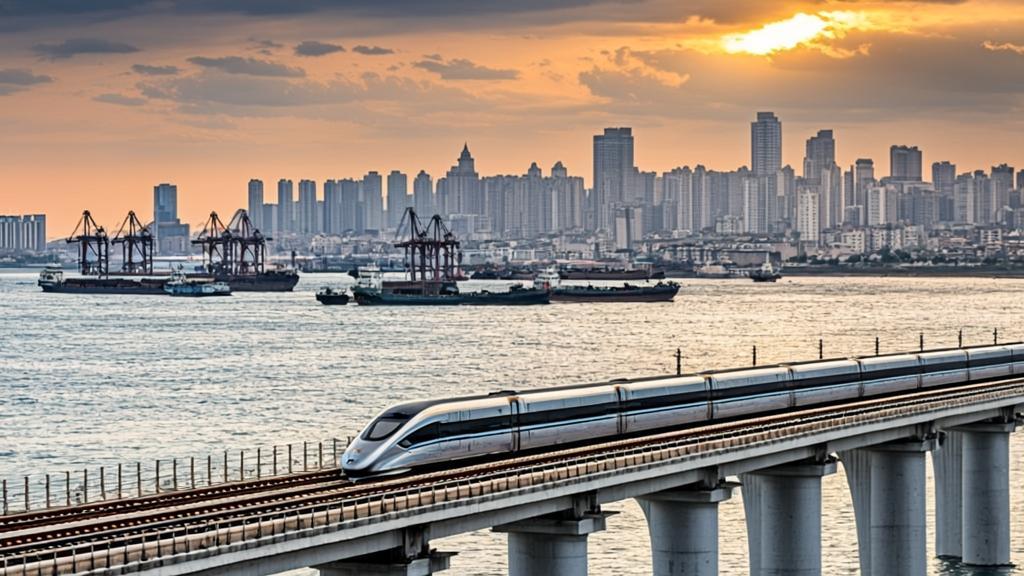
For contemporary travelers, the miracle of modernization in China is first reflected in the disruptive changes in spatial experience. In 2023, the operating mileage of high-speed rail in China reached 450000 kilometers. This means that it only takes four and a half hours to travel from Beijing to Shanghai. The past thousand kilometers have now been compressed into half a day round trip. This infrastructure density has reshaped people’s perception of geographic distance.
The construction of Yangshan Port further reflects the ultimate breakthrough of engineering capabilities. The project, launched in 2002, transformed the reefs deep in the East China Sea into one of the world’s largest deep-water ports (CCTV, 2012). The key is that such infrastructure not only serves the economy, but also reshapes regional relations. Inland cities have access to the sea through high-speed rail networks, while remote mountainous areas are connected to the national market through highways. Space equality has become possible.
CCTV (2012, December 15): Modern Miracle of China: Yangshan Port
The Miracle of China’s Modernization in the Learning Dimension: Mass Production of Human Capital
The expansion of education is the implicit engine behind this miracle. In 1980, the gross enrollment rate of higher education in China was only 2%. By 2022, this proportion had risen to 59.6%. In other words, knowledge acquisition has shifted from elite privilege to mass power. The speed of this transformation is rare in the history of human education.
The case of the Pearl River City shows the combination of technology and education. This building integrates efficient and sustainable technologies, providing a model for green building design (Study Strong Nation, 2023). The key is that the iteration speed of this technology relies on the support of a large group of engineers. millions of science and engineering graduates enter the labor market, creating the so-called ‘engineer dividend’. The accumulation of this human capital provides a foundation for subsequent technological innovation.
Learn from a strong country (2023): Chinese Modern Miracle (3 episodes)
The Miracle of China’s Modernization in the Business Dimension: The Business Logic of the Super Large Scale Market
For global businessmen, this miracle means a unique supply chain density. American scholar Turck pointed out that for the first time in history, a major power has been highly committed to helping developing countries countries pursue modernization (Turck, 2022). This two-way flow has created a new business ecosystem. The initiative of jointly building the “the Belt and Road” reflects this attitude of sharing.
The key lies in the multiplier effect of the super large scale market. Testing any new product in the Chinese market means reaching hundreds of millions of potential consumers. This scale can dilute innovation costs and reduce trial and error risks. For small and medium-sized enterprises, China is not only a manufacturing base, but also a testing ground for technology application. From mobile payments to electric vehicles, the market adoption speed far exceeds other regions.
The Unsolved Tension and Sustainability of China’s Modernization Miracle
However, compressive growth also brings structural challenges. Uneven regional development still exists. The tension between environmental costs and economic growth has not been fully resolved. In other words, the second half of the miracle requires resolving the remaining propositions from the first half. From a pursuer to a runner, the transition of roles requires new institutional flexibility.
Some observers are concerned about debt sustainability. The pressure of local government financing platforms cannot be ignored. But the key is that this ability to adjust itself is also a part of modernization. The emergence of green buildings such as the Pearl River City shows that the development concept is being revised. From simply pursuing speed to pursuing quality. This self correcting ability may be the key to the sustainability of miracles.
Narrative Still in Writing
Looking back over the past forty years, the core of China’s modernization miracle may lie in proving the diverse possibilities of development. It is neither a footnote to the Washington Consensus nor a simple return to planned economy. For future travelers, learners, and businesspeople, this land is still generating new narratives. The key is that this narrative is still being written. Every witnessing and participating in history.