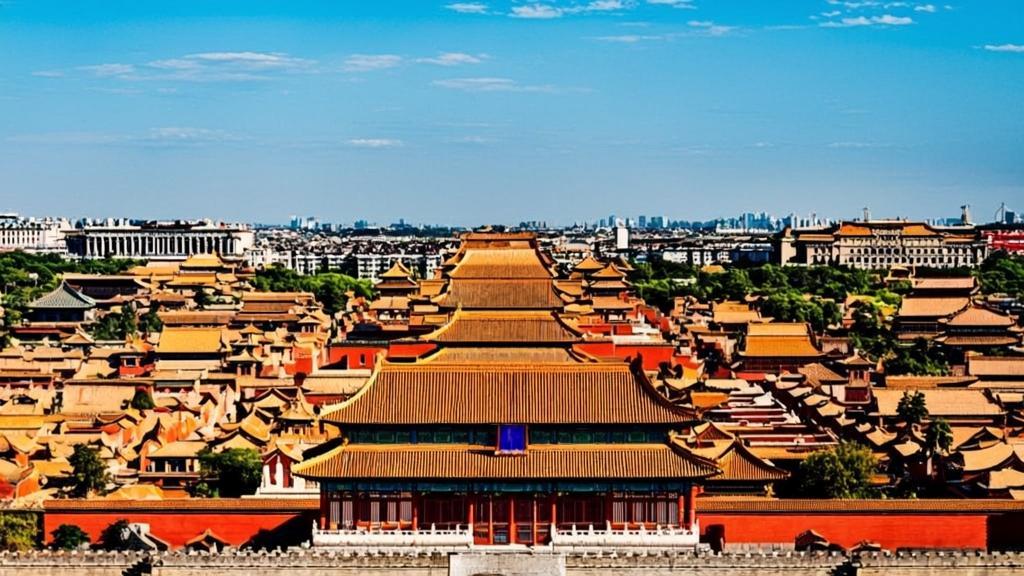
The Palace Museum — known in Chinese as Gùgōng (故宫博物院) — sits at the geographical and cultural center of Beijing. For most foreign visitors, the first glimpse of its red walls and golden rooftops triggers something close to disbelief. This place is real, and it’s enormous. But beyond the scale, there’s a deeper story here — one about power, art, history, and how a once-forbidden world became one of the most visited museums on Earth.
What Exactly Is the Palace Museum?
The Palace Museum is housed inside the Forbidden City, the imperial palace complex completed in 1420 during China’s Ming Dynasty. For over 500 years — from 1420 to 1924 — this was the home of 24 emperors and the nerve center of Chinese political power.
Then, in 1925, everything changed. The last emperor Puyi was evicted. The palace opened its gates to ordinary people. A museum was born.
Today, the numbers speak for themselves:
- 720,000 square meters of total area (roughly 180 acres)
- 980 surviving buildings
- Over 1.86 million pieces of art in the permanent collection
- 17.6 million visitors in 2024, making it the world’s most visited museum (Xinhua, 2025)
For context: the Palace of Versailles in France covers about 11 hectares of buildings. The Forbidden City’s building area is larger. And unlike Versailles, almost every structure here is original timber construction — preserved and still standing.
A Brief History Worth Knowing
Construction began in 1406 under the Yongle Emperor, who had just moved China’s capital from Nanjing to Beijing. It took 14 years and more than a million workers to complete. The materials weren’t modest either — precious Phoebe zhennan wood from southwestern China, marble quarried near Beijing, and “golden bricks” specially fired in Suzhou for the floors of the great halls (Wikipedia – Forbidden City).
Why was it called “forbidden”? Because almost no one outside the imperial court was allowed inside. Common people, foreign envoys, even most officials — all kept at a distance. The name Zǐjìnchéng (紫禁城) translates literally as “Purple Forbidden City,” with purple referencing the North Star, believed to be the celestial home of the Heavenly Emperor.
In 1987, UNESCO inscribed it as a World Heritage Site — recognizing it as the largest collection of preserved ancient wooden structures in the world (UNESCO World Heritage List).
2025 marked the Palace Museum’s 100th anniversary since opening to the public. Worth remembering.
How It Compares to Western Palaces — and Why That Matters
If you’ve visited Versailles, Buckingham Palace, or the Alhambra, the Palace Museum will feel both familiar and fundamentally different.
Like Versailles, it was built to project imperial authority. Both palaces use symmetry, scale, and ceremonial spaces to signal power. But where Versailles unfolds horizontally — gardens, fountains, a long central axis with pavilions fanning outward — the Forbidden City stacks meaning vertically in a different sense: symbolically. Every courtyard you cross, every gate you pass through, moves you deeper into a hierarchy of sacred space. Outer Court for state affairs. Inner Court for imperial life. Imperial Garden at the back.
Western palace design often celebrates natural light and open vistas. The Forbidden City does something more introverted — high red walls, narrow gateways, and sudden expansions into vast courtyards. It creates a sense of revelation. You don’t see everything at once. You earn it.
That architectural philosophy reflects a broader difference in political culture. European monarchies often displayed power publicly. The Chinese emperor was meant to be cosmically elevated — present but unreachable. The Forbidden City was designed to embody that idea physically.
What to See Inside: The Highlights
The Palace Museum is vast enough to overwhelm. Here’s where to focus your attention.
The Hall of Supreme Harmony (太和殿)
This is the centerpiece. The largest wooden hall in China, it was used for the emperor’s most important ceremonies — enthronements, major festivals, royal weddings. Step inside and you’ll find a towering throne on a raised dais, surrounded by golden pillars. Nothing quite prepares you for it.
The Treasure Gallery
A dedicated exhibition space showcasing imperial gold and silverware, jade carvings, jewels, and embroidered silks. Separate admission applies (CNY 10). Worth every yuan.
The Gallery of Clocks (钟表馆)
Possibly the most surprising collection in the entire complex. Hundreds of intricate Western-style mechanical clocks — gifts from European ambassadors, Jesuit missionaries, and foreign traders — fill the gallery. Many are still functional. Also CNY 10 extra.
The Imperial Garden (御花园)
Near the northern end of the palace. Ancient cypress trees, sculpted rockeries, and small pavilions make it feel remarkably intimate after the grand halls. A quiet place to sit and breathe.
The Collection: 1.86 Million Pieces
The Palace Museum holds one of the world’s most significant art collections. Highlights include:
- 340,000 pieces of ceramics and porcelain, including imperial Tang and Song dynasty collections
- Close to 50,000 paintings, with over 400 pre-dating the Yuan dynasty (before 1271)
- Bronze wares, jade, calligraphy, ancient books, enamel objects, and much more
Interestingly, not everything is here. During World War II, the most prized artifacts were evacuated to protect them from Japanese invasion. After the civil war ended in 1949, the Nationalist government shipped 2,972 boxes to Taiwan. Those pieces now reside in the National Palace Museum in Taipei (Palace Museum – Wikipedia). The Beijing collection had to rebuild — and it did.
In recent years, the museum has digitally documented over 1 million artifacts and made high-definition images of more than 100,000 items available online, according to a 2025 report from China’s central government (Chinese Government Official Web Portal, 2025).
Practical Visitor Information
Planning a visit? Here’s what you need to know.
Tickets:
- Peak season (April 1 – October 31): CNY 60 per person
- Low season (November 1 – March 31): CNY 40 per person
- Treasure Gallery: CNY 10 extra
- Gallery of Clocks: CNY 10 extra
- Most special exhibitions: Free
Tickets must be booked in advance online. Foreign visitors can use their passport and email address to register. Walk-in entry is not guaranteed on busy days.
Address: 4 Jingshanqian Street, Dongcheng District, Beijing
Phone: 400-950-1925
Getting there: Take the subway to Tiananmen East or Tiananmen West station. Walk north through Tiananmen Gate.
Time needed: Plan for at least half a day. A full day is better if you want to explore the side courtyards and special galleries.
Best time to visit: Weekday mornings in spring or autumn. Summer weekends can be extremely crowded.
Why This Place Stays With You
Part of what makes the Palace Museum different from other major museums — the Louvre, the British Museum, the Met — is that the building itself is the collection. You’re not walking through a neutral white-box gallery. You’re standing in the spaces where history actually happened.
Some halls still carry the furniture exactly as it was used. In others, you look through glass at thrones and ceremonial objects that were never meant to be seen by outsiders. There’s a strange intimacy in that — the sense of peering into a world that kept itself hidden for centuries.
That feeling is hard to find anywhere else.
References
Beijing Municipal Government. (2024). The Palace Museum – Beijing. https://english.beijing.gov.cn/travellinginbeijing/mustvisitsites/202306/t20230608_3127526.html
Beijing Municipal Government. (2024). Ticketing information – Palace Museum. https://english.beijing.gov.cn/specials/ticketing/museums/202407/t20240719_3752962.html
Britannica. (n.d.). Palace Museum. Encyclopaedia Britannica. https://www.britannica.com/topic/Palace-Museum
Chinese Government Official Web Portal. (2025, October 11). Lively, chic and open: Palace Museum marks 100 years of living heritage. https://english.www.gov.cn/news/202510/11/content_WS68e9af66c6d00ca5f9a06adc.html
UNESCO World Heritage Centre. (1987). Imperial Palaces of the Ming and Qing Dynasties in Beijing and Shenyang. https://whc.unesco.org/en/list/439
Wikipedia contributors. (2025). Forbidden City. Wikipedia, The Free Encyclopedia. https://en.wikipedia.org/wiki/Forbidden_City
Wikipedia contributors. (2025). Palace Museum. Wikipedia, The Free Encyclopedia. https://en.wikipedia.org/wiki/Palace_Museum