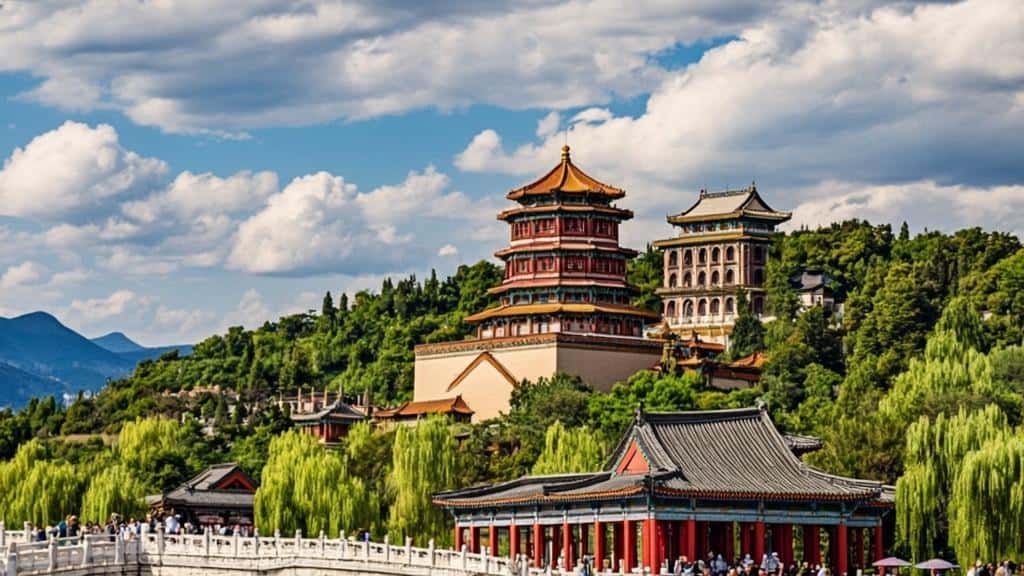
The Summer Palace sits quietly on the northwestern edge of Beijing — and yet, nothing about it is quiet. On first glance, you see a shimmering lake, a hill crowned with pagodas, and a corridor so long it seems to vanish into the mist. Then you realize: this is no ordinary park. This is where China’s imperial family came to escape the heat, conduct affairs of state, and — perhaps — pretend the outside world did not exist.
Most visitors to Beijing rush from the Forbidden City to the Great Wall. Meanwhile, the Summer Palace waits patiently, underestimated and extraordinary.
Why the Summer Palace Feels Unlike Any Royal Garden in the World
Western royal gardens — think Versailles or Hampton Court — impose geometry on nature. Symmetry, straight axes, clipped hedges. They declare control.
Chinese imperial gardens work differently. The guiding principle here is “The works of men should match the works of Heaven.” So instead of forcing nature into a grid, the designers of the Summer Palace wove around hills, lakes, and existing landscapes. The result feels organic. In fact, it feels alive.
The Summer Palace was inspired by Hangzhou’s West Lake, incorporating design features of gardens from southern China. It consists of Longevity Hill and Kunming Lake, forming a large landscape garden.
This East-meets-nature philosophy is also why the site feels so different to European visitors. There is no central axis leading your eye toward a palace facade. Instead, every bend reveals a new angle. Every pavilion frames a different view. You do not look at the garden. You move through it.
A History Written in Water and Fire
The Summer Palace was first built in 1750, largely destroyed in the war of 1860, and restored on its original foundations in 1886. It has been, in other words, both a masterpiece and a casualty of history.
In 1153, rulers of the Jin dynasty first developed imperial structures in the hills northwest of Beijing. Centuries later, Emperor Qianlong expanded the Western Lake in 1750 and transformed the region into the grand imperial retreat known today.
The most dramatic figure in the Summer Palace’s story is Empress Dowager Cixi. After the 1860 destruction by British and French allied forces, she rebuilt the palace using funds originally earmarked for the imperial navy. The decision became historically controversial. But the restored garden became arguably more beautiful than before. To many Chinese people, the palace became a symbol of national and cultural resilience in the face of foreign aggression.
In November 1998, UNESCO designated the Summer Palace a World Heritage Site. The inscription called it “a masterpiece of Chinese landscape garden design” in which “the natural landscape of hills and open water is combined with artificial features such as pavilions, halls, palaces, temples and bridges to form a harmonious ensemble of outstanding aesthetic value.”
The Long Corridor: A Guinness World Record Hidden in Plain Sight
Most visitors photograph the Tower of Buddhist Incense from across the lake. Fewer realize they are already standing inside a world record.
The Long Corridor runs for 728 meters and is divided by crossbeams into 273 sections. It features more than 14,000 painted scenes on its beams and ceilings — landscapes, flowers, birds, human figures, and stories. The corridor is registered in Guinness World Records.
This is, essentially, an open-air museum disguised as a walkway. Each painted panel tells a story drawn from classical Chinese literature, mythology, or history. Walk slowly. There is more detail here than most people catch in a lifetime of visits.
The corridor also serves a practical purpose. It connects the main halls to the lakeside pavilions, allowing the imperial family to move between buildings without exposure to rain or sun. Comfort, beauty, and storytelling — all in the same structure.
The Seventeen-Arch Bridge: A Phenomenon Worth Timing Your Trip For
There is one sight at the Summer Palace that borders on the surreal — and most visitors miss it entirely.
Around the winter solstice each year, the setting sun aligns perfectly with the Seventeen-Arch Bridge, shining golden light through all seventeen of its arched openings simultaneously. The effect lasts only minutes. However, those minutes produce one of the most photographed natural-architectural phenomena in China.
Built in the 15th year of Emperor Qianlong’s reign (1750), the bridge is over 150 meters long — currently the longest bridge in China’s imperial gardens.
Even without the solstice spectacle, the bridge is stunning at any hour. Bronze oxen stand watch on the eastern shore. In summer, lotus flowers spread across the surrounding shallows. In winter, the lake sometimes freezes, and locals skate past the bridge’s stone arches.
Practical Guide: How to Visit the Summer Palace in 2025
Tickets and Entry
Entry to the palace grounds costs ¥30 (approximately US$4) from April to October, and ¥20 (approximately US$2.75) from November to March. A combined “through ticket” — covering the main gate and all internal attractions — costs ¥60 in peak season and ¥50 in off-season.
Internal attractions include:
- Tower of Buddhist Incense (¥10)
- Garden of Virtue and Harmony (¥5)
- Summer Palace Museum (¥20)
- Suzhou Street (¥10)
Note: Four internal attractions are closed on Mondays. The park itself is open every day.
Getting There
Take Subway Line 4 to Beigongmen Station (Exit D) for the North Gate, or alight at Xiyuan Station (Exit C2) for the East Palace Gate. Both options involve short walks of under 10 minutes.
Opening Hours (2025)
- Peak season (April 1 – October 31): 6:00–20:00 (last entry 19:00)
- Off-peak (November 1 – March 31): 6:30–19:00 (last entry 18:00)
Audio Guide
The Summer Palace offers audio guide devices in 19 languages, available at the East Palace Gate, North Palace Gate, and other entry points. This is an excellent option for independent travelers who want historical context without joining a tour group.
When to Visit the Summer Palace: A Season-by-Season Breakdown
Each season transforms the park into a different experience entirely.
Spring (March–May) brings peach blossoms along the West Causeway. Pink flowers hang over the water, mixing with green willows. It is, by most accounts, the most photogenic time of year.
Summer (June–August) fills the lake with lotus blooms. Morning visits — before 8:00 AM — are strongly recommended to avoid crowds.
Autumn (September–October) delivers cool air, golden foliage, and the clearest skies of the year. Many experienced travelers consider this the best season overall.
Winter (November–February) is quieter and more atmospheric. Crowds thin out dramatically. Furthermore, if you time it right, the winter solstice alignment at the Seventeen-Arch Bridge is worth the cold entirely.
How Long Do You Actually Need?
The Summer Palace covers approximately 290 hectares, with about three-quarters consisting of Kunming Lake and Longevity Hill. That is a lot of ground.
Realistically, a half-day (4–5 hours) covers the main highlights. However, a full day allows you to linger — take a dragon boat ride on the lake, explore the Suzhou Street canal area, or simply sit on a bench and watch the light shift over the water.
If you also plan to visit the nearby Old Summer Palace (Yuanmingyuan) — the haunting ruins of an earlier imperial complex — budget a full day for both sites.
One Last Thing Before You Go
The Summer Palace tends to be quieter than the Forbidden City, even on busy weekends. Part of its appeal is exactly this: the scale of the grounds absorbs visitors. You can always find a corner of the lake, a quiet pavilion, or a stretch of the Long Corridor where the crowds thin out. That sense of space is rare in Beijing. It is, in a way, the whole point.
References
Beijing Municipal Government. (n.d.). Summer Palace. Beijing Government Official Website. https://english.beijing.gov.cn/specials/parktours/guidevisitors/summerpalace/
Britannica, T. Editors of Encyclopaedia. (2024). Summer Palace. Encyclopaedia Britannica. https://www.britannica.com/place/Summer-Palace
Lonely Planet. (2025, August). The Lonely Planet guide to the Summer Palace, Beijing. https://www.lonelyplanet.com/articles/guide-to-summer-palace-beijing
UNESCO World Heritage Centre. (1998). Summer Palace, an Imperial Garden in Beijing. https://whc.unesco.org/en/list/880/
Beijing Municipal Government — Cultural Treasures. (2024, January 11). Summer Palace. Beijing Government. https://english.beijing.gov.cn/beijinginfo/culture/culturaltreasures/sevenculture/202401/t20240111_3532659.html